
Buckethead — Spokes for the Wheels of Torment
As troubling as this video can be at times, it’s an outstanding homage to Hieronymus Bosch’s artwork and vision….
Buckethead — Spokes for the Wheels of Torment
As troubling as this video can be at times, it’s an outstanding homage to Hieronymus Bosch’s artwork and vision….
 Nabil Al-Tikriti, associate professor of history, recently published a chapter in an edited volume entitled "Hall Ishkal al-Afkar: An Ottoman Royal's Shari'a Argument For Imperial Control Over Sea Ghazi Plunder."
This segment of an edited volume originated as a chapter in Al-Tikriti's dissertation, and was then expanded and refined for a presentation for the "La Frontiere [...]
The post Al-Tikriti Writes Book Chapter appeared first on EagleEye.

Nabil Al-Tikriti, associate professor of history, recently published a chapter in an edited volume entitled “Hall Ishkal al-Afkar: An Ottoman Royal’s Shari’a Argument For Imperial Control Over Sea Ghazi Plunder.”
This segment of an edited volume originated as a chapter in Al-Tikriti’s dissertation, and was then expanded and refined for a presentation for the “La Frontiere Mediterraneenne du XVe au XVIIe Siecle: Echanges, Circulations, et Affrontements” conference in Tours in 2009. It appeared in print in 2013. It summarizes and analyzes in English an Arabic work by Sehzade Korkud (d. 1513), entitled “Hall Ishkal al-Afkar fi Hill Amwal al-Kuffar.” Also appearing in 2013 was a facsimile edition of Korkud’s entire text, along with a Turkish translation of the entire text, and a lengthy scholarly introduction of the text. This text (in the context of its 2013 publication and translation into Turkish) does appear to carry certain implications for contemporary developments in the region concerning concubinage, plunder, and “the imperial fifth.” Al-Tikriti’s chapter in this conference’s edited volume provides a brief synopsis and analysis of the text in English for those interested in understanding certain Ottoman positions in the early 16th century. The full citation of the Turkish edition is: [Sehzade Korkud, "Islam'da Ganimet ve Cariyelik: Osmanli Sistemine Iceriden Bir Elestiri," Asim Cuneyd Koksal, ed., and Osman Guman, trans., Istanbul: ISAR, 2013].
 On Nov. 23, 2014, Associate Professor of Middle Eastern History Nabil Al-Tikriti presented a paper at the 2014 Middle East Studies Association Conference in Washington, D.C. The paper, entitled "Greatness Denied: Firdevsi-yi Rumi on the Cusp of Ottoman Sunnism," was part of an Ottoman History panel, entitled "The Sunnification of the Ottoman Ideology and Polity, [...]
The post Nabil Al-Tikriti Presents Paper on Ottoman Cultural History appeared first on EagleEye.

On Nov. 23, 2014, Associate Professor of Middle Eastern History Nabil Al-Tikriti presented a paper at the 2014 Middle East Studies Association Conference in Washington, D.C. The paper, entitled “Greatness Denied: Firdevsi-yi Rumi on the Cusp of Ottoman Sunnism,” was part of an Ottoman History panel, entitled “The Sunnification of the Ottoman Ideology and Polity, 16th to 17th Centuries.”
The paper abstract is as follows: “Ilyas Çelebi “Firdevsi-yi Rumi” (fl. 1512) served primarily at the courts of Sultan Bayezid II (d. 1512) and Prince Korkud (d. 1513), authoring works of narrative history, elegiac poetry, gestes, and hagiography. In this paper, I will summarize what is known of his biography and analyze his presentation of Ottoman, Turkish, and Muslim identity.
Firdevsi, a litterateur with a considerable sense of self, completed more than twenty works while serving at the apex of Ottoman cultural production. While very successful at attracting patronage and support for lengthy and ornate literary works, his oeuvre was mostly lampooned by those who followed in the decades after his death.
Why would a writer who was so successful in his own lifetime be so reviled within a few decades of his death? Analyzing the political content and identity positions staked out by Firdevsi provides a tentative answer – societal views changed abruptly in the first tumultuous decades of the early 16th century. Firdevsi’s use of the term “Sunni” in his Qutb-name, explanation of Turkish conversion to Islam in his Süleyman-name, and portrayal of Anatolian Sufism in his Vilayet-name each provide clues as to why subsequent literary critics found his scholarship unreliable, his poetry unspeakable, and his views objectionable.”
The panel abstract is as follows: “Sunni identity of the Ottoman Empire is often taken for granted. However, recent research has begun to question the nature of Ottoman Sunnism and the process by which the Ottoman state began to distance itself from ‘confessional ambiguity’ that prevailed in Central Asia, Iran and Anatolia from the mid 13th to the late 15th century, and became increasingly concerned with formulating and enforcing a Sunni orthodoxy. While it is well known that the religious ideology of the Safavid Empire, based on Shia principles and folk Islam, began to be formulated in the early 16th century, it is not commonly acknowledged that Sunni theology was simultaneously experiencing a transformation, both in reaction to the developments in the Safavid realm and as a consequence of various socio-political processes within Ottoman territories. Titled ‘Sunnification of Ottoman Ideology and Society, 16th-17th Centuries’ our roundtable will examine this historical process from the perspective of the state, other agents of Sunnification, and those who were targeted by the new measures for correcting belief and practice.”
On Nov. 14, Associate Professor of Middle East History Nabil Al-Tikriti presented a lecture entitled “Ottoman and Safavid Religious Identities of the 16th Century” to the Philosophy Department at Texas State University, in San Marcos, Texas. In the course of this lecture, Al-Tikriti outlined the effects of the Safavid rise to power on religious identities [...]
The post Al-Tikriti Lectures on Ottoman Intellectual and Maritime History appeared first on EagleEye.
On Nov. 14, Associate Professor of Middle East History Nabil Al-Tikriti presented a lecture entitled “Ottoman and Safavid Religious Identities of the 16th Century” to the Philosophy Department at Texas State University, in San Marcos, Texas. In the course of this lecture, Al-Tikriti outlined the effects of the Safavid rise to power on religious identities in both Iran and the Ottoman Empire, as well as its longer term legacies on sectarianism in the Middle East. In addition, he drew parallels with developments which shaped Europe during the same period, pointing out that widely recognized trends experienced during the “Age of Reformation” took place well beyond the regions covered in most Western Civilization textbooks.
On Nov. 15, Al-Tikriti offered the keynote lecture for the Texas State University Phi Alpha Theta Graduate History Conference. During this lecture, entitled “Warrior Knights and Sea Ghazis in an Age of Empire,” Al-Tikriti criticized the narrative of most Western Civilizationtextbooks, which ignores what McGill University’s Professor Giancarlo Casale has referred to as the “Ottoman Age of Exploration.” In doing so, he first described Ottoman patronage of “sea ghazi” activities in the Mediterranean, particularly against the Knights of Saint John of Jerusalem. He then elaborated on the Ottomans’ “pivot to Asia,” whereby the imperial strategy shifted focus towards the Indian Ocean, where they successfully engaged with the rival Portuguese. Al-Tikriti thanks his colleagues at Texas State University for making this engaging and productive visit possible.
– November 17, 2014Posted in: News

Researchers in Germany have discovered that a manuscript of Qur’an written between 20 and 40 years after the Prophet Muhammad’s death, making it one of the earliest copies of the Islamic holy book known to be in existence.
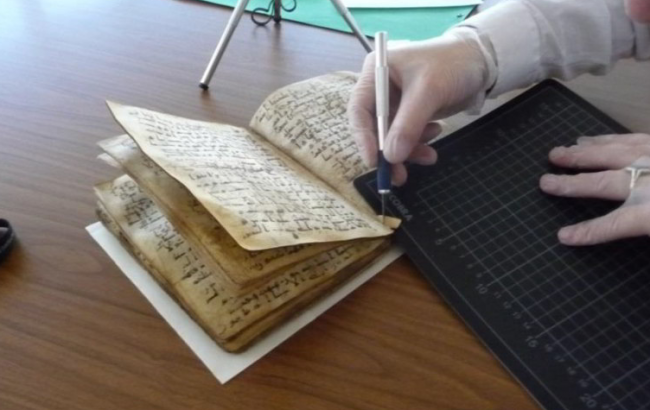
Scholars at the Coranica Project, part of the University of Tübingen, examined a manuscript written in Kufic script, one of the oldest forms of Arabic writing. Using carbon-14 dating on three samples of the manuscript parchment, the researchers concluded that it was more than 95 percent likely to have originated in the period 649-675 AD.
The manuscript is one of more than 20 fragments of Kufic script held by the Tübingen University Library. This particular item was donated to the university in the 19th century.
The entire manuscript has already been digitized and can be viewed here.
The Coranica project, a collaboration between the Académie des Inscriptions et Belles-Lettres Paris and the Berlin-Brandenburgischen Academy of the Sciences and Humanities, sponsored by the German Research Foundation (DFG) and France’s Agence Nationale de la Recherche (ANR). The project investigates the Quran in the context of its historical background using documents such as manuscripts and information derived from archaeological excavations. Click here to visit their website.
|
|
|
|
|
|
The project, which began several years ago, aims to expand the al-Masjid al-Haram, or the Grand Mosque, to cater for the millions of pilgrims who make their way to the holy city each year for the Hajj, the pilgrimage to Mecca that all Muslims are obliged to make at least once.
Mecca is the holiest city in Islam because of its link to the birth of the Prophet, and because it is the site of the Kaaba, a cube-shaped building made from black granite and said to have been built by Abraham. The Grand Mosque is built around it, and Muslims face towards it when they pray.
Many have looked on aghast at the destruction of hundreds of historic buildings and monuments to make way for the Grand Mosque’s expansion. According to the Gulf Institute, based in Washington, up to 95 per cent of Mecca’s millennium-old buildings have been destroyed, to be replaced with luxury hotels, apartments and shopping malls.
Last week, the remaining 500-year-old Ottoman columns, commemorating the Prophet’s ascent to heaven, were destroyed, Dr Irfan Alawi of the UK-based Islamic Heritage Research Foundation, told The Independent.
He said that the House of Mawlid, thought to be where the Prophet was born in AD570, is likely to be destroyed before the end of the year.
The new royal palace is to be built for King Abdullah, the formal custodian of the mosque, for his visits to Mecca. Plans for the building, seen by The Independent, include the site of the House of Mawlid, which has recently been closed to pilgrims.
The plans have been verified by an independent source who added that many critics of the construction process are unwilling to speak publicly for fear of being punished by the regime.
Saudi Arabia is ruled by the strict Wahhabi version of Islam, which prohibits the worship of any object or “saint”, a practice considered “shirq”, or idolatrous.
 The destruction of historic sites was defended recently by Saudi Arabia’s Grand Mufti, Sheikh Abdul Aziz Bin Abdullah al-Sheikh. According to Press TV, Iran’s English-language news organisation, he said the demolitions were necessary and that the nation should thank the government for the work, which is increasing the capacity of the mosque.
The rooms of the House of Mawlid are under the ground, and in 1951 a library was built over them to preserve them. This has now been closed to pilgrims. Signs on the building warn worshippers against praying. “There is no proof that Prophet Mohamed (peace be upon him) was born in this place, so it is forbidden to make this place specific for praying, supplicating or get blessing [sic],” it says.
Dr Alawi, one of the few voices to publicly oppose the destruction, claimed that religious police are posted outside the library to prevent worshipping. “The site of the Prophet’s birthplace has again come under imminent threat of being permanently forgotten under concrete and marble,” Dr Alawi told The Independent.
“Now that Hajj is finished, the 24-hour construction work has started again. They have finished the expansion on one side of the mosque. The royal palace, which will be five times bigger than the current royal palace, is to be built into the side of a mountain and will overlook the mosque.
“Between now and December the library and the rooms of the House of Mawlid are likely be built over. It’s inevitable that it will happen.
“It will be history. It will be gone. We are saying, ‘Let us excavate that house and preserve these rooms that are still there’.”
In September The Independent revealed that even the tomb of the Prophet – which is in the holy city of Medina in the al-Masjid al-Nawabi mosque – was not off-limits for some hardline Wahhabis.
 A blueprint showing how Mecca will be developed
The article, which revealed that calls for the removal of the tomb had been made in a 61-page consultation document, caused an outcry in the Middle East, and forced a denial from the Saudi authorities, who had previously refused to comment on the construction works.
Details of that plan, obtained by a leading Saudi academic, Dr Ali bin Abdulaziz al-Shabal of Imam Muhammad ibn Saud Islamic University in Riyadh, were circulated to the Committee of the Presidency of the Two Mosques. Several pages of the consultation document were published in the presidency’s journal.
The Independent has made numerous attempts to contact the Saudi authorities for a comment without success.
However, in a previous statement the authorities said: “The development of the Holy Mosque of Makkah al-Mukarramah [Mecca] is an extremely important subject and one which the Kingdom of Saudi Arabia, in its capacity as custodian of the two holy mosques, takes with the utmost seriousness. This role is at the heart of the principles upon which Saudi Arabia is founded.”
Archeology, Archeology, Asia, History, Science
6 November, 2014
Mongolia: Archaeologists Unearth Tomb of Genghis Khan
Genghis1
Öndörkhaan| Construction workers employed in road building near the Onon River in the Khentii province of Mongolia, have discovered a mass grave containing the remains of many dozens of human corpses lying upon a large rudimentary stone structure. Forensic experts and archaeologists were called on the site, which was revealed to be a Mongolian royal tomb from the 13th century that the scientists believe to be Genghis Khan’s.
See more at: http://worldnewsdailyreport.com/mongolia-archaeologists-unearth-tomb-of-genghis-khan/#sthash.jD2hmL2M.dpuf


