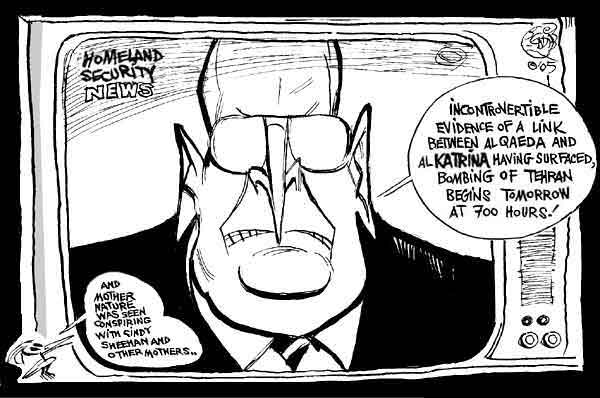
Katrina Encours et Toujours XVI

1) The Onion gets it right again:

http://www.theonion.com/content/node/40525

Halliburton Gets Contract To Pry Gold Fillings From New Orleans Corpses’ Teeth
September 14, 2005 Issue 41•37

HOUSTON—On Tuesday, Halliburton received a $110 million no-bid government contract to pry the gold fillings from the mouths of deceased disaster victims in the New Orleans-Gulf Coast area. “We are proud to serve the government in this time of crisis by recovering valuable resources from the wreckage of this deadly storm,” said David J. Lesar, Halliburton’s president. “The gold we recover from the human rubble of Katrina can be used to make fighter-jet electronics, supercomputer chips, inflation-proof A-grade investments, and luxury yachting watches.”

2) Today all MS, AL, and TX senators (each Republican) voted against setting up an independent Katrina commission, and David Vitter sat it out. It seems to me that they should get some heat on this:

http://www.senate.gov/legislative/LIS/roll_call_lists/roll_call_vote_cfm.cfm?congress=109&session;=1&vote;=00229#position

Here’s a daily kos posting concerning that same vote:

www.dailykos.com

Senate Republicans Kill Independent Katrina ResponseInvestigation by DavidNYC Wed Sep 14th, 2005 at 13:09:57 PDT

Bastards. Not that I’m surprised – but I’m alwaysangry. Every Republican but LA’s Vitter voted “no” (hedidn’t vote at all) – including that scumbag allegedmoderate Chaffee. Every Dem plus Jeffords voted “yes.”(Corzine, presumably, was absent.)

Once again, the Peter Pan Syndrome – or should I sayTinkerbell Syndrome – kicks in for the GOP.

Whensomething goes wrong, they don’t even want to knowabout it. Just clap harder, assholes.

P.S. This is why it’s so important to hold the caucustogether – a straight party-line vote makes framingmuch easier. And boy have the Republicans setthemselves up to get whooped on this one. Now it’sjust up to our side to make sure the whoopin’ getsdone.

3) Blanco vindicated by Congressional report:

www.dailykos.com

The actual report:http://www.house.gov/judiciary_democrats/crskatrinarept91205.pdf

Blanco didn’t goof on state of emergency by kos Tue Sep 13th, 2005 at 21:10:49 PDT

Non-partisan Congressional report (PDF) clears Blancoagainst (ridiculous) charges that she did not call astate of emergency in time. From a Rep. Conyers pressrelease (PDF):

“This report closes the book on the BushAdministration’s attempts to evade accountability byshifting the blame to the Governor of Louisiana forthe Administration’s tragically sluggish response toKatrina. It confirms that the Governor did everythingshe could to secure relief for the people of Louisianaand the Bush Administration was caught napping at acritical time.”

In addition to finding that “…it would appear thatthe Governor did take the steps necessary to requestemergency and major disaster declarations for theState of Louisiana in anticipation of HurricaneKatrina. (p.11)” The report found that:

All necessary conditions for federal relief were meton August 28. Pursuant to Section 502 of the StaffordAct, “[t]he declaration of an emergency by thePresident makes Federal emergency assistanceavailable,” and the President made such a declarationon August 28. The public record indicates that severaladditional days passed before such assistance wasactually made available to the State;

The Governor must make a timely request for suchassistance, which meets the requirements of federallaw. The report states that “[e]xcept to the extentthat an emergency involves primarily Federalinterests, both declarations of major disaster anddeclarations of emergency must be triggered by arequest to the President from the Governor of theaffected state”;

The Governor did indeed make such a request, which wasboth timely and in compliance with federal law. Thereport finds that “Governor Kathleen Babineaux Blancorequested by letter dated August 27, 2005…that thePresident declare an emergency for the State ofLouisiana due to Hurricane Katrina for the time periodfrom August 26, 2005 and continuing pursuant to[applicable Federal statute]” and “Governor Blanco’sAugust 27, 2005 request for an emergency declarationalso included her determination…that `the incidentis of such severity and magnitude that effectiveresponse is beyond the capabilities of the State andaffected local governments and that supplementaryFederal assistance is necessary to save lives, protectproperty, public health, and safety, or to lessen oravert the threat of disaster.”

Hang the people responsible for this mess, be theyDemocrat, Republican, or whatever else. I don’t care.But if Republicans are going to smear and claim it’ssomeone else’s fault, they might want to make surereality backs them up. Aren’t they the supposedlygodly ones? What’s that 9th Commandment say again?

4) Charmaine Neville’s testimony:

Video:

http://www.wafb.com/Global/SearchResults.asp?qu=charmaine+neville&x;=13&y;=

Transcript on DailyKos:

http://www.dailykos.com/story/2005/9/7/182431/8610

NEVILLE: MY SOUL IS NEW ORLEANS

Advocate staff photo by MARK SALTZDamion Neville, left, hugs his mother, New Orleans jazz and blues singer Charmaine Neville, who survived Hurricane Katrina in New Orleans. The two were reunited on Saturday in Baton Rouge after Damion arrived from Houston.Resting Saturday at a friend’s quiet home in Southdowns, Charmaine Neville was a world away from the despair and desperation that surrounded her New Orleans home last week.Before Hurricane Katrina and breaks in the city’s levee system brought a great city to its knees, Neville lived on Pauline Street in the city’s Ninth Ward.A singer, Neville is a member of one of New Orleans’ great musical families. Her father, Charles Neville, performs with uncles Aaron, Art and Cyril in the Neville Brothers band. She estimates the musicians in her family number well over 100. In New Orleans, she said, every neighborhood and every family has musicians.

http://www.2theadvocate.com/stories/090405/new_soul001.shtml

5) Here’s a link to a superfund site near in the 9th Ward, that might be affected by the flooding:

http://www.epa.gov/superfund/sites/npl/la.htm#Agriculture_Street_Landfill

6) Here’s an eyewitness account / letter from a St. Bernard resident:

Today I went to the the Capitol with Bill Hyland for a called meeting at 2:00 p.m. for St. Bernard Parish residents. Some people arrived at 10:00 a.m. and when we arrived the crowd circled the whole building and up the front steps. We were able to enter on the ground level and enter the House Chamber. The crowd was in the thousands and it was pandemonium. The only mention of the St. Bernard courthouse was by one speaker who said the water had come up on the first floor. I think, but have no way of knowing, that speakers were set up for the hundreds who could not get into the building. The trauma of these people is unbelievable. They have no answers – they were told to settle in where they are for at least 4 months. No house was without damage. They think tornadoes
hit in more than one place. All state and parish officials were present with unbelievable stories. These people all stayed in the parish during the Hurricane and are still there with the help of Murphy Oil and their facilities. They took over their own parish and without help from anywhere they protected their people and the parish. With a solid plan they will allow people to go back to check for any belongings and then leave, after the polluted oil spill is cleaned up. Many teachers need jobs but will get checks until the money runs out. No one is talking about “old records” (documents) only day to day survival right now. There is some interesting work going on state wide to prevent historic buildings such as the remains of the Islenos Museum from being dozed until some assessment can be done. The all purpose build stands as do the houses which have been moved to the complex. The Ducros house stood with ruined interior. A ssessments were given by all parish departments, the major concern is dealing with the insurance companies who, once again in Louisiana, will declare that the damage is from rising water and not wind. Charlie Melancon is working on this with Congress. I was able to greet many of our Islenos friends and all of the Parish officials. They are tired but no one spoke of slowing down until the job is done. They do have a Colorado National Guard Unit helping now. These are some of my thoughts and experiences and if you want to ask about anything I have not included please let me know. Bill will continue to be with me part of each day handling messages from the Islands and other places. His house stands, has damage, and had about10 feet of water inside. His plans, as others, are uncertain at this point. The US Post Office is now setting up a system where peope can receive mail where ever they are, this is a massive undertaking as is everything else.

7) Animal rescues in NO:

Adam Parascandola is an animal control officer in Washington, D.C. He is in New Orleans rescuing animals.
Aside from the public health and safety necessity (imagine the potential for the spread of disease by sick and abandoned animals), animal rescue efforts are aiding in the rescues of humans. Many poor and elderly people consider their pets to be their closest companions. Adam has encountered several New Orleans residents who were reluctant to leave their homes without their pets but became willing after they learned their animal companions would be rescued and cared for.

Here is a link to Adam’s blog:

http://www.washhumane.org/hurricane%20index.htm

8) New Yorker article on Mississippi Gulf Coast gaming, EPA regulations, and Trent Lott’s interventions:

http://www.newyorker.com/talk/content/articles/050919ta_talk_mayer

WIND ON CAPITOL HILLHIGH STAKESIssue of 2005-09-19Posted 2005-09-12

Among the blown-off rooftops, upended pine trees, and other detritus that Katrina scattered along the Gulf Coast were a good number of twisted and bashed-in slot machines. The storm had hurled them ashore as it ripped casino barges from their moorings in Biloxi, Gulfport, and Bay St. Louis.

Carol Browner was the head of the Environmental Protection Agency during the Clinton Administration, when many casinos in Mississippi were constructed. Last week, speaking from her office at the Washington consulting firm where she now works, she recalled the difficulties that her department experienced years ago when they tried to persuade legislators, including Mississippi Senator Trent Lott, that building on wetlands was environmentally risky. Developers, and the politicians who supported them, argued that gambling would attract commerce to the state.

The proposed casinos, Browner said, “were supposed to be in the water because the state didn’t want them on the solid land.” (To accommodate the moral qualms of conservative locals, the legislature relegated gambling to “navigable waters.”) She went on, “But they were huge, and they were right up against the shore. If you put structures this big into an estuary, you’re disrupting the aquatic life and changing the habitat and eradicating the wetlands, which has a huge effect on drainage. The wetlands act like a sponge in a storm. They’re an incredibly smart and helpful part of nature. But they have to be kept moist, like a sponge on your kitchen counter. If they’re dried out, and developed, they don’t work. The shoreline’s a very important buffer in a storm.”

Browner said that Lott was not alone among politicians in his disregard for the environment. “For fifty years,” she pointed out, “there’s been significant inattention to the environmental consequences of developing the wetlands.” But Lott was particularly single-minded in his support of casino development. “I had barely taken office,” Browner said, “when I discovered there was a ‘hold’ on a department nominee.” (Placing a hold, which is a common maneuver in the Senate, can keep a nominee’s name from moving forward to a vote.) “I didn’t have a clue who put the hold on the nominee. Then Trent Lott called me up and said that he had done it. He told me, ‘I figured I’d have a problem with the E.P.A. I don’t have one yet. But this is a warning to you.’ Then he lifted the hold. But the message was clear.

“A few years later, in 1997, Clinton nominated someone else to a job in the E.P.A. that needed Senate confirmation,” she recalled. Browner learned that a hold had been placed on this person, too. “It was a person who was perfectly qualified,” she said. “So the hold seemed odd.

“We called around to see what was the matter,” she went on. “And I found out that Lott had put a hold on this person. I then spoke with him about it, and he said, ‘It’s not about the nominee.’ He said, ‘It’s because I want you to fire another employee, because he’s standing in the way of wetlands permits needed for casinos.’
“He wanted me to fire this guy who was handling the wetlands permits down in our regional office in Atlanta,” she said. “I couldn’t have done it if I’d wanted to. I told him I wasn’t going to. It’s the job of the E.P.A. to enforce Section 404 of the Clean Water Act, which covers all wetlands permits, and this guy was doing his job.” Browner said that she did not tell the employee in Atlanta, because she didn’t want him to feel pressured. “Lott thought the guy was working with the Army Corps of Engineers to hold up the casino permits, and he was determined to get rid of him.”

Browner said that Lott kept the hold on the nominee for several months. “We couldn’t get the confirmation through,” she said. “Then finally, one day, I heard that the Atlanta wetlands-permit officer was no longer in the job.” (A person close to the agency says that the Atlanta officer, whose name was Mike Wylie, was transferred to another job within the E.P.A., where he still works.)

“I called Lott,” Browner said, “and I told him that I didn’t fire the guy but that he was gone. That very night, the E.P.A. nominee was confirmed.” (Both Lott and Wylie declined to comment.)

For years Lott has had a house on the Gulf, in Pascagoula, a hundred-and-fifty-four-year-old cottage built on stilts. It was obliterated by Hurricane Katrina. When President Bush toured the blighted coastline with Lott, he said, “Out of the rubbles of Trent Lott’s house—he’s lost his entire house—there’s going to be a fantastic house. And I’m looking forward to sitting on the porch.”

9) Cheney’s heckler identified:

The doctor is in

The heckler who cursed Vice-President Dick Cheney on live television has become a bit of a hero among foes of the Bush administration.

The man, who had just
visited his hurricane-destroyed home at the time he told the veep to “Go [bleep] yourself Mr. Cheney,” has been identified as Dr. Ben Marble, a young emergency-room physician who plays in alternative rock bands.

He has been lauded on various Web sites and blogs, has set up his own Web site that discusses the incident, has been attempting to sell a tape of the incident on eBay, and even links to a line of “Go [Bleep] Yourself Mr. Cheney” merchandise, including T-shirts, bumper stickers, coffee mugs, a baby bib, and a dog shirt, emblazoned with the now-infamous line.

“So we survived the worst disaster in the history of our nation,” Marble writes on his Web site, “Only to have a politician come to our neighborhood to try to score some brownie points after totally screwing up the rescue efforts????”

Merchandise Link:

http://www.cafepress.com/benmarblemd

10) Katrina activism announcement, from “Working Assets”:

ACTIVISM UPDATE: September 14, 2005

Political Justice for Hurricane Families

Shame on America. The horror of Katrina has revealed, not just to this nation but to the world, the growing fissures between the working poor and the ultra rich, between African American and white citizens, between those who had the resources to get out of New Orleans — and those who were left to drown.

You’ve given to relief. Now it’s time to stand with those who were left behind to ensure that when the next Katrina hits, America does not fail the least among us. There are three ways to give.

Tell Washington: The common good depends on good government

Give now: $5 will help us put this billboard up in Grover Norquist’s neighborhood.

After you’ve given money to help evacuees with basic human needs, make a $5 donation to send a message to Washington, D.C. Our lawmakers need to know that the common good depends upon good government. Your token contribution of $5 will help us put this shocking graphic on a billboard outside of Grover Norquist’s office at Americans for Tax Reform where 100 influential conservative leaders hold a weekly strategy session each Wednesday.

——————————————————
Reunite families brutally separated by the haphazard and too-late evacuation

Give now: If you act now, your donation will be matched dollar for dollar — and a $49.50, $99.50 or $149.50 contribution buys a $99, $199 or $299 one-way ticket to reunite a family.

During the evacuation, mothers — almost exclusively African American– had to choose between remaining with older children and carrying infants to safety. Extended families boarded separate buses, unsure of their fate, only to find themselves separated by thousands of miles and trapped in shelters with no way out. Husbands and wives, parents and children, now in shelters, have to endure the continuing trauma of separation. You can reunite a family today by helping us buy one-way tickets which we are providing, without bureaucratic red tape, to families in shelters identified by our friends at the NAACP, ACORN and other groups on the ground.

—————————————————–
Help evacuees organize to demand a say in relief funds and reconstruction efforts

Give now: Don’t let the government leave evacuees behind again.

As Van Jones of the Ella Baker Center puts it, the governing philosophy of the people who run our government is sink or swim for almost everybody unless you are a crony, and then different rules apply. We must act now to ensure that evacuees have a say in how resources are allocated to survivors and to protect the long-term redevelopment of New Orleans and other Gulf Coast communities from opportunistic cronyism. Corporations with close ties to those in power — like Halliburton — cannot be allowed to treat disaster recovery efforts as a corporate ATM. Humane treatment of survivors demands more than a handout — it demands a sea change in politics as usual.

Make one donation to our Political Justice for Survivors fund and we’ll support a range of local community-based organizations who won’t pack up and leave once the media spotlight goes away. These groups include:
ACORN supports the political organizing of evacuees to get the respect they deserve from local and national political representatives and fight for humane treatment. A national network of community organizations, ACORN is headquartered in New Orleans and has been particularly hit hard by this tragedy.

New Orleans People’s Committee was convened by Black community activists and organizers of color from Community Labor United. The goal of the committee is to unite evacuees to demand a role in reviewing and influencing how resources are allocated on behalf of survivors and to fight for decision-making power in the long-term redevelopment of New Orleans.

Long after the aid agencies and relief volunteers have gone, the New Orleans Network, Sparkplug Foundation, Biloxi-based Gulf Coast Community Foundation, and the Baton Rouge Area Foundation will still be working on the ground to help evacuees and the families of hurricane survivors as they forge new lives in the wake of Katrina.

——————————————————
Please forward this newsletter to your friends, mailing lists and bloggers you know to help spread the word about this important campaign!

Please give generously to reunite families and help us build a better, more humane Gulf Coast.

Michael KieschnickPresidentWorking Assets If you do not wish to receive updates about ways you can make your voice heard:

Please click on the following link to unsubscribe to this newsletter.

http://www.workingforchange.com/unsub/wa_unsub.cfm?emailaddr=naltikriti@yahoo.com
Or, send a blank e-mail to unsubscribe@values.workingassets.com.

PLEASE NOTE: THIS ADDRESS IS FOR UNSUBSCRIBE REQUESTS ONLY. INQUIRIES SENT TO THIS ADDRESS WILL NOT BE READ. You may receive one additional newsletter while we process your request.
PLEASE SEND QUESTIONS OR COMMENTS TO:
katrina@workingassets.com.
www.workingassets.com

11) Another eyewitness account, one from a perspective many wish didn’t exist — but does:

An interesting insight from a man who “rode it out” (as opposed to the talking heads and others who got there later). The following report is from a USNA, who left the Navy four years after graduation, got a PhD in astronautics and went to work for NASA for 35 years. He now owns a B&B; in Vicksburg, Mississippi, and was brought up in New Orleans. He has been missing for a week but finally surfaced today and this is his first report. for my money, you can forget everything anyone else has written or broadcast — these are the straight facts, or as close as you can get to them. Gentlemen:

Thanks to you all for kind thoughts and prayers for those impacted by this disaster of biblical size.
We are back at home after almost a week in a local motel room after we lost power (I have to sleep with a machine, I fear).

Prior to power loss, we had a house full (one or two who even offered to pay me – most were freebies). Slowly after power loss the temperature finally got too hot (and even our freebies left us) for comfort (above 100 degrees one day).

One of our refugee families (It’s OK to call them refugees – as they are white!) started their careers at Martin in Baltimore and ended up in New Orleans on the Shuttle External Tank. Their home was on Emerald Street in a high end neighborhood near the 17th Street canal. They left here for Baltimore –
where they have relatives.
Another “guest” family was trying to decide between family in Michigan or Houston. Another just lost some shingles.

One lived on the Beach Road in Pass Christian. Their home is so many splinters. I don’t think I was able to relieve their shock enough – but did get them past the zombie stage before they left for family in Alabama.
A bunch (7-8) went and stayed with my brother-in-law in the huge metropolis of Valley Park, Mississippi – so even with no power, our “guests” got taken care of before we departed for cooler, if smaller quarters for ourselves.

Our burglar alarm eventually lost even backup power – and Vicksburg appears to have inherited at least one gang of looters (victims to Vic P.) who – while breaking in – mistook some of our high end electronics for food and water for their starving families. Hopefully the internal heat forced them out once their arms were full. I don’t know if these “victims” were at the Superdome or not. They tried again when the alarm was up and were defeated by it – but not caught.

Only other personal loss of any consequence is four freezers of frozen food.

So we will survive – and the house is getting cool – I just have not figured out how to get the trees cut up and disposed of (one guy wanted $500! – I’ll watch them rot in place before I pay that). Hopefully, a cousin will help do that tomorrow.

OK. Katrina.

First – The worst storm I have ever seen (and I saw a lot from New Orleans and elsewhere). The worst.

NASA used to loan me to the Corps of Engineers, the FEMA folks, the city and state, the Weather Bureau et al to help them plan for storm and flooding (Mississippi River, too) disasters.

Never. Never. Never did we see – nor contemplate – a category 5 storm 1300 miles wide!

Never did we figure 4 breaches of the levees.

We figured a storm surge overtopping one of the levees – or a single breach – but never four breaches.

We never figured losing the Mississippi Gulf Coast and even parts of New Orleans at the same time – nor part of Alabama.

We never figured storm damage the size of Minnesota!

We never figured losing principal bridges and highways for entry.

The size of the storm and the extent of the damage is unprecedented. Far beyond anything anyone has ever seen or contemplated.

Un-damned-believable!

So I am not surprised at all that the initial response was “inadequate.”

Use of the Superdome was to protect you from the wind and rain until they were gone – you were supposed to go back home soon as the worst passed – not make it your home. The pumps would handle the worst of the rain water.

Food and drink?

They had enough for a few (less than 2000) folks for two-three hours.

Baby formula? Dialysis? Special medicines?

Get real!!!

So the true answer to “Who is responsible?” is that Katrina is – no person.

Because there has never been a storm like this any time in our known past – no one did nor could have predicted any storm this big – let alone what to do about it.

For you California boys, think of an earthquake that knocks out from north of Napa to the Mexican border – from the ocean to Phoenix.

Were there mistakes made?

You bet!
The mayor did not have anyone competent to plan nor execute big storm actions. HE waited too late (or didn’t know) to ask for things. No curfew. No city transit nor school buses used to take people to shelter or out. No food, water, etc. No police plan (2/3 police force vanished – now they lie about it). New Orleans police robbing a crime scene is not unheard of. (There are some clean NOLA police officers, but they are unusual.)
The governor was not much better (“stupid” comes to mind). Wanted to keep personal control so bad – she forget that you had to do the right things at the right time. Did not have the National Guard ready. Did not have competent staff for this (had nice young men who campaigned for her). Did not ask for the right stuff at the right time. I called the State “Emergency Operations Center” the night of the landfall and the next day several times and they couldn’t even tell me which roads were closed – couldn’t even give me local law enforcement phone numbers! Big salary; nice offices; crap for brains.

The state (governor) even blocked the Red Cross from New Orleans (as in food, water, and medical care…….)! Go figure. [THIS IS NOT TRUE, FEMA BLOCKED THE RED CROSS FROM NO. I GOT THIS WHILE THERE – NABIL]

As much as Baker and Vic P. might dislike it, George Bush did the right thing before it was necessary – he declared the emergency before the storm came ashore! That made the federal assets available then – but the city and state had to ask for them – and didn’t – until too late.

Contrast that with Mississippi and Alabama – where the governors (and mayors) DID ask for help as the law requires. Worst destruction, but less than expected loss of life – and without the stupid handling of “refugees” and “Afro-American citizens.”

The bureaucracy? Lord!

Congress – who said levee improvements were “Pork!” Those good liberal NY Senators, for example – maybe even Californian’s!

Enough blame for everyone – if you are so inclined – blame your favorite. But if you do or must blame, you are less than intelligent.

The storm is to blame. Never before one so big and strong.

Keep your “Yeah, but’s” to yourselves. I’m tired of them. It is stupid politics – not facts.

Constraints

I-10 east of New Orleans (and US90 East of Biloxi) were closed – the bridges were gone!

The causeway north of New Orleans was closed.

I-10 on the West side of New Orleans was(is) under water.

Only state Hwy 1/ US90 west were open (once debris was removed) at all – not a main nor well known route.
Legal and admin constraints (you gotta know to ask – and ask).
TV

For the most part, TV reporters and “experts” were full of crap. Note that most of them (until the last couple of days) were seen in front of the Superdome, Convention Center, their hotel, Bourbon street, or the I-10 next to the dome – all nice and dry areas near their hotel rooms. With only the occasional helicopter ride – and even then they couldn’t identify where they were.

In other words – they didn’t cover “New Orleans”- just a very small area near the dome.
Their “experts” are also mostly full of it – not all, but most.

Personal

One friend of our son just called us. He was thought dead until two days ago when he surfaced in time for his memorial service! He went five days without a meal. He was to come stay with us – but the FEMA powers flew him to Salt Lake City (no choice) instead. Doing well now. Mormons are great hosts.

Our granddaughter has a friend at school who has still not heard from her parents from Bay St. Louis. By now, I think you can connect those dots. We plan to do something to help her keep her scholarship without the state getting in it – to mess her up.

Fritz, we are delighted you found your sister. We are still searching (and praying) for a lot of friends.

New Orleans

Bill P. posted an article that sums it up pretty well.

The nation has no choice but to rebuild it. New Orleans is the single, most important port in the nation.
Agriculture, energy, chemicals, imports. Two thirds of the continent’s production flows through New Orleans – and always has. Jefferson foresaw it; Andy Jackson secured it for us; and Lincoln understood its importance to us all. No corner of this country is without something that passed through that port. And we need those special skills in that location. Those people need some place to live.

When your house floods – You don’t bulldoze it!

You cut out and remove all sheet rock or plaste
r and insulation below the max water level. Let it dry out.

Lliberally spray straight Clorox on all studs and outside wall from the inside. Let it dry out. (This kills bacteria and mold spores.)

Spray and saturate lumber with Zintox or Coppertox (if you can find it) to kill future bugs and preserve the wood ( or a long lasting insecticide and wood preservative).

Install insulation (after checking/cleaning electrical, plumbing, etc.) with about 1/3 small box of baking soda loose on top of insulation (fire protection).

Put up sheet rock, tape it, float it, texture it, and paint it.

Pass out the beer.

Light up a Cuban cigar.

New Orleans is bad geology, but manageable. Those who say not to rebuild are full of it – they just want publicity – or for us to pay them a consulting fee for their worthless opinions (like so many “talking heads”). Existing technology will do it (ask the Dutch).

Restoring the wetlands can be done with silt from the river (that’s how they were formed before the levees). Ever heard of a siphon? Yet Congress killed the funding to even try it.

As far as the politics – or socio-economic underclass of New Orleans – that may have no solution – that is practical nor solvable – in this forum.

I’m too tired tonight to even think about it. It has been building up for a long time – and it ain’t pleasant to fix – but too many black poor in too small a space.

We are on the third generation of New Orleans welfare poor.

Did anyone besides me notice the Viet-Namese/Americans waiting to evacuate?

The Viets waited quietly – no whining to TV – and left New Orleans last – as a group – cleaning up the trash around them before departure.

The Effort

I think we can all agree that those who did show up to help – did a great, unselfish job. We even had a fire truck from Los Angeles, doctors from Wisconsin, boat rescuers from Kentucky, help from everywhere – even West Virginia. Those Coast Guard kids were great rescued 1,700 the first night. The National Guards from so many states are wonderful. A great national effort.

Here in Vicksburg, we have over 700 new citizens we are trying to adsorb above the initial surge. 220 new kids in our public schools today. Even quite a few in the private schools. The (white) Baptist churches are truly leading the way here – almost makes me ashamed to be a Methodist – all denominations are helping the Baptists.

South Mississippi recovery will be slow but will happen. The National Guard from other states may be released to go back to their homes in a few days – the effort there is going better than expected.

What can you do?

The Red Cross, Salvation Army, the Navy and Marine Corps
relief groups, Air Force Aid Society all need help with this.

Contact your elected representatives and ask them to speed the rebuilding.
You’ll be doing yourselves a favor.

“It is a gift that is twice blessed.”

Thank you,Bill Smollen, USNA’57 (15), Past President, Bed and Breakfast Association ofMississippi (BBAM)Bill and Shirley Smollen, Proprietors1902-8 Stained Glass Manor – Oak Hall2430 Drummond Street, Vicksburg, Mississippi 39180

12) Musician Clarence ‘Gatemouth’ Brown Dies:

See also his own website
http://www.gatemouth.com/

where donations are invited to help pay for the costs of the funeral…

http://news.yahoo.com/s/ap/20050911/ap_en_mu/obit_gatemouth_brown
By DOUG SIMPSON, Associated Press WriterSun Sep 11,11:51 AM ET

Clarence “Gatemouth” Brown, the singer and guitarist who built a 50-year career playing blues, country, jazz and Cajun music, died Saturday in his hometown of Orange, Texas, where he had gone to escape Hurricane Katrina. He was 81.

13) Here’s another conservative website out to smear Ray Nagin and the locals, from Nashville. Another out of town “expert” pointing to NO school buses, and now for the first time saying that an empty Amtrak train left town because Nagin wouldn’t let them evacuate people. I will leave it to others to fight these points out:

http://www.billhobbs.com/

Posted in Uncategorized | 1 Comment

Katrina Encours et Toujours XV

1. (deleted for inaccuracy about fatality) pswartz

2) Here is a lengthy and difficult eyewitness posting about what folks experienced in Bywater off Poland Ave. It does support the conclusion that chaos broke out in the wake of the hurricane — at least in Bywater. My brother has photos of a city bus which wrecked a block from his house in Bywater after a night of joy riding:

http://www.sistermachinegun.com/newsgroup/post.jsp?msgid=1126387587240&r;=

3) After reading this posting, I imagine several more New Orleanians will revert to paganism, or worse yet, unreconstructed Papism:

Just wanted to pass this along!

Interesting Revelations about Katrina:

The name Katrina means pure. The dictionary defines pure as … free from adulterants or impurities, free of dirt, defilement, or pollution, containing nothing inappropriate or extraneous. It has been previously stated that Katrina was a cleansing, a washing way for those cities & states that have been known for sin. Calculated stats indicate that Katrina hit almost 5 years [isn’t it only four years?] to the date of 9/11. But to be a little more exact it had been 1,814 days since 9/11. Here is what Revelations chapter 18, verses 14-19 (1814) says.
Revelation 18:

14: And the fruits that thy soul lusted after are departed from thee, and all things which were dainty and goodly are departed from thee, and thou shalt find them no more at all.
15: The merchants of these things, which were made rich by her, shall stand afar off for the fear of her torment, weeping and wailing.
** Merchants are those who supported the sin. **
16: And saying, alas, alas that great city, that was clothed in fine linen, and purple, and scarlet, and decked with gold, and precious stones, and pearls!
** Purple & gold (The colors of Mardi Gras) **
17: For in one hour so great riches is come to nought. And every shipmaster, and all the company in ships, and sailors, and as many as trade by sea, stood afar off.
** One hour, about the length of time that Katrina stayed over New Orleans. **
18: And cried when they saw the smoke of her burning, saying, What city is like unto this great city!
19: And they cast dust on their heads, and cried, weeping and wailing, saying, Alas, alas that great city, wherein were made rich all that had ships in the sea by reason of her costliness! for in one hour is she made desolate.

Desolate – Devoid of inhabitants
Devoid – Completely lacking; destitute or empty
Inhabitant – One that inhabits a place, especially as a permanent resident

4) Here’s an African-American New Orleanian responding to what he sees/hears from others in a diner. Note the connection between this message and the one immediately prior:

http://www.blackcommentator.com/149/149_think_wise_new_orleans.html

This is an open letter to the man sitting behind me at La Paz today, in Nashville, at lunchtime, with the Brooks Brothers shirt:

You don’t know me. But I know you.

I watched you as you held hands with your tablemates at the restaurant where we both ate this afternoon. I listened as you prayed, and thanked God for the food you were about to eat, and for your own safety, several hundred miles away from the unfolding catastrophe in New Orleans.

You blessed your chimichanga in the name of Jesus Christ, and then proceeded to spend the better part of your meal – and mine, since I was too near your table to avoid hearing every word – morally scolding the people of that devastated city, heaping scorn on them for not heeding the warnings to leave before disaster struck. Then you attacked them – all of them, without distinction it seemed – for the behavior of a relative handful: those who have looted items like guns, or big screen TVs.

I heard you ask, amid the din of your colleagues “Amens,” why it was that instead of pitching in to help their fellow Americans, the people of New Orleans instead – again, all of them in your mind – choose to steal and shoot at relief helicopters.

I watched you wipe salsa from the corners of your mouth, as you nodded agreement to the statement of one of your friends, sitting to your right, her hair neatly coiffed, her makeup flawless, her jewelry sparkling. When you asked, rhetorically, why it was that people were so much more decent amid the tragedy of 9-11, as compared to the aftermath of Katrina, she had offered her response, but only after apologizing for what she admitted was going to sound harsh.

“Well,” Buffy explained. “It’s probably because in New Orleans, it seems to be mostly poor people, and you know, they just don’t have the same regard.”

She then added that police should shoot the looters, and should have done so from the beginning, so as to send a message to the rest that theft would not be tolerated. You, who had just thanked Jesus for your chips and guacamole, said you agreed. They should be shot. Praise the Lord.

Your God is one with whom I am not familiar.

Two thoughts.

First, it is a very fortunate thing for you, and likely for me, that my two young children were with me as I sat there, choking back fish tacos and my own seething rage, listening to you pontificate about shit you know nothing about.

Have you ever even been to New Orleans?

And no, by that I don’t mean the New Orleans of your company’s sales conference. I don’t mean Emeril’s New Orleans, or the New Orleans of Uptown Mardi Gras parties.

I mean the New Orleans that is buried as if it were Atlantis, in places like the lower 9th ward: 98 percent black, 40 percent poor, where bodies are floating down the street, flowing with the water as it seeks its own level. Have you met the people from that New Orleans? The New Orleans that is dying as I write this, and as you order another sweet tea?

I didn’t think so.

Your God – the one to whom you prayed today, and likely do before every meal, because this gesture proves what a good Christian you are – is one with whom I am not familiar.

Your God is one who you sincerely believe gives a flying fuck about your lunch. Your God is one who you seem to believe watches over you and blesses you, and brings good tidings your way, while simultaneously letting thousands of people watch their homes be destroyed, and perhaps ten thousand or more die, many of them in the streets for lack of water or food.

Did you ever stop to think just what a rancid asshole such a God would have to be, such that he would take care of the likes of you, while letting babies die in their mother’s arms, and old people in wheelchairs, at the foot of Canal Street?

Your God is one with whom I am not familiar.

But no, it isn’t God who’s the asshole here, Skip (or Brad, or Braxton, or whatever your name is).

God doesn’t feed you, and it isn’t God that kept me from turning around and beating your lily white privileged ass today either.

God has nothing to do with it.

God doesn’t care who wins the Super Bowl.

God doesn’t help anyone win an Academy Award.

God didn’t get you your last raise, or your SUV.

And if God is even half as tired as I am of having to listen to self-righteous bastards like you blame the victims of this nightmare for their fate, then you had best eat slowly from this point forward.

Why didn’t they evacuate like they were told?

Are you serious?

There were 100,000 people in that city without cars. Folks who are too poor to own their own vehicle, and who rely on public transportation every day. I know this might shock you. They don’t have a Hummer2, or whatever gas-guzzling piece of
crap you either already own or probably are saving up for.

And no, they didn’t just choose not to own a car because the buses are so gosh-darned efficient and great, as Rush Limbaugh implied, and as you likely heard, since you’re the kind of person who hangs on the every word of such bloviating hacks as these.

Why did they loot?

Are you serious?

People are dying, in the streets, on live television. Fathers and mothers are watching their baby’s eyes bulge in their skulls from dehydration, and you are begrudging them some Goddamned candy bars, diapers and water?

If anything the poor of New Orleans have exercised restraint.

Maybe you didn’t know it, but the people of that city with whom you likely identify – the wealthy white folks of Uptown – were barely touched by this storm. Yeah, I guess God was watching over them: protecting them, and rewarding them for their faith and superior morality. If the folks downtown who are waiting desperately for their government to send help – a government whose resources have been stretched thin by a war that I’m sure you support, because you love freedom and democracy – were half as crazed as you think, they’d have marched down St. Charles Avenue and burned every mansion in sight. That they didn’t suggests a decency and compassion for their fellow man and woman that sadly people like you lack.

Can you even imagine what you would do in their place?

Can you imagine what would happen if it were well-off white folks stranded without buses to get them out, without nourishment, without hope?

Putting aside the absurdity of the imagery–after all, such folks always have the means to seek safety, or the money to rebuild, or the political significance to ensure a much speedier response for their concerns – can you just imagine?

Can you imagine what would happen if the pampered, overfed corporate class, which complains about taxes taking a third of their bloated incomes, had to sit in the hot sun for four, going on five days? Without a Margarita or hotel swimming pool to comfort them I mean?

Oh, and please, I know. I’m stereotyping you. Imagine that. I’ve assumed, based only on your words, what kind of person you are, even though I suppose I could be wrong. How does that feel Biff? Hurt your feelings? So sorry. But hey, at least my stereotypes of you aren’t deadly. They won’t effect your life one bit, unlike the ones you carry around with you and display within earshot of people like me, supposing that no one could possibly disagree.

But I’m not wrong, am I Chip? I know you. I see people like you all the time, in airports, in business suits, on their lunch breaks. People who will take advantage of any opportunity to ratify and reify their pre-existing prejudices towards the poor, towards black folks. You see the same three video loops of the same dozen or so looters on Fox News and you conclude that poor black people are crazy, immoral, criminal.

You, or others quite a bit like you, are the ones posting messages on chat room boards, calling looters sub-human “vermin,” “scum,” or “cockroaches.” I heard you use the word “animals” three times today: you and that woman across from you – what was her name? Skyler?

What was it you said as you scooped the last bite of black beans and rice into your eager mouth? Like zoo animals? Yes, I think that was it.

Well Chuck, it’s a free country, and so you certainly have the right I suppose to continue lecturing the poor, in between checking your Blackberry and dropping the kids off at soccer practice. If you want to believe that the poor of New Orleans are immoral and greedy, and unworthy of support at a time like this – or somehow more in need of your scolding than whatever donation you might make to a relief fund – so be it.

But let’s leave God out of it, shall we? All of it.

Your God is one with whom I am not familiar, and I’d prefer to keep it that way.

Tim Wise is the author of White Like Me: Reflections on Race from a Privileged Son (2005: Soft Skull Press). He lived in New Orleans from 1986-1996. He can be reached at timjwise@msn.com.

5) Here’s another response by one of this list/blog’s readers to one of those right-wing “told you so, NO” letters, the same one I sent around a couple of days ago.

Concerning this response, I only disagree with the assertion that FEMA was incompetent. I more or less side with the lefty conspiracy theorists that it’s actually worse than that — although it’s not simply a question of race war as they say. I think FEMA actually did precisely as they were set up to do, and it wasn’t really Brown’s fault. FEMA originally was set up both to preserve state sovereignty after a nuclear apocalypse and to better manage federal disaster relief (I understand late in the Carter Admin).

They’re more concerned with control than with actualrelief, which makes them a different beast than eithernormal citizens or true “first responders”. Theyexerted control quite well over themselves and theirgoals, but they also actively repulsed citizens’attempts to bring relief — which in turn led to abrief spasm of looting, which itself has been exaggerated. That active repulsion of private reliefis not incompetence, it’s a sign of a bloody-mindedbureaucratic zeal to control everything all the time. The militarization of the damage zone after FEMAfailed is nothing more than a continuation of the sameorientation. In the end, the sooner we all get back to the city, the less damage to our community:

Friends,

One of my relatives forwarded to me an unattributed email that gives an analysis of the governmental responses (or lack thereof) to Katrina. This is the second one that I have seen that absolves the feds and goes after city and state (mostly city) officials.

I will no longer let these pass. If you have the time and a good sense of humor, scroll down to read the original critique. My response is directly below the preface that you are reading now.

Please note that I do not absolve local or state officials in any way, and I have serious misgivings about the behavior of many (though not all) individuals in the New Orleans Police Department. I do try to make sure that we do not lower the bar of expectations for the executive branch of the federal government.

Unlike the author of the “must read” email, I sign my work.

Peace (and here’s to a new New Orleans),
Chris Wiseman

The “analysis” below isn’t just finger-pointing. It’s ignorant finger-pointing. This person seems especially upset with African-American people, but I don’t even need to get into that.

One doesn’t need to go past point #1.

Five days before the storm was Wednesday morning. Did anyone in the UNITED STATES or the WORLD think that Katrina was a serious threat to New Orleans? I can safely tell you “NO.”

The biggest nervines in the metropolitan area didn’t evacuate until late Friday and Saturday. Was ANYONE, even people with easy access to cars, evacuating New Orleans on Wednesday morning? No, I don’t think so. The “five days notice” thing is completely laughable.

Second, good luck to this critic or anyone else finding over 500 school bus drivers for evacuation in ANY city, much less New Orleans. In addition, I would like to find any city in the United States that could evacuate over 400,000 people (1.5 million metro) in the span of two days.

As of Saturday morning, there was still some serious question as to the track of the storm. Add to this the poverty, age, illness, and lack-of-vehicle factors in the population of the city, and a reasonable observer could not expect a full evacuation.

Also, the population surveys previously done showed that fully 20 percent of the city’s population would not evacuate in the event of a Category 4 or ab
ove storm. In a city and nation that treasure freedom–no, dear critic, New Orleans is not a “socialist” city–we believe in taking people at their word and planning accordingly. Cambodia in 1975 could count on a 100 percent evacuation if necessary. New Orleans, or any other democratic city worthy of its name, cannot.

Third, last time I checked, New Orleans and Louisiana are part of a nation-state with vital national interests that must be protected by the national government. A port and oil interests, not to mention the lives of citizens, would seem to be worthy of national protection, especially in a post-9/11 era when the Department of Homeland “Security” has had four years to prepare for something like this–regardless of the cause. If Al-Qaeda had blown the levee at the 17th street canal, what would be the difference in net result? Is that all it takes to create complete mayhem in a major city?

Fourth, part of the reason for having a federal government at all is to mediate competition over limited resources, particularly in stressful times. When citizens of my city are met (after WALKING across the bridge) at the foot of the Crescent City Connection bridge by Gretna police with guns and dogs, something’s wrong. Yes, there were bad people in that crowd, but there were a lot of good people too. When one parish government is fighting with another, somebody up the chain is screwing up. I’m perfectly prepared to go after the governor on that one, but an active federal presence would have made this moot.

Even if one is upset with the mayor of New Orleans, please know this: the Royal Canadian Mounted Police arrived in St. Bernard Parish WELL before the feds did. Junior Rodriguez, the parish president, has publicly confirmed this. St. Bernard Parish is majority white, with a white president and a virtually all-white leadership. I don’t think FEMA’s problems are racist stupidity and incompetence. I think it’s the rawest, purist form of incompetence, so pure that they’re incapable of being effective racists even if they wanted to.
Finally, the fact is that every level of government will have to shoulder major blame. I personally find it easier to be hard on the federal and state levels of government, given the resources at their disposal. (It has been well-known for a long time that New Orleans is a poor city. Given that knowledge, it is negligent at best for the higher levels of government to assume that the city has the requisite resources at hand to deal with a force of nature that crosses parish and state lines.)

I was in my house in New Orleans on Saturday. The mayor mad it very clear that EVERYONE needed to take this storm seriously and get out.

This critic can’t have it both ways. If New Orleans were a “socialist” city, the cops would have been at my door forcing me to leave at gunpoint. They weren’t. I left with my children by choice on Sunday morning.

Add to all this the reality (and it is a reality) that rather than ask everyone to sacrifice for the war on terrorism (e.g. via a draft), the president has chosen to use the various national guards as “piggy banks” for international action. (I thought it was a “national” guard, but I guess I was wrong.) A substantial proportion of the Louisiana National Guard troops and their equipment are in the Middle East. It is ludicrous to say that this was not a factor in the poor response.

This is the second time I’ve seen this kind of “must read” email going around. I will no longer let these go by without being challenged.

Please forward this to anyone you received this from, or at least let me have the chance to do so.

Thanks for showing this to me.

Sincerely,
Chris Wiseman

P. S. Do the math on the school bus issue, which is the whole basis of this “essay’s” argument against the mayor. This critic’s numbers point to an average of over 50 people on each school bus. I’ve taken high school kids on an overnight senior retreat. We couldn’t get 100 of them plus possessions on two buses. I needed more vehicles. And that was at a tightly-run Catholic high school. Imagine trying to evacuate complete strangers for an INDEFINITE amount of time. Do you really think you’d average more than 50 people per school bus? This critic’s head is in the clouds, or perhaps someplace else.

6) All the stupid quotes of the past two weeks pulled together in one posting. A great source for those wanting to remember exactly what Barbara Bush, W, DeLay, Hastert, Baker, Santorum, and Tancredo have said to insult New Orleans and its citizens:

http://politicalhumor.about.com/od/currentevents/a/katrinaquotes.htm

7) This from one of our readers, anonymously:

I wanted to tell you about a personal Katrina tragedy. My mother in law, _______ passed away this evening in Texas, where she and her husband had evacuated. …I wonder how many others have died of a broken heart and soul upon seeing New Orleans like it is now. Somebody told me Clarence Gatemouth Brown had passed, probably due to a broken heart. These are not statistics being measured because the CDC has no steady in-place population to examine. But I bet people all over this country are dying this way, now, because of the experience of Katrina.

8) Another posting by Jordan Flaherty. Compare his posting with that of Mike Clark about Bywater — clearly the stories are mixed:

Back Inside New Orleans
by Jordan Flaherty
September 12, 2005

What actually happened in New Orleans these past two weeks? We need to sort through the rumors and distortions. Perhaps we need our version of South Africa’s Truth And Reconciliation Commission. Some way to sort through the many narratives and find a truth, and to find justice.

I spent yesterday inside the city of New Orleans, speaking to a few of the last holdouts in the 9th ward/bywater neighborhood. Their stories paint a very different picture from what we’ve heard in the media. Instead of stories of gangs of criminals and police and soldiers keeping order, there were stories of collective action, everyone looking out for each other, communal responses.

The first few nights there was a large, free community barbecue at a neighborhood bar called The Country Club. People brought food and cooked and cooked and drank and went swimming (yes, there’s a pool in the bar).

Emily Harris and Richie Kay, from Desire Street, traveled out on their boat and brought supplies and gave rides. They have been doing this almost every day since the hurricane struck. They estimate that they have rescued at least a hundred people. Emily doesn’t want to leave. She is a carpenter and builder, and says, “I want to stay and rebuild. I love New Orleans.”

Emily describes a community working together in the first days after the hurricane. She also describes a scene of abandonment and disappointment. “A lot of people came to the high ground at St. Claude Avenue. They really thought someone would come and rescue them, and they waited all day for something – a boat, a helicopter, anything. There were helicopters in the sky, but none coming down.”

So people started walking as a mass uptown to Canal Street. Along the way, youths would break into grocery stores, take the food and distribute it evenly among houses in the community.

“Then they reached Canal Street, and saw that there was still no one that wanted to rescue them. That’s when people broke into the stores on Canal Street.”

I asked Okra, in his house off of Piety Street, what the biggest problem has been. He said, “It’s been the police – they’ve lost the last restraints on their behavior they had, and gotten a license to go wild. They can do anything they want. I saw one cop beat a guy so hard that he almost took his ear off. And thi
s was someone just trying to walk home.”

Walking through the streets, I witnessed hundreds of soldiers patrolling the streets. Everyone I spoke to said that soldiers were coming to their house at least once a day, trying to convince them to leave, bringing stories of disease and quarantine and violence. I didn’t see or speak to any soldiers involved in any clean up or rebuilding.

There are surely reasons to leave – I would not be living in the city at this point. I’m too attached to electricity and phone lines. But I can attest that those holdouts I spoke to are doing fine. They have enough food and water and have been very careful to avoid exposing themselves to the many health risks in the city.
I saw more city busses rolling through poor areas of town than I ever saw pre-hurricane. Unfortunately, these buses were filled with patrols of soldiers. What if the massive effort placed into patrolling this city and chasing everyone out were placed into beginning the rebuilding process?

Some neighborhoods are underwater still, and the water has turned into a sticky sludge of sewage and death that turns the stomach and breaks my heart. However, some neighborhoods are barely damaged at all, and if a large-scale effort were put into bringing back electricity and clearing the streets of debris, people could begin to move back in now.

Certainly some people do not want to move back, but many of us do. We want to rebuild our city that we love. The People’s Hurricane Fund – a grassroots, community based group made up of New Orleans community organizers and allies from around the US – has already made one of their first demands a “right of return” for the displaced of New Orleans.

In the last week, I’ve traveled between Houston, Baton Rouge, Covington, Jackson and New Orleans and spoken to many of my former friends and neighbors. We feel shell shocked. It used to be we would see each other in a coffee shop or a bar or on the street and talk and find out what we’re doing. Those of us who were working for social justice felt a community. We could share stories, combine efforts, and we never felt alone. Now we’re alone and dispersed and we miss our homes and our communities and we still don’t know where so many of our loved ones even are.

It may be months before we start to get a clear picture of what happened in New Orleans. As people are dispersed around the US reconstructing that story becomes even harder than reconstructing the city. Certain sites, like the Convention Center and Superdome, have become legendary, but despite the thousands of people who were there, it still is hard to find out exactly what did happen.

According to a report that’s been circulated, Denise Young, one of those trapped in the convention center told family members, “yes, there were young men with guns there, but they organized the crowd. They went to Canal Street and ‘looted,’ and brought back food and water for the old people and the babies, because nobody had eaten in days. When the police rolled down windows and yelled out ‘the buses are coming,’ the young men with guns organized the crowd in order: old people in front, women and children next, men in the back,just so that when the buses came, there would be priorities of who got out first.” But the buses never came. “Lots of people being dropped off, nobody being picked up. Cops passing by, speeding off. We thought we were being left to die.”

Larry Bradshaw and Lorrie Beth Slonsky, paramedics from Service Employees International Union Local 790 reported on their experience downtown, after leaving a hotel they were staying at for a convention. “We walked to the police command center at Harrah’s on Canal Street and were told …that we were on our own, and no they did not have water to give us. We now numbered several hundred. We held a mass meeting to decide a course of action. We agreed to camp outside the police command post. We would be plainly visible to the media and would constitute a highly visible embarrassment to the City officials. The police told us that we could not stay. Regardless, we began to settle in and set up camp. In short order, the police commander came across the street to address our group. He told us he had a solution: we should walk to the Pontchartrain Expressway and cross the greater New Orleans Bridge where the police had buses lined up to take us out of the City…

“We organized ourselves and the 200 of us set off for the bridge with great excitement and hope. …As we approached the bridge, armed Gretna sheriffs formed a line across the foot of the bridge. Before we were close enough to speak, they began firing their weapons over our heads. This sent the crowd fleeing in various directions…

“Our small group retreated back down Highway 90 to seek shelter from the rain under an overpass. We debated our options and in the end decided to build an encampment in the middle of the Ponchartrain Expressway on the center divide, between the O’Keefe and Tchoupitoulas exits. We reasoned we would be visible to everyone, we would have some security being on an elevated freeway and we could wait and watch for the arrival of the yet to be seen buses.

“All day long, we saw other families, individuals and groups make the same trip up the incline in an attempt to cross the bridge, only to be turned away. Some chased away with gunfire, others simply told no, others to be verbally berated and humiliated. Thousands of New Orleanians were prevented and prohibited from self-evacuating the City on foot. Meanwhile, the only two City shelters sank further into squalor and disrepair. The only way across the bridge was by vehicle. We saw workers stealing trucks, buses, moving vans, semi-trucks and any car that could be hot wired. All were packed with people trying to escape the misery New Orleans had become.”

Media reports of armed gangs focused on black youth, but New Orleans community activist, Black Panther, and former Green Party candidate for City Council Malik Rahim reported from the West Bank of New Orleans, “There are gangs of white vigilantes near here riding around in pickup trucks, all of them armed.” I also heard similar reports from two of my neighbors – a white gay couple – who i visited on Esplanade Avenue.

The reconstruction of New Orleans starts now. We need to reconstruct the truth, we need to reconstruct families, who are still separated, we need to reconstruct the lives and community of the people of New Orleans, and, finally, we need to reconstruct the city.

Since I moved to New Orleans, I’ve been inspired and educated by the grassroots community organizing that is an integral part of the life of the city. It is this community infrastructure that is needed to step forward and fight for restructuring with justice.

In 1970, when hundreds of New Orleans police came to kick the Black Panthers out of the Desire Housing Projects, the entire community stood between the police and the Panthers, and the police were forced to retreat.

The grassroots infrastructure of New Orleans is the infrastructure of secondlines and Black Mardi Gras: true community support. The Social Aid and Pleasure Clubs organize New Orleans’ legendary secondline parades – roving street parties that happen almost every weekend. These societies were formed to provide insurance to the Black community because Black people could not buy insurance legally, and to this day the “social aid” is as important as the pleasure.

The only way that New Orleans will be reconstructed as even a shadow of its former self is if the people of New Orleans have direct control over that reconstruction.

But, our community dislocation is only increasing. Every day, we are spread out further. People leave Houston for Oregon and Chicago. We are losing contact with each other, losing our community that has nurtured us.

Already, the usual forces of corporate restructu
ring are lining up. Halliburton’s Kellogg Brown & Root subsidiary has begun work on a $500 million US Navy contract for emergency repairs at Gulf Coast naval and marine facilities damaged by Hurricane Katrina. Blackwell Security – the folks that brought you Abu Ghraib – are patrolling the streets of our city.

The Wall Street Journal reported that the rich white elite is already planning their vision of New Orleans’ reconstruction, from the super-rich gated compounds of Audubon Place Uptown, where they have set up a heliport and brought in a heavily-armed Israeli security company. “The new city must be something very different,” one of these city leaders was quoted as saying, “with better services and fewer poor people. Those who want to see this city rebuilt want to see it done in a completely different way: demographically, geographically and politically.”

While the world’s attention is focused on New Orleans, in a time when its clear to most of the world that the federal government’s greed and heartlessness has caused this tragedy, we have an opportunity to make a case for a people’s restructuring, rather than a Halliburton restructuring.

The people of New Orleans have the will. Today, I met up with Andrea Garland, a community activist with Get Your Act On who is planning a bold direct action; she and several of her friends are moving back in to their homes. They have generators and supplies, and they invite anyone who is willing to fight for New Orleans to move back in with them. Malik Rahim, in New Orleans’ West Bank, is refusing to leave and is inviting others to join him. Community organizer Shana Sassoon, exiled in Houston, is planning a community mapping project to map out where our diaspora is being sent, to aid in our coming back together. Abram Himmelstein and Rachel Breulin of The Neighborhood Story Project are beginning the long task of documenting oral histories of our exile.

Please join us in this fight. This is not just about New Orleans. This is about community and collaboration versus corporate profiteering. The struggle for New Orleans lives on.

9) Reading this posting makes me quite optimistic about the 9th Ward / Bywater ‘hood. I think the Bohemians will be back, better than ever:

The Ninth Ward neighborhood in New Orleans has been on the tip of many tongues over the course of the past two weeks. This area, also known as the Bywater, is the part of the city that has been under the most water since Katrina hit and the levee broke. Just down-river from the French Quarter, this is an historical neighborhood that many famous residents have called home: trumpeter Kermit Ruffins, the musical Lastie family, poet and author Kalamu ya Salaam, and rock-and-roll legend Fats Domino, who was rescued from his house in the Ninth Ward just last week. But on the corner of Saint Claude Avenue and Clouet Street, there is another star in this neighborhood’s galaxy.
___________________________
The Saturn Bar is a humble little building with a small sign and a few bits of neon lighting the way to the corner door. Inside, the light from the neon soon reveals an array of treasures from wall to wall and ceiling to floor. O’Neil Broyard is the caretaker of its contents; he is a native of the city and has been at the helm of this neighborhood joint for more than forty years. When his regulars come calling, you’ll find him behind the bar, popping the cap off of an Abita or pouring a little Wild Turkey. But if it’s slow, he’ll be busying himself somewhere among his vast collection of baseball caps and garage sale paintings, tending to his flock of animals, or fiddling with his urban garden. With the time Broyard spends cultivating seeds, he could garnish more cocktails than he cares to even sell. He has a collection of fruit trees, a few vegetables and dozens of tomato plants. There have actually been times that Broyard has reaped such a harvest that he would share the bounty with his customers, regulars and tourists alike. He even grows mirlitons, a squash that’s used regularly in Creole cooking and a vegetable that is celebrated each year with the community-wide Mirliton Festival.

What constitutes the fabric of a community? The streets? The buildings? The businesses? The people? These things are certainly part of the warp and woof of any neighborhood. But what about the corner bar? Clouet Street is under water, but The Saturn Bar beckons to all of us as a reminder of the small treasures tucked in and around a city like New Orleans and the role that they can play in a neighborhood like the Ninth Ward. It’s not Galatoire’s or Commander’s Palace. It’s a little brown building with a door that opens to a community. It’s the thing that connects that community to the rest of us—and to the rings of Saturn.

While there have been so very many losses to mourn these last two weeks, we can now allow ourselves a hint of celebration: O’Neil Broyard and his beloved Saturn Bar have survived the storm. Now, he and his flock wait for the streets to dry up and for their neighbors to return.

10) Bill Maher a couple of nights ago on Bush and Katrina:

“Mr. President, this job can’t be fun for you anymore. There’s no more money to spend–you used upall of that. You can’t start another war becauseyou used up the army. And now, darn the luck, therest of your term has become the Bush familynightmare: helping poor people. Listen to your Mom.The cupboard’s bare, the credit cards maxed out. No one’s speaking to you. Mission accomplished. “Now it’s time to do what you’ve always done best:lose interest and walk away. Like you did with yourmilitary service and the oil company and thebaseball team. It’s time. Time to move on and trythe next fantasy job. How about cowboy or spaceman? Now I know what you’re saying: there’s somany other things that you as President couldinvolve yourself in. Please don’t. I know, I know.There’s a lot left to do. There’s a war with Venezuela. Eliminating the sales tax on yachts.Turning the space program over to the church. AndSocial Security to Fannie Mae. Giving embryos thevote.

“But, Sir, none of that is going to happen now. Why? Because you govern like Billy Joel drives. You’ve performed so poorly I’m surprised that youhaven’t given yourself a medal. You’re acatastrophe that walks like a man. Herbert Hooverwas a shitty president, but even he never concededan entire city to rising water and snakes. “On your watch, we’ve lost almost all of our allies,the surplus, four airliners, two trade centers, apiece of the Pentagon and the City ofNew Orleans. Maybe you’re just not lucky. I’m not saying youdon’t love this country. I’m just wondering howmuch worse it could be if you were on the otherside.
“So, yes, God does speak to you. What he is sayingis: ‘Take a hint.’ “

11) Is it just me, or do any others think that Baghdad and New Orleans should declare each other “sister cities” after their respective disasters in the past 2 years? The parallels just keep coming on:

– city under military occupation
– looting and breakdown of order
– Bush contractors getting all the reconstructioncontracts
– archives under water
– militarization of relief efforts
– mercenary “contractors” all over town protecting thewealthy and/or robber barons

http://www.guardian.co.uk/katrina/story/0,16441,1567656,00.html

Mercenaries guard homes of the rich in New Orleans
Jamie Wilson in New Orleans
Monday September 12, 2005
The Guardian

Hundreds of mercenaries have descended on New Orleansto guard the property of the city’s millionaires fromlooters.

The heavily armed men, employed by private militarycompanies including Blackwater and ISI, are part ofthe militarisation of a city which had a reputationfor being one of the most relaxed and easy-go
ing inAmerica…

12) Bad, bad news from St. Bernard Parish, the hardest hit area of all (along with Plaquemines):

http://wafb.com/Global/story.asp?S=3840414

Associated Press

Thousands of St. Bernard Parish residents who journeyed to the state Capitol, desperate for information about their homes, received only grim news Monday: Every part of the parish was flooded by Hurricane Katrina. Some homes were coated with oil from a nearby refinery. And one official estimated no one would live in the parish until at least summertime.

“When you go back to St. Bernard, the only memories you’re going to have is what you left with,” Parish President Henry “Junior” Rodriguez told a crowd in the House chamber that lined the walls, filled up the balcony and spilled down the stairs of the building.

State police estimated the crowd reached as many as 5,000 people, who filled hallways of the Capitol, hoping to gather scraps of information about a parish whose devastation was overshadowed by the flooding of New Orleans and the chaos that followed there.

“It’s sort of like the stepchild and the forgotten parish,” said Frances Smith, a resident of Meraux, awaiting a briefing from parish officials.

Rodriguez was upfront about the status of the parish. To Shell Beach residents, he told them a few buildings weathered the storm but may not be repairable. To Hopedale residents, he said not one structure was standing.

“When you go back, you won’t recognize it,” he told all residents.

For homes that may have been repairable after the waters receded, an oil spill at Murphy Oil in Meraux may have made them uninhabitable, officials warned.

Amid the questions and the descriptions of devastation, a bitterness tinged with pride was obvious among both the residents and parish officials, who said they were left to rescue their own as the floodwaters swallowed homes and businesses. State Sen. Walter Boasso, whose business and home were submerged in the flooding, noted Canadian help arrived before the U.S. Army did.

“Did we get neglected? Absolutely we got neglected,” he said. “But did the local people take up the slack? You’re damn right we did. We didn’t wait for anybody to show up.”

“Good thing,” a resident shouted back.

Bodies of the dead still were being collected Monday. Sheriff Jack Stephens said the parish death toll stood at 56 but officials knew of at least 10 more locations where they needed to recover bodies. He said the highest risk areas, where water covered the roofs of houses, hadn’t been searched yet.

Boasso said 30,000 homes were completely lost and he’s heard estimates that it would take at least four months to clean up the parish that is home to 68,000 residents.

“I’m told we’re going to be able to go back in an organized fashion to our homes and try and recover what we want,” said Boasso, choking up.

He said the water should be drained by Tuesday, but officials said environmental testing to determine whether the soil or air was contaminated must be completed before residents would be allowed back into the parish to collect what belongings they could. And Rodriguez said when people are allowed to briefly return, they should bring rubber gloves, boots and masks.

No one should expect to live in the parish again until next summer, according to Craig Taffaro, a parish councilman.

Despite estimates of a long recovery, officials said they hoped the community would rebuild and that residents would return.

“You give us such hope. Please, please stay with us. We will come back again,” said Judy Darby Hoffmeister, a member of the parish council.

13) NOLA.com job database:

An open message to our NOLA.com audience:

Due to the tremendous changes in the New Orleans community, we have created a new resume database for individuals needing to find a job anywhere in the country. Employers will be given access to this database.
If you are in need of permanent or temporary employment, no matter where you are living at the present time, please post your profile, and if you have one, attach a resume, at http://backtowork.nola.com. There are no charges to you for this service. You will be able to post your profile confidentially or you can choose to make your contact information public.

There are many companies trying to help. The more information you provide about your skills and your current location, the easier it will be for employers to determine if they have openings that would match your abilities.

Sincerely,
Mark Rose
General Manager
NOLA.com

14) The Feds gear up for a hostile takeover, and the locals gear up for a reconstruction fight:

http://www.nola.com/newslogs/tporleans/index.ssf?/mtlogs/nola_tporleans/archives/2005_09_13.html#079203

Officials: N.O.’s rebuild should be locally based
Washington-run redesign remains a big worry
By Bill Walsh
Washington bureau

WASHINGTON – Local residents and civic and politicalleaders, not Washington policy-makers, should take thelead in charting the future for New Orleans and theGulf Coast region in the wake of Hurricane Katrina,Sen. Mary Landrieu, D-La., said Monday.

“We know how people like to have their houses builtand where they want to stay,” Landrieu said after apress conference with Louisiana clergy. “While weappreciate the help in rebuilding and expect attentionand support unprecedented in the nation, it will beled by the people of Louisiana, Mississippi andAlabama.”
Landrieu was reacting to what she said was a “generalsense” that members of Congress already are hatchingplans to redesign the city of New Orleans.

As the scope of destruction from the Aug. 29 storm hasstarted to become clear, powerful lawmakers have allbut insisted that New Orleans be fundamentallyredeveloped to ensure it doesn’t fall victim to futurehurricanes. Unsaid, but implied, is the fact thatCongress would resist approving the billions ofdollars necessary to rebuild unless the plans meetwith lawmakers’ approval.

House Speaker Dennis Hastert, R-Ill., has said itdoesn’t “make sense” to rebuild New Orleans the way itwas before Katrina struck and that whole neighborhoodsshould be bulldozed. He also said it is important thatas New Orleans is revived “we rebuild smart.”

He didn’t explain what he meant by “smart,” but urbanplanners, architects and construction firms around thecountry already have begun to float ideas formega-levees slicing through the city where submergedneighborhoods now stand, towering flood wallspartitioning New Orleans to keep flooding in check andmassive landfill operations to raise low-lying areasthat frequently flood.

At the same time, lawmakers have discussed legislationto clamp down on the federal flood insurance program,which effectively would deny coverage to homes infrequently flooded areas; such legislation wouldrequire a large-scale redevelopment of the areas nowunder water in New Orleans and surrounding suburbs.One member suggested a large park in New Orleans toreplace submerged neighborhoods; it would serve asboth a memorial to flood victims and a buffer againstfuture disasters.

This week, the Louisiana delegation hopes to unveilits package of legislation intended to put a localmark on the flurry of Katrina-related legislation inCongress.

Rep. Thomas Tancredo, R-Colo., went furthest inraising fears about who will sketch the plans for arebuilt New Orleans. He urged Hastert and otherRepublican leaders last week not to give anyrebuilding money to Louisiana officials because ofwhat he called “mind-boggling incompetence” in dealingwith the dis
aster and a “long history of publiccorruption.” He has offered a resolution, so farwithout much support, to create a 15-member Housecommission to oversee the disbursal of $62.3 billionin disaster assistance already approved by Congress.

During a visit to New Orleans on Monday, PresidentBush gave support to the idea that the city shouldchart its own future.

“My attitude is this: The people of New Orleans candesign the vision, the people of New Orleans can layout what New Orleans ought to look like in the future,and the federal government will help,” Bush said. “Ithink the best policy is one in which the federalgovernment doesn’t come down and say, ‘Here’s whatyour city will look like.”

15) Another parallel with Baghdad, with historical archives flooded in basements:

Traister, Rebecca. History is being flooded, too: Slave records, jazz archives, Jefferson Davis’ mansion: Hurricane Katrina has put them all in peril. Salon.Com. 2005 Sep. 10.

http://www.salon.com/news/feature/2005/09/10/new_orleans_archives/print.html

“… Last weekend, archivists attempted to get back into the Notarial Archives, a one-of-a-kind collection of over 40 million pages of signed acts compiled by New Orleans notaries dating back to 1699. Some of the archives were in the old Amoco building in the French Quarter, while others were in the basement of the civil courts building. The archivists were blocked by Federal Troops. The story was reported by the Times-Picayune, perhaps spurring guards to finally allow the curators into the archives on Tuesday June 6, along with representatives from Munters, a Swedish disaster recovery firm.

Reports from Notarial Archives were encouraging. Curator Ann Wakefield posted to the SSA message board that the archive’s research center, on the third floor of the Amoco building, had sustained minimal damage, though the civil courts building had taken in some water. On Sept. 8, Wakefield reported that Munters had pumped out the Civil District Courthouse office, and that “The plans are to remove all records from the courthouse location tomorrow.” As for the Amoco building, Wakefield wrote, “The most cost-effective thing we can do to stabilize the research center is to block up the broken windows and pump air conditioning in. It is still uncertain whether this can be accomplished.”

Other archivists were feeling relatively lucky as well, though anxious about gaining access. Brenda Square heads the Amistad Research Center, which houses the records of the American Missionary Association, the first abolitionist missionary society in the United States, and contains art, photographs, and over 15 million documents charting African American history. Reached by phone, Square said, “Fortunately, the news has been good. We have yet to get in to evaluate our collection. But our building, which is on the Tulane campus, did not get any water.” Square noted that she had been as prepared as possible, and had spent recent years “monitoring information which indicated the high probabilities of high water levels [in the case of flooding]. So over the last five years we’ve moved valuable things up to higher levels.” …

It’s also not lost on those who pay attention to preservation that they are living through world-changing history right now. Brent Hightower, the only archivist at the Times-Picayune after the hurricane, posted a notice on message boards looking for preservation materials. “The first priority,” said Hightower by phone, “is my friends and coworkers who are taking pictures and writing stories, making sure their stuff is backed up and not lost.” Hightower said he is making every effort to “preserve a historical record” of the current events, as well as preserving paper copies of current newspapers. He said he’s also trying to keep contiguous microfilm records and hard copy records. “I’ve looked at those records from Betsy in 1965 so many times,” said Hightower. “It would destroy me if I couldn’t figure out a way to provide that for future generations.”.”

16) Move-On petition calling for an independent Katrina investigative commission:

http://political.moveon.org/katrinacommission/?id=5985-1300791-VilBdRr743OCVgoc9IR5DA&t;=4

17) Here is a posting said to be by the commanding officer of the USS Iwo Jima, the aircraft carrier docked in New Orleans and directing relief efforts. I wonder if it’s authentic, although I don’t see anything that would immediately disqualify it:

Subject: IWO Update – 6 Sep 05
Hello All;

Since I took over IWO JIMA over a year ago, I felt as though I had control of the destiny of the ship. I thought I lost it today, the first time ever, and that we were merely reacting to events rather than controlling them.
Within the first 24 hours after arriving pierside in New Orleans, IWO JIMA has become many things. We are one of the few full service airports in the area and have been operating aircraft on and off our deck for almost 15 hours each day. We are also one of the only air conditioned facilities within a ten mile radius and though we have had problems making water from the polluted Mississippi, we are also the only hot shower within miles. All day long we have been accommodating local policemen, firemen, state troopers, national guard, 82nd Airborne division personnel with hot showers and hot food. I met an ambulance team from Minnesota who just drove straight to New Orleans when they heard of the tragedy and have been supporting hospitals free of charge for the last week. They hadn’t had a hot meal in over a week and were grateful to have the opportunity to have lunch onboard. The Deputy Commander of the RI National Guard reported to me that he had guardsmen who were whipped, but after a hot shower and an IWO JIMA breakfast were ready to hit the patrols again. Rarely have I seen so many smiling, happy faces than on these people. After two weeks in the trenches sleeping on concrete floors, no shower, and eating MREs, good ship IWO JIMA has been a Godsend. I had an opportunity to talk to the Director of Homeland Security for a few minutes in my cabin. I asked him if there was anything more I could do for him, he asked if he could get a shower. I was glad to turnover my cabin to him. The local FEMA coordinator and his logistics and security teams were on my quarterdeck this afternoon asking permission to set up their command center on the pier next to the ship. While they had sophisticated command and control equipment, they had no place to berth their 250 FEMA members. We were glad to give them a home. Contrary to the press, all the FEMA people I met had been on station since last Sunday (before the Hurricane hit), never left the area, and have been in the field ever since. The command duty officer was told that one state trooper had driven 80 miles to get to the ship. He said that the word was out: Come to IWO JIMA. We expect that the flood gates will open on us.
Early this morning we received our first medical emergency: an elderly woman with st
roke-like symptoms. Throughout the day we received about a dozen medical emergencies, the most serious was an elderly man who was stabbed in the chest and was bleeding to death. The doctors performed surgery on him and saved his life. I toured the hospital ward; all our charges were elderly and disadvantaged individuals. As with Hotel IWO JIMA, we expect to see many more casualties tomorrow.

Our curse appears to be our flight deck and our extraordinary command and control capabilities. Our challenge today was the tidal wave of Flag and General Officers that flooded onboard, 17 total, virtually all without notice. I couldn’t believe there were so many involved in this effort and they all wanted to come here. They poured onto the flight deck in o
ne helicopter after another in order to meet with General Honore, the Joint Task Force Commander. The majority showed up around the same time and all wanted to leave at the same time, making it a nightmare for our flight deck team to control and coordinate flights on and off the ship for all these admirals and generals while supporting the humanitarian effort. I spent most of the day running around the ship getting these people off and on helicopters and in and out of the meetings and command spaces. It was like herding cats. But the ship performed superbly and “flexed” to meet the challenge. Regretfully, we expect nearly 20 admirals and generals onboard tomorrow for more meetings. To add to the challenges, virtually all of these commands are sending liaison staffs to help coordinate issues, and already a number of admirals and generals have “permanently” embarked. The Inn is full.
I talked to one of the FEMA team members who had also worked the disaster relief for 9/11. I asked him how much more difficult was the Katrina relief effort compared to 9/11. He said it was without measure: thousand of times worse than 9/11. He couldn’t articulate the magnitude of the destruction.

Despite all the challenges, I think we regained control by the end of the day. We are forearmed for tomorrow’s onslaught. At our evening Dept Head meeting, I asked all my principals to tell me what the stupidest thing they heard or saw today. The list was enormous. But the most absurd item was when my Tactical Action Officer, who runs our 24 hour command center (CIC) got a phone call from the Director of the New Orleans Zoo. Apparently, there was a large fire near the zoo. It was so intense that the fire department had to abandon the cause, but military helos were heavily engaged in scooping up giant buckets of water and dumping in on the blaze in an effort to put it out. The director complained to us that the noise from the helos was disturbing the animals, especially the elephants, which he was most concerned about, and asked us to stop. The TAO thanked him for his interest in national defense.

It is inspiring to meet and talk to such a huge number of individuals who are doing the Lord’s work to recover this city. They have had little sleep, little food, no showers, working 16-18 hours a day, and in some cases no pay, and they are thanking ME for a hot meal! Only in America. We have turned the corner. It will take an awful long time, but we have turned the corner.
All the best,
RSC

——————————————————Subject: IWO Update – 7 Sep 05

Hello All;
We finally had a chance to have Captain’s Call this morning. The ship has been running at full speed for 8 days straight with a myriad of changing missions and requirements piled on top of us. I thought it best to tell the crew where I thought this was going and what impact we have made. I told them that as with any contingency operations there is that initial surge of energy and inspiration that often times gives way to frustration and tedium; I did not want them to underestimate the magnitude of what they were accomplishing each day by their hard work on the flight deck, the galley, the well deck, CIC, Radio Central (JMC), on the pier, and in the engineering spaces to support this great undertaking. Every job on the ship is important and the contribution of IWO JIMA has already been enormous.

Our contributions have been growing. Today, we opened out doors to 900-1,200 Army, National Guard, and local law enforcement personnel to take showers and get hot meals. We were getting overwhelmed. There was a steady stream of 60 to 100 every hour on the quarterdeck asking to come onboard and get refreshed. The word has obviously gotten out. One Army Captain told the Command Master Chief that his unit of 60 soldiers had come from 60 miles away because his general told him to “go to IWO JIMA and they’ll take care of you.” We couldn’t say no.

Not satisfied with the record-setting flight operations yesterday, the flight deck team nearly doubled the number of aircraft hits. At one point the team was bringing in Army Blackhawks two at a time, one group after another in perfect sequence. It was an impressive sight to behold. Medical casualties continued to come onboard the ship, some by stretcher and ambulance, others by air or boat. After yesterday, the Medical folks reworked their procedures, so today everything flowed smoothly. Supply department has served up thousands of meals; the mess line never closes. Deck department got back to their roots and conducted boat operations and a sterngate marriage with TORTUGA’s LCM-8 landing craft, moving more supplies to our sister ship. But lest we forget, the bedrock of IWO JIMA’s strength lies in three simple things: electricity, air conditioning, hot water – all provided by the uncomplaining engineers.

But of all the manifold capabilities of good ship IWO JIMA, medical, logistic, and air support, our command and control capabilities have moved to the forefront. It almost sounds surreal but IWO JIMA has literally become the headquarters, the “center of the universe” for all Federal recovery efforts – DoD as well as civilian. It is on this ship that the myriad efforts have all come together. Yesterday, for the first time ever, some 17 admirals and generals got together with the Joint Task Force Commander, General Honore, face to face to coordinate the numerous and ever growing military recovery and support efforts. Today, the same cadre of admirals and generals were back onboard but this time accompanied by the civilian side. FEMA has now established their headquarters on the pier along side (and onboard IWO JIMA) to better coordinate their efforts with us. But with this has come an ever growing number of staff members embarking on the ship. Our population has grown from a crew of some 1,200 to nearly 2,500 (including several hundred guardsmen and soldiers living onboard) with all the detachments, augments, and now senior staffs. I think we are now up to one three-star, one two-star, and four one-stars embarked good ship IWO JIMA. We are bursting at the seams. We have spent the vast majority of our days taking care of and chasing down the myriad staff members. It is like herding cats, except these cats fly on and off our flight deck periodically.

I had a chance to meet Governor Blanco of Louisiana and her Lieutenant Governor today when she came onboard for the giant 1200 briefing with General Honore and were later joined by Admiral Nathman and Vice Admiral Fitzgerald. The ships Ready Room was bursting at the seams with senior officers and high officials – you had to step outside just to change your mind. I had seen the Governor on TV many times. She looked different in person: tired and worn out. She told me that she was averaging about 4 hours of sleep a night, but smiled, “I guess that’s about what you get in the military.” You could see the severe strain of the past weeks events. I quoted her the famous line from Churchill the night be became Prime Minister of wartime Britain, “that it was as if I were walking with Destiny, and that all of my past life had been but preparation for this moment and this trial.” The recovery from the damage of Hurricane Katrina is an unprecedented trial for the Governor and many, many others. My observation is that America, throughtout her history, has always been slow to respond, but once that powerful engine gets into gear it is massive and unstoppable. I suspect this will also be the case for the Gulf Coast.

It has become our tradition at the evening department head meeting to go around the room and have each person list the stupidest or silliest thing they heard or saw during the day. As you can imagine, the log book is overflowing with accounts. Yesterday it was the helos and the elephants at the zoo. Today it was me. I have been inundated with doing interviews: CNN, Pentagon press, Regina Mobley and Channel 13 news, the Boston Globe, Carla McCabe
and the Army Times, and finally Greta Van Susturen. We did a spot with Greta on the pier this morning with the massive bow of IWO JIMA in the background and helos flying on and off the ship with great noise – an impressive backdrop for this puffed up officer. As I was being interviewed by Greta, a pair of Blackhawks swooped onto the flight deck sending up a great wind which blew off my ball cap. I instinctively scrambled after it before it blew into the water. When I turned around the FOX News photographer looked at me and smiled, “I got that on film.”

Look for me chasing my hat down the pier on the next Fox News spot.

All the best,
RSC

18) Bush Joke:

Q: What is George W. Bush’s position on Roe vs.Wade?
A: He really doesn’t care how people get out of New Orleans.

19) More complaints and comparisons about Bush’s relief reaction:

Subject: FW: How SHOULD a President Respond

In September 1999, Hurricane Floyd — a category 3 — was bearing down on the Carolinas and Virginia.
President Clinton was in Christchurch, New Zealand – meeting with President Jiang of China (you know, actually working). He made the proclamation that only Presidents can make and declared the areas affected by Floyd “Federal Disaster Areas” so the National Guard and Military can begin to Mobilize. Then he cut short his meetings overseas and flew home to coordinate the rescue efforts. This all one day BEFORE a Cat-3 hit the coast. That is how you do it.

How about this dope’s own father during Hurricane Andrew? Once again, President Bush (41) — August, 1992 — was in the midst of a brutal campaign for re-election. Yet, he cut off his campaigning the day before and went to Washington where he marshaled the largest military operation on US soil in history. He sent in 7,000 National Guard and 22,000 regular military personnel, and all the gear to begin the clean up within hours after Andrew passed through Florida. “Cause, you know, those people and their stuff was actually where it belonged, rather than being used for insurgent target-practice halfway around the world in a vain effort to make Iraq safe for Iranian takeover.”

In August of 1969 when Cat-5 Hurricane Camille hit roughly the same area as Katrina, President Nixon had already readied the National Guard and ordered all Gulf rescue vessels and equipment from Tampa and Houston to follow the Hurricane in. There were over 1,000 regular military with two dozen helicopters to assist the Coast Guard and National Guard within hours after the skies cleared.

Bush 43 – August 2005 – Cat-5 Hurricane Katrina bears down on New Orleans and the Mississippi gulf. Both states are down nearly 8,000 National Guard troops because they are in Iraq — with most of the rescue gear needed. Bush is on vacation. The day before Katrina makes landfall, Bush rides his bike for two hours. The day she hits, he goes to John McCain’s birthday party; and lies to old people about the multi-billion-dollar pharmaceutical company welfare boondoggle. People are dying, the largest port of entry in the United States (and fifth largest in the World) is under attack. Troops and supplies are desperately needed. The levees are cracking and the emergency 1-1/2 ton sandbags are ready, but there aren’t enough helicopters or pilots to set them before the levees fail. The mayor of New Orleans begs for Federal coordination, but there is none, and the sandbagging never gets done. So Bush — naturally — goes to San Diego, to play guitar with country singer and lie to the military about how Iraq is just exactly like WWII. The levees give way, filling New Orleans with water, sewage, oil and chemicals. Ten percent of all US exports and 50% of all agricultural exports ordinarily go through this port. It is totally destroyed. Bush decides he’ll end his vacation a couple of days early — TOMORROW –BECAUSE HE HAS TICKETS TO A PADRES GAME! He goes back to the Fake Farm in Crawford, with every intention of doing something on WEDNESDAY about this disaster that happened starting last Sunday night. He had time for a couple of rounds of golf, too.

20) Simon Schama compares 9/11 to Katrina:
http://www.guardian.co.uk/katrina/story/0,16441,1567841,00.html

Sorry Mr President, Katrina is not 9/11
America this weekend marked the fourth anniversary of9/11 as anger over the hurricane continued to mount.The two disasters, says Simon Schama, revealed verydifferent faces of the same country
Monday September 12, 2005
The Guardian

Slipstreaming behind the annual rituals of sorrow andreverence for 9/11, George W Bush has decreed that,five days later, on the 16th, there is to be a furtherday of solemnities on which the nation will pray forthe unnumbered victims of Hurricane Katrina. Prayers (like vacations) are the default mode for thispresident who knows how to chuckle and bow the head inthe midst of disaster but not, when it counts, how togovern or to command. If you feel the prickly heat ofpolitics, summon a hymn to make it go away; makeaccountability seem a blasphemy.

Thus has George Bush become the Archbishop ofWashington even as his aura as lord protector slidesinto the putrid black lagoon, bobbing with cadaversand slick with oil, that has swallowed New Orleans. Nodoubt the born-again president is himself sincereabout invoking the Almighty. But you can hear themuttered advice in the White House: Mr President, wewere in trouble after 9/11; the unfortunate episode ofthe schoolroom, My Little Goat and all that. But dowhat you did then; set yourself once more at thecentre of the nation; go to the epicentre of thehorror and embrace its heroes; make yourself thecountry’s patriotic invigorator and all may yet bewell.

So this weekend it was predictable that the presidentwould shamelessly invoke the spirit of 9/11 to coverhis shamefully exposed rear end – “resolve of nation… defend freedom … rebuild wounded city … carefor our neighbours”. But comparisons with 9/11 – thefourth anniversary of which was marked in New Yorkyesterday – will only serve now to reinforce thedifferences between what the two calamities said aboutAmerica, and especially about those entrusted with itsgovernment. The carnage of 9/11 generated an intensesurge of patriotic solidarity, even with America’sBabylon, a city scandalously and notoriouslyindifferent to Heartland values. This was because themass murders had been committed by people who definedforeignness: theocratic nihilists who equatedpluralist democracy with depravity. A hard-ass citysupposedly abandoned to the most brutal forms ofaggressive individualism (a fiction it liked tocultivate) showed instead the face of Americanmutualism as volunteers poured into the smoulderingtoxic crater. Blood and food donations piled up and amayor disregarded his personal safety to be where hehad to be, in the thick of the inferno; his dailypress conferences astoundingly bullshit-free, unafraidof bearing bad news; treating his fellow-citizens,mirabile dictu, like grown-ups.

The rest of the country looked at Zoo York and,astoundingly, saw images and heard stories that madethemselves feel good about being American: the flag ofdefiance flown by firemen amid the Gothic ruins; thecountless tales of bravery and sacrifice among thosetrapped inside the towers. For all the horror, thiscould be made into a good epic of the Americancharacter. It was this redeeming sense of nationalcommunity that protected the president from any kindof serious political scrutiny whenever he invoked 9/11as the overwhelming reason for launching the invasionof Iraq. As John Kerry found to his cost, unexaminedpassion triumphed over reasoned argument. Bush wonre-election simply by making debate a kind of treason;an offence against the entombed.

Out of the genuinely noble response to 9/11, then,came an unconscionable deceit. Out of the ignobleresponse to Katrina will come a sal
utary truth. Foralong with much of New Orleans, the hurricane hasswept away, at last, the shameful American era of thefearfully buttoned lip. Television networks that haveself-censored themselves into abject deference havenot flinched from their responsibility to show corpsesdrifting in the water; lines of the forlorn and theabandoned sitting amid piles of garbage outside theConvention Centre; patients from Charity Hospitalwaiting in the broiling sun in vain for water andmedical supplies; helicopters too frightened of armedlooters to actually land, but throwing bottles ofwater down from their 20ft hover. Embarrassed by theirignorance of the cesspool that was the ConventionCentre, members of the government protested that itwas hard to know what was really going on “on theground”. All they had to do was to turn on the TV tofind out.
Millions of ordinary Americans did. And what they saw,as so
many of them have said, was the brutality,destitution, desperation and chaos of the Third World.Instead of instinctive solidarity and compassion, theyhave witnessed a descent into a Hobbesian state ofnature; with Leviathan offering fly-by compassion,30,000ft up, and then, once returned to the WhiteHouse, broadcasting a defensive laundry list ofdeliveries, few of which showed up when and where theywere needed. Instead of acts of mutual succour, therewas the police force of Gretna, south of New Orleans,sealing off a bridge against incoming evacuees, andturning them back under threats of gunfire. Instead ofa ubiquitous mayor with his finger on the pulse, andthe guts to tell the truth, enter Michael Brown, apathetically inadequate director of the FederalEmergency Management Agency, Fema, hounded from his11-year tenure as supervisor of commissioners andstewards of the International Arabian HorseAssociation by legal proceedings. Instead of summarilyfiring “Brownie”, the president ostentatiouslycongratulated him on camera for doing “a heck of ajob”.

Only on Friday, in an attempt at damage control, wasthe hapless Brown “recalled” to W
ashington, hisposition as Fema director intact.

And instead of an urban community of every conceivablerace, religion and even class brought together bytrauma, another kind of city, startlingly divided byrace and fortune, has symbolised everything aboutAmerica that makes its people uneasy, ashamed and,finally, perhaps lethally for the conservativeascendancy and its myths, angry. A faint butdetectable whiff of mortality is steaming up, not justfrom the Louisiana mire, but from this Republicanadministration. Call me a cynic but is it entirely acoincidence that suddenly the great black hope ofmoderate Republicanism, Colin Powell, is everywhere,publicly repenting of his speech to the UN (and byimplication damning those who supplied him withunreliable intelligence), and offering, unbidden, hisown lament for the institutional meltdown thatfollowed the breach of the levee. The administrationis already thought of as a turkey and the turkeyvultures are starting to wheel.

Historians ought not to be in the prophecy businessbut I’ll venture this one: Katrina will be seen as awatershed in the public and political life of the US,because it has put back into play the profoundquestion of American government. Ever since RonaldReagan proclaimed that government was not the answerbut the problem, conservatism has stigmatised publicservice as parasitically unpatriotic, an anomaly inthe robust self-sufficiency of American life. For themost part, Democrats have been too supine, tooembarrassed and too inarticulate to fight back with acoherent defence of the legitimacy of democraticgovernment. Now, if ever, is their moment; not torevive the New Deal or the Great Society (thoughunapologetically preserving social security might be astart) but to stake a claim to being the party thatdelivers competent, humane, responsive government, theparty of public trust.

For the most shocking difference between 9/11 andKatrina was in what might have been expected in theaftermath of disaster. For all the intelligencesoundings, it was impossible to predict the ferocity,much less the timing, of the 9/11 attacks. But Katrinawas the most anticipated catastrophe in modernAmerican history. Perhaps the lowest point in Bush’sabject performance last week was when he claimed thatno one could have predicted the breach in the NewOrleans levees, when report after report commissionedby him, not to mention a simulation just last year,had done precisely that. But he had cut the budgetappropriation for maintaining flood defences by nearly50%, so that for the first time in 37 years Louisianawas unable to supply the protection it knew it wouldneed in the event of catastrophe. Likewise Fema, whichunder Bill Clinton had been a cabinet level agencyreporting directly to the president, had under hissuccessor been turned into a hiring opportunity forpolitical hacks and cronies and disappeared into thelumbering behemoth of Homeland Security. It was Femathat failed the Gulf; Fema which failed to secure thedelivery of food, water, ice and medical suppliesdesperately asked for by the Mayor of New Orleans; andit was the president and his government-averseadministration that had made Fema a bad joke.

In the last election campaign George W Bush askedAmericans to vote for him as the man who would bestfulfil the most essential obligation of government:the impartial and vigilant protection of its citizens.Now the fraudulence of the claim has come back tohaunt him, not in Baghdad but in the drowned countiesof Louisiana. In the recoil, disgust and fury felt bymillions of Americans at this abdication ofresponsibility, the president – notwithstanding hiscomically self-serving promise to lead an inquiry intothe fiasco – will assuredly reap the whirlwind.

Posted in Uncategorized | 8 Comments

Katrina Encours et Toujour XIV

Soon, it will be time to return to non-Katrina related postings. The news cycle is gradually returning to normal, and it’s unclear that the world will be as obsessed with Katrina as we New Orleanians and Gulf Coasters will be in the coming months. However, that time hasn’t come yet, so here’s another posting devoted solely to Katrina.

I find it really odd to be citing the New Orleans Times-Picayune for so many postings, considering how it’s often in the past been a completely lame local paper driven primarily by corporate interests. Yet, I must admit that they’re doing a great job in this disaster.

Finally, seeing the Saints and LSU win at the last minute must have felt great to an awful lot of area folks — it worked for me.

1) Here is the best flood mapping website I’ve seen yet. Try the “hybrid” map to pinpoint various blocks in the city, or where your house is:

http://mapper.cctechnolcom/floodmap.php

2) Here are some alternative organizations to donate to for Hurricane Katrina relief efforts:

http://katrina.mayfirst.org/

Grassroots/Low-income/People of Color-ledHurricane Katrina Relief

3) Here’s a blog detailing some of the nasty things carried out in the past two weeks:

http://www.legitgov.org/index.html#breaking_news

4) Some of the conspiracies outlined in this blog go further than I would, but others make sense enough:

http://xymphora.blogspot.com/2005/09/new-orleans-hostage-crisis.html

5) Summer Camp with Tom DeLay (taking his place on the Wall of Shame with Hastert, B. Bush, W, Tancredo, Santorum, and the other freaks of nature):

http://blogs.chron.com/domeblog/archives/2005/09/delay_to_evacue.html

DeLay to evacuees: ‘Is this kind of fun?’U.S. House Majority Leader Tom DeLay’s visit to Reliant Park this morning offered him a glimpse of what it’s like to be living in shelter.

While on the tour with top administration officials from Washington, including U.S. Secretary of Labor Elaine L. Chao and U.S. Treasury Secretary John W. Snow, DeLay stopped to chat with three young boys resting on cots.

The congressman likened their stay to being at camp and asked, “Now tell me the truth boys, is this kind of fun?”

They nodded yes, but looked perplexed.

With a group of reporters and press officers in tow, DeLay then moved on, chatting with others, including a local IRS representative. He then visited with job recruiters set up in Reliant Park.

Earlier DeLay spoke with volunteers and thanked them for their service.

“You are becoming famous all over this country and even the world,” he said, adding that he’s often approached by lawmakers commending Houston’s response to the disaster.

–Purva Patel

6) Another local official faces FEMA down:

http://www.nola.com/newslogs/breakingtp/index.ssf?/mtlogs/nola_Times-Picayune/archives/2005_09_11.html#078842

Jefferson Parish Sheriff Harry Lee commandeers Sam’sWal-Mart stores
Sunday, 10:30 a.m.

Jefferson Parish Sheriff Harry Lee said he has”commandered” the Sam’s and Wal-Mart stores in theparish and ordered them to open as soon as possible.

Lee said he took the action after he learned that aWal-Mart store wanted to open recently but was told byFEMA officials that it could not.

“I am upset with FEMA and some of their regulations,”Lee said.

After talking about the situation concerning theWal-Mart on Thursday, Lee said he briefly talked toSen. Mary Landrieu, D-New Orleans on Friday. He askedher to check on the situation and find out if therewas a legitimate reason to keep the store closed.

But because of communication difficulties, he did nothear back and took the situation in his own hands.

Lee said he gave handwritten notes to Wal-Mart storesin Harvey and Kenner saying they were ordered to openas soon as possible. Lee said Parish President AaronBroussard agreed with the decision.

Lee said anyone from FEMA who tries to close eitherstore will be arrested by deputies.
“We’re encouraging the businesses to get up andgoing.”

On other topics, Lee said he had 40 deputies whodidn’t report for duty for the storm. One who tried toreturn was told not to waste his time.

“As far as I am concerned (he) will never get a job inlaw enforcement again,” Lee said.

7) Nagin on relief mistakes:

http://www.nola.com/newslogs/tporleans/index.ssf?/mtlogs/nola_tporleans/archives/2005_09_11.html#078742

Nagin: Mistakes were made at all levels
His biggest frustration was slow pace of relief
By Gordon Russell Staff writer

In a stark reminder of how drastically HurricaneKatrina has affected the lives of New Orleanians,Mayor Ray Nagin has purchased a home in Dallas andenrolled his young daughter in school there.

Nagin, who spoke with The Times-Picayune by telephonefrom Dallas, where he has been since Wednesday, saidhe plans to return to New Orleans on Saturday. He saidhe will remain in the Crescent City while his familylives for the next six months in Dallas, makingoccasional visits to his family when possible.

It’s not clear where Nagin will be living: His home onBayou St. John suffered massive flooding, the mayorsaid, although he has not inspected it.

In a brief but wide-ranging interview, the mayorreflected on the tragedies of the past two weeks.Acknowledging that he may have made some mistakes, hesaid he hopes others in positions of authority -including President Bush and Gov. Kathleen Blanco –are scrutinized as closely as he and his staff havebeen.

“I’m not pointing any fingers at anyone,” Nagin said.”But I was in the fire. I was down there. Where werethey? I’m confident the truth is going to come out.But I want everybody’s record analyzed just as hard asmine.

“Listen, this was unprecedented. Nothing has everhappened like this. For people to sit back and say,’You should have done this, you should have done that’it’s Monday morning quarterbacking. They can shoot ifthey want, but I was there, and I will have thefacts.”

Nagin’s biggest frustration, and his biggest source ofpuzzlement, is the slow pace of the relief efforts. Hesaid state and federal officials made repeatedpromises that weren’t kept.

“This is ridiculous,” he said. “I mean, this isAmerica. How can we have a state with an $18 billionbudget and a federal government with anI-don’t-know-how-many trillion dollar budget, and theycan’t get a few thousand people onto buses? I don’tget that.

“All I saw was a huge two-step, if you will, betweenthe federal government and the state as far as who hadthe final authority. Promises made that weren’t reallykept. It was frustrating. We’d analyze things,double-check them, and then, later in the afternoon,we’d find out that someone was changing the plan,moving resources around.”

Where were the resources?

Some officials at the state and federal level havesuggested that part of the reason for the slowresponse was a lack of awareness about the level ofdevastation the city had suffered. They have faultedcity officials for not sending out a stronger SOS.

While Nagin has said he didn’t think the slow responsewas related to the demog
raphic of the overwhelminglypoor, African-American residents that needed rescuing,his thinking has evolved.
“Definitely class and, the more I think about it,definitely race played into this,” he said. “How doyou treat people that just want to walk across thebridge and get out, and they’re turned away, becauseyou can’t come to a certain parish?

How do resources get stacked up outside the city ofNew Orleans and they don’t make their way in? How doyou not bring one piece of ice?

“If it’s race, fine, let’s call a spade a spade, adiamond a diamond. We can never let this happen again.Even if you hate black people and you are in aleadership position, this did not help anybody.”

As hearings on the Katrina response start to crank upin Washington, Nagin said, those questions, amongothers, need to be asked.

“I think the government ought to be asking itself,’What happened to the resources?’

“Why were people promised resources and they didn’tshow up? Where were the military resources? Where wasthe National Guard? Why were we left with a city onthe verge of collapse, fighting for the soul of thecity, with 200 National Guardsmen and 1,200 police?

“It was a serious breakdown,” the mayor continued.”Make sure that whether it’s Ray Nagin or the governoror the president, we take a serious look at this andmake the changes that need to be made. I’m afraid someof this was a tug-of-war about who gets to spend themoney at the end of the day. And I don’t appreciatethat.

“I saw too many people die, and a lot of people didn’tsee any of that. They had a press conference and left.I’m looking up, fighting this incredible battle, andthey’re doing press conferences and lying to thepeople. They’re telling them 40,000 troops are in NewOrleans. It was all bull.”

Communications shut down

“Analyze my ass, analyze everyone’s ass, man. Let’sput the facts on the table and talk turkey. Why wasthere a breakdown at the federal and state level onlyin Louisiana? This didn’t happen in Mississippi.That’s the question. That’s the question of the day.”

Nagin said the city’s communications essentially shutdown, but said that state and federal officials werelikewise at a loss. Within a few days, city officials,including Chief Technology Officer Greg Meffert aidedby a crew from Unisys and other outside volunteers,were able to patch together a rough network.

“All communications broke down,” Nagin said. “I gotcell phones from as high up as the White House thatdidn’t work. My Blackberry pin-to-pin was the onlything that worked. I saw the military struggle withthis, too. No one had communications worth a damn.”

Even if communications were challenging, Nagin notedthat FEMA officials were up in helicopters inspectingthe damage from the storm within about 24 hours afterit passed. So the message should have been clear, hesaid: Send in the cavalry.

“I think they realized the magnitude of what washappening,” he said.

The best-laid plans

Federal officials have faulted Nagin’s administrationfor not marshaling its Regional Transit Authoritybuses and those of the School Board to start ferryingthe tens of thousands of evacuees stranded at theSuperdome and the Convention Center out of town.

Nagin said perhaps some of the criticism is fair. Buthe said there were various logistical hurdles thatmade it hard to use that equipment, and the buseswould have hardly created a dent in the size of thecrowds anyway.

“It’s up for analysis,” he said. “But we didn’t haveenough buses. I don’t control the school buses, andthe RTA buses as far as I know were positioned highand dry. But 80 percent of the city was not high anddry. Where would we have staged them? And who wasgoing to drive them even if we commandeered them? IfI’d have marshaled 50 RTA buses, and a few schoolbuses, it still wouldn’t have been nearly enough. Wedidn’t get food, water and ice in this place, andthat’s way above the local level.

“Our plan was always to use the buses to evacuate tothe Dome as a shelter of last resort, and from there,rely on state and federal resources.”

Those resources took way too long to arrive, Naginsaid – in fact, much of the help didn’t arrive untilafter the mass evacuations from the Dome and theConvention Center had occurred. As a result, peoplesuffered and died needlessly, a truth that has beenweighing heavily on his mind.
“I saw stuff that I never thought I would see in mylifetime,” he said. “People wanting to die. Peopletrying to give me babies and things. It was ahelpless, helpless feeling.

“There was a lady waiting in line for bus who had amiscarriage. She was cleaning herself off so shewouldn’t lose her place in line. There were old peoplesaying, ‘Just let me lie down and die.’ It’s bulls—,absolutely bulls—. It’s unbelievable that this wouldhappen in America.”

Answering criticism

While a number of people in the sea of refugees thatpacked the Dome and Convention Center complained thatNagin had not come to address them, Nagin said he didvisit both facilities and speak with people.

“I went there,” he said. “I went through the crowdsand talked to people, and they were not happy. Theywere panicked. After the shootings and the looting gotout of control, I did not go back in there. Mysecurity people advised me not to go back” afterWednesday, he said.
By Thursday, crowds had gotten increasingly restless.At one point, a crowd surged dangerously around PoliceSuperintendent Eddie Compass, and a knot of policeofficers had to help him to safety.

Part of the discomfort in the Dome and ConventionCenter was due to the lack of toilet facilities afterthe city’s water system went down late Wednesday. Thecity’s hurricane plan calls for portable toilets atshelters, but none ever arrived. Nagin said hisunderstanding was that the National Guard was incharge of providing them.

Also, he added, “Our plan never assumed people beingin the Dome more than two or three days.”

Nagin said he saw a few bright spots amid the rubbleof the city. He said the New Orleans Police Department- at least, the majority of it, given that there werea number of desertions – should be hailed for fightingan almost impossible fight, handling search-and-rescuemissions while trying to keep an increasingly lawlesscity in check.

“They were absolutely heroic,” he said. “The stuffthey were dealing with, man. They spent the first twoor three days pulling people out of the water. Whenthe looting started to get to the point that it was areal concern, they had to get involved in seriousfirefights. I mean, we had radio chatter where policewere pinned down in firefights and ran out ofammunition. That’s never happened.”

‘A better city’

Nagin also expressed cautious optimism about thecity’s future.

“I think we’ll be a better city,” he said. “I thinkwe’re going to see an unprecedented construction boom,and some better-paying jobs. Small businesses willstart thriving, and I think the tourist industry willbounce back stronger than ever.”

Many people who were stranded for days at the Dome andConvention Center told reporters they were nevercoming back to their devastated city. The mayoracknowledged that some of them probably meant it,including some of the displaced New Orleanians he’smet since arriving in Dallas.

“I think some people will probably not come back,” hesaid. “You know, Texas is treating people very well,probably much better than we treated people.

“But I think once people start to see the rebuilding,and that the culture of the city will not bematerially affected, they’ll be back.”

How things progress will depend largely on the levelof federal aid, the mayor said. And it’s still unclearwhether entire neighborhoods will have to be razed -and whether some areas should be abandoned because oftheir propensity to flood.

“The longer those neighborhoods stay under water, theharder it’s g
oing to be to rebuild them,” he said.

Meanwhile, there are going to have to be seriousconversations about changes to the housing codes andimprovements to the levee system, whose inadequacieswere laid bare by Katrina.
“I’ve been talking to some people in Texas, and Ithink maybe some better designs for housing that canhandle some of this,” Nagin said. “And the leveesystem is designed only to withstand a Category 3storm. Obviously, we have to do better than that.”

8) T-P writer David Meeks on Reconstruction:

http://www.nola.com/newslogs/tporleans/index.ssf?/mtlogs/nola_tporleans/archives/2005_09_11.html#078742

Residents will rebuild their city
By David MeeksSports editor

New Orleans is still beautiful. In the pitch blacknight of an unlit Magazine Street, it’s beautiful. Inthe eerie, abandoned Uptown neighborhoods, its allureendures. Dominated by floodwaters, its water systemunusable and power lines shredded from the river tothe lake, the soul of the city is still there, as ithas been for almost 300 years.

In the resilient eyes of the people still in thestreets, working to get the residents out and therecovery started, there is a look that says NewOrleans already is coming back from its greatest disaster.

It’s always been that way in this town. New Orleanshas seemed perched on the edge of destruction at manypoints in its history, seemingly vulnerable to afinal, catastrophic punch. But through several boutsof yellow fever, the Civil War and the economiccollapse of the 1980s, New Orleans has been a symbolfor America in its remarkable ability to persevere.

Hurricane Katrina may be unprecedented in its level ofdestruction, but it will not make any difference tothe most steadfast New Orleanians who, helped bypeople from around the world, are determined to keepthis special place alive. New Orleans may have beenknocked unconscious, but it’s not dead. It still has apulse, and it’s waiting for us to come back, get it toits feet and help it take its first steps.

And although most of the people who love New Orleansmust now do so at a distance, the perspective I bringis not from Baton Rouge or Houston or Birmingham. It’sfrom being on the ground – from the day the storm hit,through the looting, chaos, violence and massive troopdeployment – covering a story all of us hoped we’dnever have to cover.

In one fateful week, we saw a city pushed to the edgeand pulled back. We saw terror and we saw teamwork. Wesaw fellow citizens hit with more desperation than anyhuman being deserves, but they hung in there. For mostin our small group of journalists, we were armed forthe first time in our lives, but we didn’t want tofire a shot and never had to. We were on our own andyet we weren’t – there were thousands of good NewOrleanians, sticking together, helping each other out,sharing clothes, food and water. Getting the job done.

When we had extra food or water, we gave it away. Whena convoy of ambulances got lost and desperately neededto get to the Convention Center, we led them there.When we could help refugees, we helped. There’s nodoubt about it: We were not only on this story, wewere in it, and there was nothing to do but get towork – as journalists, and as residents, too. Get towork for New Orleans. It’s what we all have to do.

Reporting in the city the week after the hurricane waslike reporting from a hole, sending your stories outto someone and never seeing what happened to them. Wesaw only snippets of national coverage, with thebreaking news leading inevitably to the endless expertopinions of people who don’t know a damn thing excepthow to look into a camera and listen to themselvestalk.

I remember a blabbering woman going on about how weshouldn’t give too much money to New Orleans torebuild because the city’s so corrupt it will just getwasted. I remember a guy weighing the value of thecity in economic terms, as if it’s only worth savingif it can keep the oil and gas coming so he can drivearound in his big fat SUV.

To see fellow Americans so casually disregard our ownhistory saddens me. Here is historic New Orleans, atruly European city in the United States, a place thatwas a major urban center under two foreign nationsbefore it became American, a city that was one of thefirst to donate firetrucks and dispatch volunteers toNew York after the Sept. 11, 2001, terrorist attacks,and people talk about throwing it away because ahurricane hit.

Well, I’ll give the opposing view: This is a bettercountry than that. We’re better people than that. Wecan do better than that. Perhaps it is true thatpeople shouldn’t live here. But then, they shouldn’tlive in San Francisco, waiting for the nextearthquake. And they shouldn’t live on the side of ahill in Southern California, fearing the next wave ofwildfires and mudslides. There sure are a lot oftornadoes in Texas. And how many hurricanes have hitFlorida? Should we all get out?

Seems to me we can either make a list of all theplaces we shouldn’t live or learn our lessons and tryto live as smartly as we can in the places we love. InLakeview, where my house is under 8 feet of water,should we rebuild the houses higher? Yes, we should.Should we fix design flaws in the levees and make themstronger? Definitely. Should we take this opportunityto redevelop the city in a way that makes it a betterplace to work and live? We all want that.

We’ve got issues, and believe me, New Orleaniansaren’t blind. Anyone who lives here knows what it’slike to curse this town in a loving embrace. Sweepingchanges need to be made, but now is not the time totalk about that.

We learned a few things in trying to keep a newsoperation running on streets where, if something goeswrong, all the help you’re getting is the help youhave with you. You’ve got to be resourceful, andyou’ve got to focus only on the task right in front ofyou. We learned the latter from law enforcementpersonnel and rescue workers, who have an amazingability to do just that.
I remember a scene that gave us a laugh, just becauseit’s something you can’t imagine really happening. Acolleague and I were in a canoe on Canal Boulevard,headed to rescue some pets in Lakeview. A boat wascoming the other way, passing us just like it wasstill a highway – except the road was 8 feet underwater.

An officer from out of town looked over and askedsimply, “Is this the way to Esplanade?”
“Yep,” I said.

Neither of us said anything more. We just kept going.We got our job done. Whatever job he was going to do,I can tell you by the look in his eyes that it gotdone.

And that, my friends, is how we’re going to get thisdone.

9) Chris Rose:

http://www.nola.com/newslogs/tporleans/index.ssf?/mtlogs/nola_tporleans/archives/2005_09_11.html#078742
Stop, in the name of normalcy (or a hint of it,anyway)
By Chris RoseColumnist

Amid the devastation, you have to look for hope.Forward progress of any kind.

Even the smallest incidents of routine and normalcybecome reassuring. For instance, I was driving downPrytania, and at the corner of Felicity, the lightturned red.

Out of nowhere, in total desolation, there was aworking stoplight. I would have been less surprised tofind a Blockbuster Video on Mars.

And the funny thing is, I stopped. I waited for it toturn green, and then I drove slowly on my way, eventhough there were no other cars anywhere and thelikelihood of getting a ticket for running the onlytraffic signal in town seems very unlikely right now.

Considering.

Also on Prytania, there was a gardener watering theplants on the porch of Nicolas Cage’s mansion, and Iguess that’s a good sign. Life goes on. In very smallway
s.

The toilets flush now, and I never thought that wouldbe a sound of reassurance. An even better sound wasfinding out that WWOZ is broadcasting on the Web -radio in exile – laying out their great New Orleansmusic.

That’s important. I have no idea from where they’reoperating or which disc jockeys are spinning thediscs, but I can tell you this: The first time I hearBilly Dell’s “Records from the Crypt” on the radioagain, I will kiss the dirty ground beneath my feet.

On Friday, you started to see guys with broomscleaning Canal Street and Convention Center Boulevard.Up until then, any tidying up required either abackhoe, a crane or a Bobcat.

God only knows where they’re going to put all thisgarbage, all this rubble, all these trees, but they’regathering it up all the same.

The streets of the French Quarter, absent the rubbleof the CBD, basically look and smell the same as theydo the day after Mardi Gras, except with no brokenstrands of beads in the gutter.
OK, maybe it was a real windy Mardi Gras, but you getthe point.

It just needs a little face-lift, a little sweeping upand a good hard rain to wash away . . . all the badstuff.

A counterpoint to that scene would be Uptown onBroadway – Fraternity Row – where the street isactually cleaner than usual, and that’s because thefine young men and women of our universities had notyet settled into their early-semester routines ofdragging living room furniture out onto their frontyards and drinking Red Bull and vodka to while awaytheir youth.
I wonder where all of them are? When this is over, whowill go there and who will teach there?

What will happen to us?

One thing’s for sure, our story is being told.

The satellite trucks stretch for eight blocks on CanalStreet and call to mind an event like the Super Bowlor the Republican Convention.

It’s a strange place. Then again, anywhere that morethan 10 news reporters gather becomes a strange placeby default.

I saw Anderson Cooper interviewing Dr. Phil. And whileCooper’s CNN camera crew filmed Dr. Phil, Dr. Phil’scamera crew filmed Cooper, and about five or six othercamera crews from other shows and networks stood tothe side and filmed all of that.

By reporting this scene, I have become the mediacovering the media covering the media.

It all has the surrealistic air of a Big Event, whatwith Koppel and Geraldo and all those guys wanderingaround in their Eddie Bauer hunting vests, andimpossibly tall and thin anchorwomen from around theregion powdering their faces and teasing their hair sothey look good when they file their latest report fromhell.

“And today in New Orleans . . . blah blah blah.”

Today in New Orleans, a traffic light worked. Someonewatered flowers. And anyone with the means to getonline could have heard Dr. John’s voice wafting inthe dry wind, a sound of grace, comfort andfamiliarity here in the saddest and loneliest place inthe world.

It’s a start.

Columnist Chris Rose can be reached atnoroses@bellsouth.net.

10) I hope this fellow’s wrong, but I admit he may not be:

http://observer.guardian.co.uk/international/story/0,6903,1567215,00.html

We will never return, say survivors of drowned city

As the tide of evacuees rolls into Baton Rouge, JamieDoward learns that thousands will not go back to NewOrleans – and the effect on the economy across theSouth will be deep and prolonged
Sunday September 11, 2005
The Observer

Guns and God are easy to find on Highway 61 – butgasoline is harder to come by. The churches and gunstores along the road that hugs the Mississippi northout of Baton Rouge are struggling to meet demand fortheir services in the aftermath of Hurricane Katrina.By contrast, many petrol stations along the highwaystill stand idle a fortnight on, their forecourtsclosed off with ticker tape as they await newsupplies.

The tens of thousands in the New Orleans diasporapassing through the area and leaving their drowningcity behind have to travel 200 miles north, to Monroenear the Louisiana-Arkansas border, before they canhope to find a motel. And then they may balk at theprice: even the most flea-bitten hostels have raisedtheir prices as demand for rooms has rocketed. Thoseevacuees prepared to stump up cash spend their dayssitting around motel swimming pools, mobile phonesglued to their ears, waiting for news.

Most evacuees, however, have no choice but to takerefuge in one of the hundreds of church shelters thathave mushroomed across Louisiana and Texas, some ofwhich now house hundreds of people. But, as the lastof those who refuse to leave New Orleans are forciblyevacuated, many shelters now have signs saying Full….

11) Cornel West on Katrina:

http://observer.guardian.co.uk/international/story/0,6903,1567216,00.html

Exiles from a city and from a nation
Cornel West
Sunday September 11, 2005
The Observer

It takes something as big as Hurricane Katrina and themisery we saw among the poor black people of NewOrleans to get America to focus on race and poverty.It happens about once every 30 or 40 years.What we saw unfold in the days after the hurricane wasthe most naked manifestation of conservative socialpolicy towards the poor, where the message for decadeshas been: ‘You are on your own’. Well, they reallywere on their own for five days in that Superdome, andit was Darwinism in action – the survival of thefittest. People said: ‘It looks like something out ofthe Third World.’ Well, New Orleans was Third Worldlong before the hurricane.

It’s not just Katrina, it’s povertina. People werequick to call them refugees because they looked as ifthey were from another country. They are. Exiles inAmerica. Their humanity had been rendered invisible sothey were never given high priority when thewell-to-do got out and the helicopters came for thefew. Almost everyone stuck on rooftops, in theshelters, and dying by the side of the road was poorblack….

12) On New Orleans Live Oaks:

http://www.nola.com/newslogs/tporleans/index.ssf?/mtlogs/nola_tporleans/archives/2005_09_11.html#078742

Replanting trees part of rebuilding effort
Rooting for recovery: Live oaks weather storm
Hurricane Katrina can teach lessons, arborists say
By Sheila Grissett Staff writer

Despite the horrific blow dealt to southeastLouisiana’s urban forest by Hurricane Katrina and itsfilthy, watery aftermath, local landscapeprofessionals say many of the area’s rugged, belovedlive oaks are doing what they do best: soldiering onand surviving.

But, they say, there was massive loss of other typesof trees throughout the metro area, and recovery willtake years.

Of the 720 live oaks that edge stately St. CharlesAvenue in soft shadow and shade, only four fell toKatrina’s winds, said arborist John Benton, whoregularly surveys trees on the avenue and tends liveoaks on public and private property throughout themetropolitan New Orleans area.

Ditto the live oaks in Audubon Park and the ancientstand along City Park Avenue, areas that escaped thesalt-tinged floodwaters that are still submerging theroot systems of trees on lower ground to the north andeast.

“I haven’t been able to do a close inspection yet, butfrom what I’ve seen and what I know of those trees, Idoubt that there’s a single live oak down in Audubon,”Benton said.
“Live oaks evolved here on the coastal zone,” he said.”They’re designed for this geography and this weather.They’re tough.”
The healthiest amo
ng them may even be tough enough tosurvive the filthy soup that has swamped much of NewOrleans and parts of heavily canopied Old Metairiefrom the breach of the 17th Street Canal, as long asthe roots aren’t submerged more than a few weeks.

“Live oaks have the ability to recover from a periodof standing water, where most other trees don’t,” saidBenton, owner of Bayou Trees, which is removing treesfrom utility lines for BellSouth and helping cleanJefferson Parish streets for the Federal EmergencyManagement Agency. “But the saltier the water, and thelonger they stand in it, the less chance they’ll haveof recovery,” he said.

Benton said salty water will dry out tree roots muchlike table salt shrivels a garden slug and thatstanding water kills a tree by cutting off oxygen tothe roots.

“There are so many variables at this point that it’simpossible to know how this will turn out for the liveoaks now under water. What has happened here, as faras I know, is unprecedented,” Benton said. “There’s nomodel to compare this to. Only time will tell.”

Survival of the fittest

State Department of Forestry and Agriculture personnelhaven’t yet begun to examine tree damage or urbanreforestation, focusing instead on its continuing rolein the search for Katrina’s human victims. And thedepartment won’t send urban foresters in into the NewOrleans area until environmental testing indicates itis safe to return, said Paul Orr, a departmentspokesman.

But Orr said he has seen enough from satellite imageryto agree with Benton’s assessment that the oldest liveoaks on high, dry ground along City Park Avenue shouldbe safe, while those growing in more northerlysections of the park, flooded Old Metairie and the NewOrleans lakefront are in peril.

“It looks like we could lose the trees from Storylandto Robert E. Lee Boulevard because of standing water,although there are some cypress trees in there thatcould survive,” Orr said.
Orr said he hopes to begin assessing widespread treedamage on the north shore this week.

“There’s more tree damage there because there are moretrees there,” he said. “And we had significantdowning, especially pines.”Indeed, north and south of Lake Pontchartrain, treessmashed homes, businesses, vehicles and utility lines,damaging vital infrastructure and complicating theexpensive task of restoring electricity and otherpublic services.Tropical Storm Cindy in July “took out the weakesttrees, and Katrina took out the unstable trees thatCindy left, as well as the technically healthy treesthat were planted in the wrong environment,” Bentonsaid.

Katrina’s victims included a behemoth live oak thatwent down in Old Metairie on Dorrington Avenue justoff Metairie Road.

“It’s probably 90 years old, but look at this,” Bentonsaid, examining the upended tree, which sheared limbsfrom a neighbor’s live oak in its fall. “You can seethat years ago, these roots were cut here at thestreet, meaning the tree wasn’t anchored well enoughto stand.

“You show me a healthy live oak in a yard that hasn’tsuffered that kind of mechanical damage, and I’ll showyou a tree that’s not moving,” Benton said.

A stronger future

In the rebuilding to come, Orr and Benton said theyhope the communities affected by Katrina learn toredevelop a safer urban tree landscape by planting theright trees in the right spots and properlymaintaining them, so that the ghastly lessons ofKatrina aren’t repeated.

“We’ll be watching from the sidelines and looking foropportunities to have input,” Orr said. “The way tominimize tree damage in future storms is not toexclude trees from the landscape, but to usewind-resistant varieties to protect structures.

“It’s easy to look around now and see tree-relateddamage, but if you hadn’t had those trees, you’d havehad direct wind damage because there would have beennothing to deflect the wind,” Orr said. “The canopy ofa city like Baton Rouge, for example, where you have50 percent coverage, actually deflects hurricane-forcewinds and keeps them from getting down to therooftops.
Remove those, and you’d have wholesale wind damage toall the rooftops instead of having tree damage to someof them.”
But not all canopies are created equal.
Water birch and Bradford pear trees split. Pine andpecan trees crack. Pines and water oaks also blowover. And even the revered bald cypress, which sharestop billing with live oaks as a super wind-resistanttree, can topple if it’s not growing in wet soil,which is its natural environment.
“You can’t say enough about how important it is toplant the right tree in the right place,” said Benton,who said a 20-year-old cypress fell on his mother’sMetairie home during Katrina because it was growing ata higher-than-ideal elevation. “It didn’t act in itscharacteristic way because it wasn’t well anchored,and it wasn’t well anchored because it was growing toofast as a result of not growing in wet soil.”

Benton reported “unbelievable” tree loss throughoutwhat he calls “new Metairie” north of West MetairieAvenue.

“The live oaks and palms, which also evolved along thebeach and are adapted to the area, did very well,” hesaid. “But those other tall trees, especially thewater oaks, which did most of the damage south of thelake, were down everywhere.”

Trees can come back

Professionals say people shouldn’t jump to conclusionsabout the status of their trees. Although many liveoaks lost limbs, that’s not a fatal blow if the treeis generally healthy, arborists said.
“The live oaks of the Mississippi Gulf Coast were torndown to nubs during Hurricane Camille, but most ofthem came back,” Orr said.

And live oaks that lost their leaves during Katrinadid so in order to decrease wind resistance, nature’sway of helping them survive. Releafing should begin ina month, Benton said.
On the other hand, brown leaves could simply be theresult of salt spray, or they could indicate that thetree is dying. Only time will tell, arborists said.

“Human beings are impatient,” Orr said. “The urbanforest isn’t some sort of 1,000-year-old forest. It’sa dynamic and growing thing. It grows back . . . butnot overnight. We’re going to be dealing with thisdamage probably for years.”

13) Another Katrina Cartoon:

http://www.bendib.com/newones/2005/september/small/9-9-Al-Katrina.jpg

14) What does FEMA stand for, four letter word that it is and all?:

F—! Evacuate! Move on! Apply Blame;
Finally Emergency Men Arrive;
Federal Experts, My Ass;
Falsely Exaggerating Management of Accidents;
Fail to Evacuate and Manage Appropriately;
Forget Ever Managing Again;
For Evacuees, Missing in Action;
Flood Evacuation? Maybe After;
Fearing Every Mass Attack;
Federal Emergency Mismanagement Agency;
Funneling Everyone’s Money Away;
Few Emergencies Merit Attention;
Federal Emergencies Managed Atrociously;
Forget Emergencies, can’t Manage Anything;
Feeble Excuses Mounting All over;
Flood Event Maims Administration;
Failure Eventually Means Asskicking;
Foreseeable Election Matter Already;
Finally Evaluating Messy Aftermath;
Federal Excuse-Making Agency;
Failed to Evacuate My Ass;
Failure to Effectively Manage Anything;
Farting Each Minute Automatically;
F—ing Evacuate Masses Appropriately;
Fumbling Every Major Attack;
F— Every Minority in America;
F— Everything, Massive Anarchy;
Farewell, Emergency Mike, Adios

And our favorite:Former Equestrian Managers Association.

15) ESPN weighs in on the value of New Orleans, at least to sports writers and broadcasters:

http://sports.espn.go.com/espn/eticket/story?page=nawlins

16) On D
rainage progress:

http://www.nola.com/newslogs/tporleans/index.ssf?/mtlogs/nola_tporleans/archives/2005_09_11.html#078742

Sunday, September 11, 2005
Pace of drainage is rare bright spot
Drained but not defeated, pump crews offer optimism
Water is going down faster than expected
By Gordon Russell Staff writer

First the good news: The city is draining faster thanexpected, and much of it could be largely dry inweeks, not months, the Sewerage & Water Board nowdares to hope. The problem is that water service, aprecondition for safe resettlement, may be monthsaway, due to the extensive damage to S&WB; mains andpiping.

The challenge of “dewatering” the city, to use thefashionable term for pumping it dry, is being met by agroup of about 300 water board engineers and pumpoperators who stayed on the job in Hurricane Katrina’saftermath at sometimes harrowing risks.They briefly abandoned their posts when the waters gotso deep that pumps’ motors fried and the possibilityof drowning was real. But once rescued, most went backto work anywhere they could be useful, and they havecontinued nonstop ever since, sleeping on the floorswhere they work. Despite the ordeal, many wereoptimistic this week about getting pumps on line andstarting the arduous task of removing an inland sea ofcontaminated water from the city.

Amid visible evidence that the water levels aredropping in various parts of town, some agencyemployees expressed optimism that much of the citywill be dry in two or three weeks, although theycautioned it could be longer.

The Army Corps of Engineers offered more specificpredictions Saturday. Current projections are that the”primary flooded areas” of Orleans Parish will be dryby Oct. 2, said Dan Hitchings, a director in thecorps’ Mississippi Valley division. More heavilyflooded eastern New Orleans and St. Bernard Parish areexpected to be dry by Oct. 8, and Plaquemines Parishby Oct. 18, or about 40 days sooner than initialprojections.

Among the signs of progress: Near City Hall, PoydrasStreet — which had been under about 3 feet of water– is dry. Uptown, the water along Carrollton Avenuehas receded almost to the Interstate 10 overpass, adrop of at least 3 feet. Parts of the Lower 9th Wardnear the river, including blocks of Tricou Street, aredrained almost completely, with as much as 5 feet ofwater receded in some places, leaving behind acrusted, brown sludge.

“Pumps are constantly coming on line,” said Marcia St.Martin, the water board’s executive director.By early Saturday, more than 16 of the city’s 75 majorpumps were working. She was unable to say how much ofthe city was still under water. Eighty percent of thecity was under water at the height of the flooding.

The areas near major pumping stations are expected todry first. Some said the Lower 9th Ward – though thesite of the greatest reduction in water depths so far,thanks to drainage through levee breaches – may be thelast to be dry because of likely damage to pumps thatdrain the neighborhood. To a large extent, what driesout first will depend on which pumps are restoredfastest.
Even if the city dries out relatively soon, however,agency officials warned that getting the water outwill be just the beginning. The storm’s floodwaterscaused massive pipe breaks in both the sewerage andwater systems, they said. That means it could be morethan three months before city tap water is safe todrink. Meanwhile, sewerage and foul floodwaters, forthe time being, will be pumped directly into theMississippi River and Lake Pontchartrain.

Bullet dodged?
The force of Katrina’s catastrophic winds was awesomeeven to water board veterans of numerous hurricanes. At one point, a massive set of ancient wooden doorswas ripped off its hinges, nearly flattening a groupof employees, said one of the chief operators at theMelpomene Pumping Station No. 1, at Martin Luther KingJr. Boulevard and South Broad Street. It took six mento hoist the doors back up and brace them with scraplumber, said the operator, who did not want his namepublished, in deference to civil service policy thatforbids employees to talk to the media.

But a few hours after the storm passed, there wascause for optimism. New Orleans seemed to have dodgeda bullet. The operator was getting ready to shut offhis pumps because the area was dry. “Everyone thought,’OK, it’s over with,'” he said. “Nobody knew about thebreach. Then I saw water running down Broad Street. Iain’t ever seen that.”

Within 48 hours, the group had to be rescued andbrought to another pumping station that was still dry:Pumping Station No. 6 on Metairie Road, which dumpsdirectly into the 17th Street Canal, the now-repairedwaterway that fed the cataclysmic flooding in thewestern parts of the city. On Thursday, a week and a half after Katrina’spassage, they were restoring more pumps.
“It was traumatic, but God is good,” the operator saidof his ordeal. “He got us out. And when it was time topump this water out, he got us back here.”Jason Higginbotham, the water board’s emergencydirector, told similarly frightening stories aboutother workers trapped by rising waters.

One group of operators at Pumping Station No. 5 had toswim to safety across the roiling water of the FloridaCanal in eastern New Orleans. Another group of 12 mengot trapped at Pumping Station No. 4 on the LondonAvenue Canal in Gentilly, where levees were twicebreached.
“These guys got flooded, and they made a makeshiftboat out of a fence,” said Higginbotham, whocoordinated the rescue of trapped workers. “They triedto float to UNO, and on the way, they rescued a bunchof people from their rooftops.”

Eventually, the group made its way to safety at the Interstate 10 pumping station near the SouthernRailroad underpass, close to the Jefferson/Orleansparish line. Higginbotham said one man had a cellphone that worked, and members of the group were ableto call their families.

Then it was back to work.
Three hundred of the agency’s 1,200 workers werecalled to work during the storm, while most of therest — whose jobs do not involve drainage –evacuated. While some workers were stranded for days, St. Martin said she thought that by Saturday all ofthose who were working during the storm had beenaccounted for. As far as she knew, there were nodeserters, St. Martin said.

The dedication shown by workers is particularlyimpressive given that many are paid only about $20,000annually and were coping with emotional trauma.

Some lost their homes, and many more have been unableto contact their families. St. Martin, for one, saidshe thinks her Gentilly home is gone, but she hasn’thad a chance to look.

“These people are clearly dedicated to the citizens ofour city, and I personally feel they should berecognized for it,” St. Martin said. “These guysrisked their lives.”

The heroics were supported by stubborn pride amongmany agency workers. At least one retired employeeshowed up for work after the storm and pitched in:General Superintendent Joseph Sullivan, who is wellpast retirement age, worked around the clock untillate this week.

A number of employees said that they thought theirpumps could have done the job had the levees donetheirs.

“We had this hurricane beat, man,” said Bob Moeinian,superintendent of pumping, shaking his head infrustration. “If the levee had not broken, we’d bejust like the West Bank: street cleanup and poweroutages.

“And all that $500 million we spent on the sewersystem, we don’t know where that is,” he added,referring to the massive infrastructure replacementthe board has been working on for several years undera federal consent decree.

The floodwaters that consumed many pumping stationseventually made their way to the main waterpurification plant on South Claiborne Avenue inHollygrove, knocking out the agency’s power supplylate
Aug. 31, two and a half days after the storm.

That was a devastating blow. It meant no more sewerageservice for the tens of thousands of people still inthe city, including emergency workers and theunfortunate people waiting to be evacuated at theSuperdome and the Convention Center. It also crippledground-level firefighting, although helicopterspulling water from the Mississippi River helped stopthe burning that broke out on both sides of the river.

Drying out
The first sign of major progress for the water boardcame Tuesday, when water board workers were able torevive the first of four turbines that juice theagency’s power plant. The plant, now dry, had beeninundated by about 3 feet of water, a first in theannals of New Orleans storm disasters. Since then, asecond turbine has been restored.

The return of power meant the water could be turnedback on, though at only about half its usual pressure, and not at all in the system’s far easternextremities. Though some of the few residents left onthe east bank have been showering and cooking withboiled water, St. Martin said Saturday she stillcouldn’t guarantee water safety.

“We’re providing water for fire protection only,” shesaid.

The restoration of power also means some of theagency’s massive drainage pumps, once repaired, can bereactivated. About two-thirds of the pumps are poweredby the S&WB;’s plant, and the rest use power fromEntergy and are still off line.
Before the plant was re-energized, the only waterleaving the swamp
ed city was either flowing back outthrough levee breaches or being pumped out by small,portable pumps brought in by the Army Corps ofEngineers.

Though they say they appreciate the corps’ help, waterboard employees said portable pumps are too small tomake an appreciable difference in the water level inflooded neighborhoods.

“They secured the levee, and without them, we wouldn’tbe playing ball,” Higginbotham said.
“The corps isusing the biggest sump pumps you can get. It’s aidingus, and they deserve credit for that. But the Sewerage& Water Board’s pumps are the ones that are going topump the city dry.”

Higginbotham said the portable pumps have twoproblems. One, their capacity is about a tenth of thatof an S&WB; monster. And two, the small pumps are proneto clogging, whereas the water board’s pumps areprotected by a huge rakes that collect debris and thenperiodically dump it onto a shelf above the intake.

Those rakes, which were still inoperable Thursday atPumping Station No. 6 on Metairie Road by the 17thStreet Canal, have scarfed up all manner of flotsam,including tree branches, garbage cans, flowerpots andother household items. For all that, the pumps arestrong enough to push a rippling current of watertoward the lake — indeed, so strong a current thatofficials must be careful not to stress the pluggedbreach in the 17th Street Canal. But for that concern,the Melpomene Pumping Station No. 1 on South BroadStreet would be up and running. For the time being itis being held in abeyance because it dumps into the17th Street Canal and might overwhelm it, St. Martinsaid.

Once the rakes at the pumping stations begin working,officials expect to find grim evidence of the storm’stoll. “After a normal storm, we sometimes pick upbodies here,” one employee said. This time, therecould be dozens, workers predicted.

A slow slog
Though about a fifth of the 75 major drainage pumpsare back on line, restoring the rest will take time,officials said.

Flooded pumping stations first have to be drained.Then the equipment, which has been fouled with grit,debris and mud from the storm waters, must bepressure-washed and dried with a special heater. Thenit can be tested.

In many cases, the equipment will have to be repaired.Workers from General Electric are helping, and thecompany has promised to rush delivery of necessaryparts, which in normal times can take up to a year.

According to John Huerkamp, director of operations fordrainage, GE had promised to deliver a new switch gearfor one of the broken turbines at the power plant.

Hundreds of workers from other public utilities aroundthe country also are on the way. The hope is to givethe water board’s employees a break, although many sofar have refused to take one.

“They offered us some R and R,” Moeinian said. “Butfolks decided to stay around because there was no oneelse to operate the equipment.”

Along with exhaustion, water board workers are facingtechnical obstacles, among them the challenge ofgetting diesel fuel into pumping stations stillinaccessible by road. Drums have had to be brought byhelicopter and boat. Soon, high-riding trucks will beable to make it to most or all of the stations,officials hope.

There also are other, more practical, considerations.St. Martin said the agency is trying to account forthe 900 workers thought to have evacuated and isasking them to call (877)863-9405 to report theirwhereabouts. An employee Web site is in the works.Meanwhile, the board is trying to find housing for theworkers it will need in the months ahead.

Higginbotham said he has requested that a cruise shipbe made available. Mobile homes and tents are anotheroption; St. Martin said FEMA has begun procuring themfor the agency.

Water breaks
Water board employees have not been able to assessdamage to the agency’s water and sewer operations, inpart because of lingering high water and in partbecause the priority is on pumping out the city, butit’s clear the system suffered massive damage.In Algiers, which was relatively unscathed by thestorm, pipes usually deliver about 8 million to 10million gallons of water a day. After the storm, thenumber was up to 27 million gallons, Huerkamp said.The reason is that the water is leaking massivelyunderground, probably because uprooted trees havebroken water mains.

The damage is expected to be worse on the east bankbecause of the flooding, which causes the ground toshift, breaking pipes.

The same pattern of destruction applies to the sewersystem. For now, the agency is shooting its wastewaterdirectly into the Mississippi River, as is permittedin emergencies under its permit from the U.S.Environmental Protection Agency, St. Martin said.The situation presents troubling long-term problems:Untreated sewage, even after the plant is fixed, willcontinue to seep from broken pipes for months, untilthe agency can find all the leaks with smoke tests andclosed-circuit cameras. Once the problems areidentified, it will take months or even years torepair all the leaks, work that will likely involvetearing up streets.

The water repairs will be similar in scope. And untilmost of the water leaks are fixed, tap water may beunsafe to drink, because of infiltration bygroundwater.

Huerkamp said officials from the federal Centers forDisease Control and Prevention asked him this weekwhen he thought the water might again be potable. “Itold them maybe 90-days plus,” he said. “The problemis, how do you know if the water is clean if it’smixing with groundwater?”
St. Martin was more optimistic. “We got a new shipmentof filters, and we’re going to start changing them,”she said. “I think it will be sooner than that.”

17) On the connection between wetlands, global warming, and storm damage:

http://online.wsj.com/public/article/0,,SB112561128847329529-1B4pBn_Apa5SSUnjHjFLuuj_Lc0_20051003,00.html?mod=tff_article

Man-Made MistakesIncrease DevastationOf ‘Natural’ Disasters
September 2, 2005;
Page B1

While storms such as Hurricane Katrina are sometimes called an act of God or a natural disaster, the devastation they leave behind is not. Some scientists believe even the storms themselves could be at least partly man-made.

As Theodore Steinberg argues, G
od is getting a bum rap. “This is an unnatural disaster if ever there was one, not an act of God,” says Prof. Steinberg, an environmental historian at Case Western Reserve University, Cleveland. “If the potential for mass death and destruction from extreme weather existed anywhere in the U.S., it existed in New Orleans.”

In his 2000 book “Acts of God: The Unnatural History of Natural Disaster in America,” Prof. Steinberg documented how much of the toll from “natural” disasters, from the 1886 Charleston earthquake to 1990s hurricanes, has been exacerbated by human actions….

18) The issue of US Government aid to the State of Israel has never really resonated with most Americans. However, perhaps it will start resonating with Katrina survivors when they compare the relative relief packages below, one for withdrawing from illegally occupied land and the other for surviving a storm and then being driven off one’s land by one’s own government:

Israeli aid vs Katrina aid

http://www.ctv.ca/servlet/ArticleNews/story/CTVNews/10819

“How much will it all cost?

Approximately $2 billion US with much of the moneycoming in the form of U.S. government assistance. Eachsettler family will receive between $200,000 to$300,000 US and the opportunity to relocate to othercommunities being created for them inside Israelproper. Most of the houses, synagogues, buildings andmilitary infrastructure in the settlements will bedestroyed before the land is handed over to thePalestinians.”

http://www.guardian.co.uk/uslatest/story/0,1282,-5263193,00.html

U.S. Offers Katrina Families $2,000 Each

Posted in Uncategorized | 2 Comments

Katrina Encours et Toujours XIII

Maybe it’s time to change the title? I’m not going to write much myself tonight, as instead I’ll just turn it over to more eyewitness accounts, photos and articles.

1) How’s this for a “blame game”? Read a New Orleanian’s response to one of the right-wing articles’ posted yesterday, blaming locals for their travails [I’ve reposted the offending article, as well as the email addresses of relevant correspondents]:

Dear Kathleen and Maxine,

Being a New Orleanian let me be the first to tell you to how much this type of email hurts me and my family, my friends, my loved ones and the City that I love and miss. Half of the people I know in New Orleans woke up Sunday August 29th and left their homes in New Orleans for the last time. Their homes and belongings are now gone. Many are living in areas of the country wondering what happens next. These were people that were probably a lot like you. Imagine if this happened to you. My family is now living apart.
My wife is staying (notice I did not use the word living) in Memphis with my sister (God Bless her and her husband), my step daughter is in Jackson with her father (we did get her in a good school) and my stepson has decided he wants to rebuild New Orleans and is staying with his grandfather in Jefferson Parish helping neighbors clean up. And I’m in working a town outside of New Orleans and thankful that I still have a job and living with friends in Baton Rouge. If I’m lucky I’ll see my family a couple of days every two-three weeks. It took 9 days to locate my wife’s grandmother that had been evacuated prior to the storm because we could not contact the hospital she was in. I wish you could have seen the tears in my father-in-law’s eyes when he talked to his mother for the first time after Katrina. I still have a friend missing that stayed in New Orleans and I know she made it through the storm but now there is 10 feet of water in her home. I pray that she is safe.

I don’t know what Oxford and Batesville are like (I have an idea based on this email) but in New Orleans we are a close knit community. We go to Church on Sunday and then eat lunch at our mama’s house. We know are neighbors, we have faith in the Saints, we love the Hornets and have friends and family in our homes very Mardi Gras, French Quarter Fest, Jazzfest, New Years, Final Four, Sugarbowl and Superbowl. Your impression of New Orleans is probably from the short time you spent on Bourbon Street during a convention or during Mardi Gras or what you have seen on COPS. That impression is like going to the Vietnam Memorial in Washington and saying “I understand their sacrifice”.

What I can glean from your email is that you have watched a lot of CNN and consider yourself an expert on the interaction of city, state and federal governments and tend to believe internet rumors as apposed to spending the time to determine facts from fiction. So that you will have some facts for your next email I have listed the following facts. Mayor Nagin was the first Mayor in the 200 year history of New Orleans to order a mandatory evacuation of the City. The Mayors of the Cities of Waveland, Gulfport, Biloxi, Pass Christian all followed Mayor Nagin’s lead and ordered mandatory evacuations.

After the storm passed there was no communication in entire Gulf Coast area. This was due to the loss of phone lines, cell towers, power and people with loved ones on the Coast calling to locate their friends and family which tied up any available phone services. Most of the city and school bus drivers had left the area, so it would have been difficult to use the “over 500 busses at his (Mayor Nagin) disposal to use between the local school busses and the city transportation busses – but he (Mayor Nagin) never raised a finger to prepare them or activate them” as your email states.

The part that was omitted from your email was how after the worst natural disaster in our Nation’s history the President did a flyover at 2,500 feet in Airforce One to survey the damage. That flyover probably lasted 45 seconds. But now after the President has begun to receive significant political pressure the President and the Vice President have now been in the area 3 times (another visit is scheduled), which by the way causes a tremendous diversion of resources, so that they can receive media coverage to show their concern for all my family and friends that have suffered losses. This political pressure was caused in part by an interview that Mayor Nagin did. Kathleen and Maxine, do you know the interview I’m speaking of? The one that the media has decided to only play sound bites were Mayor Nagin is cursing but the media does not play the entire interview where Mayor Nagin breaks down into tears at the end because of the great loss our City has suffered.

As your email states “it’s certainly not a time for people to be pointing fingers and trying to find a bigger dog to blame for local corruption and incompetence.” But it seems that is just what both of you are doing by sending this email out. If you would like to do something constructive spend you time raising money, help by working with your church or the Red Cross to help the people on the Gulf Coast and New Orleans, open your home to some of the 1.2 million people that are now displaced and living in your area or as your email states in the last sentence pray. I have also copied several of my friends that have suffered losses in case they would like to give you their opinions on what you should do.

Lastly, I would guess there are several “displaced” people in your area that would be thankful to have a job and would spend their day working instead of like yourself wasting their employer’s time and resources sending out emails based on rumors and political spins. So please next time you feel the need to forward an email don’t waste your time sending out trash and Kathleen stick with doing your accounting work at Bursar’s Office at Ole Miss and Maxine just answer the phones for Complete Computers. I hope that after you receive this email you rethink your understanding of the human tragedy that has unfolded over the last two weeks. And if you profess to be a Christian please go seek counseling because you have no idea what it means to be a Christian if you thought this email to be interesting.

Regards
Greg Strategier

Maxine Thaggard: mmthaggard@panola.com
Kathleen Henry: kjhenry@olemiss.edu

Subject: Interesting???

A SAD STATE OF CORRUPT LOCAL GOVERNMENT LOOKING FOR A HAND OUT.

Politics over duty

This is a post from a fellow over in Merritt Is, FL, a reporter who’s been researching what went on before the storm hit

I think all of Nagin’s pomp and posturing is going to bite him hard in the near future as the lies and distortions of his interviews are coming to light.

On Friday night before the storm hit Max Mayfield of the National Hurricane Center took the unprecedented action of calling Nagin and Blanco personally to plead with them to begin MANDATORY evacuation of New Orleans and they said they’d take it under consideration. This was after the NOAA buoy 240 miles south had recorded 68′ waves before it was destroyed.

President Bush spent Friday afternoon and evening in meetings with his advisors and administrators drafting all of the paperwork required for a state to request federal assistance (and not be in violation of the Posse Comitatus Act or having to enact the Insurgency Act).

Just before midnight Friday evening the President called Governor Blanco and pleaded with her to sign the request papers so the federal government and the military could legally begin mobilization and call up.
He was told that they didn’t think it necessary for the federal government to be involved yet. After the President’s final call to the governor she held meetings with her staff to d
iscuss the political ramifications of bringing federal forces. It was decided that if they allowed federal assistance it would make it look as if they had failed so it was agreed upon that the feds would not be invited in.

Saturday before the storm hit the President again called Blanco and Nagin requesting they please sign the papers requesting federal assistance, that they declare the state an emergency area, and begin mandatory evacuation.

After a personal plea from the President, Mayor Nagin agreed to order an evacuation, but it would not be a full mandatory evacuation, and the governor still refused to sign the papers requesting and authorizing federal action.

In frustration the President declared the area a national disasterarea before the state of Louisiana did so he could legally begin some advanced preparations. Rumor has it that the President’s legal advisers were looking into the ramifications of using the insurgency act to bypass the Constitutional requirement that a state request federal aid before the federal government can move into state with troops – but that had not been done since 1906 and the Constitutionality of it was called into question to use before the disaster.

Throw in that over half the federal aid of the past decade to New Orleans for levee construction, maintenance, and repair was diverted to fund a marina and support the gambling ships.

Toss in the investigation that will look into why the emergency preparedness plan submitted to the federal government for funding and published on the city’s website was never implemented and in fact may have been bogus for the purpose of gaining additional federal funding as we now learn that the organizations identified in the plan were never contacted or coordinating into any planning – though the document implies that they were.

The suffering people of New Orleans need to be asking some hard questions as do we all, but they better start with why Blanco refused to even sign the multi-state mutual aid pack activation documents until Wednesday which further delayed the legal deployment of National Guard from adjoining states.

Or maybe ask why Nagin keeps harping that the President should have commandeered 500 Greyhound busses to help him when according to his own emergency plan and documents he claimed to have over 500 busses at his disposal to use between the local school busses and the city transportation busses – but he never raised a finger to prepare them or activate them.

This is a sad time for all of us to see that a major city has all but been destroyed and thousands of people have died with hundreds of thousands more suffering, but it’s certainly not a time for people to be pointing fingers and trying to find a bigger dog to blame for local corruption and incompetence. Pray to God for the survivors that they can start their lives anew as fast as possible and we learn from all the mistakes to avoid them in the future.

2) Louisianians and Mississippans could always do whatIraqis did when federal carpetbaggers like Halliburton, KBR, and Bechtel vacuumed up all thosebig USG no-bid contracts and put Iraqi truck drivers, oil workers, bureaucrats, and construction workers out of work — they could start a rebellion. Somehow I doubt that will happen, but just remember who got all of that 60 billion USD Congress just committed for reconstruction when you turn around in 6 months and everyone in NO is still unemployed and angry. Now we know the real reason why Tancredo didn’t want to fund reconstruction through state and local authorities:

http://news.yahoo.com/s/nm/20050910/pl_nm/contracts_dc

Firms with Bush ties snag Katrina deals
Sat Sep10,11:03 AM ET

WASHINGTON (Reuters) – Companies with ties to the BushWhite House and the former head of FEMA are clinchingsome of the administration’s first disaster relief andreconstruction contracts in the aftermath of HurricaneKatrina.

At least two major corporate clients of lobbyist JoeAllbaugh, President George W. Bush’s former campaign manager and a former head of the Federal Emergency Management Agency, have already been tapped to start recovery work along the battered Gulf Coast.

One is Shaw Group Inc. and the other is HalliburtonCo. subsidiary Kellogg Brown and Root. Vice President Dick Cheney is a former head of Halliburton.

Bechtel National Inc., a unit of San Francisco-basedBechtel Corp., has also been selected by FEMA toprovide short-term housing for people displaced by thehurricane. Bush named Bechtel’s CEO to his ExportCouncil and put the former CEO of Bechtel Energy incharge of the Overseas Private Investment Corporation.

Experts say it has been common practice in bothRepublican and Democratic administrations for policymakers to take lobbying jobs once they leave office,and many of the same companies seeking contracts inthe wake of Hurricane Katrina have already receivedbillions of dollars for work in Iraq.

Halliburton alone has earned more than $9 billion. Pentagon audits released by Democrats in June showed$1.03 billion in “questioned” costs and $422 millionin “unsupported” costs for Halliburton’s work in Iraq.

But the web of Bush administration connections isattracting renewed attention from watchdog groups inthe post-Katrina reconstruction rush. Congress hasalready appropriated more than $60 billion inemergency funding as a down payment on recoveryefforts projected to cost well over $100 billion.

“The government has got to stop stacking seniorpositions with people who are repeatedly cashing in onthe public trust in order to further privatecommercial interests,” said Danielle Brian, executivedirector of the Project on Government Oversight.

TWO BUSH APPOINTEES AT HALLIBURTON

Allbaugh formally registered as a lobbyist forHalliburton subsidiary Kellogg Brown and Root inFebruary.
In lobbying disclosure forms filed with the Senate,Allbaugh said his goal was to “educate thecongressional and executive branch on defense,disaster relief and homeland security issues affectingKellogg Brown and Root.”
Melissa Norcross, a Halliburton spokeswoman, saidAllbaugh has not, since he was hired, “consulted onany specific contracts that the company is consideringpursuing, nor has he been tasked by the company withany lobbying responsibilities.”

Allbaugh is also a friend of Michael Brown, directorof FEMA who was removed as head of Katrina disasterrelief and sent back to Washington amid allegations hehad padded his resume.

A few months after Allbaugh was hired by Halliburton,the company retained another high-level Bushappointee, Kirk Van Tine.

Van Tine registered as a lobbyist for Halliburton sixmonths after resigning as deputy transportationsecretary, a position he held from December 2003 toDecember 2004.

On Friday, Kellogg Brown & Root received $29.8 millionin Pentagon contracts to begin rebuilding Navy basesin Louisiana and Mississippi. Norcross said the workwas covered under a contract that the companynegotiated before Allbaugh was hired.

Halliburton continues to be a source of income forCheney, who served as its chief executive officer from1995 until 2000 when he joined the Republican ticketfor the White House. According to tax filings releasedin April, Cheney’s income included $194,852 indeferred pay from the company, which has also wonbillion-dollar government contracts in Iraq.

Cheney’s office said the amount of deferredcompensation is fixed and is not affected byHalliburton’s current economic performance orearnings.

Allbaugh’s other major client, Baton Rouge-based ShawGroup, has updated its Web site to say:

“HurricaneRecovery Projects — Apply Here!”

Shaw said on Thursday it has received a $100 millionemergency FEMA contract for housing management andconstruction. Shaw also clinched a $100 million orderon Friday
from the U.S. Army Corps of Engineers.
Shaw Group spokesman Chris Sammons said Allbaugh wasproviding the company with “general consulting onbusiness matters,” and would not say whether he playeda direct role in any of the Katrina deals. “We don’tcomment on specific consulting activities,” he said

3) More on contracting:

www.nola.com

…Rep. Charlie Melancon, D-Napoleonville, said that he too has found that colleagues wanted to hear firsthand about reports of ineptitude with the federal rescue efforts and wanted to know if they were as bad as portrayed in the media. Melancon said he answers that they probably were “worse.”

On Friday, he was complaining that a federal contract to provide air ambulance service in Louisiana was given to two out-of-state firms, rather than Acadian Ambulance of Louisiana, which has been providing the service “quite efficiently” in the aftermath of Katrina.

4) Check out these water temperatures in the Gulf before Katrina. Naw, there’s no connection to globalwarming here. These were pointed out by the remarkable amateur meteorologist on www.irishtrojan.com . I got an email with the same imagery on the Friday afternoon before Katrina hit, and didn’t think much of it at the time…

http://www.aoml.noaa.gov/phod/dataphod1/work/HHP/NEW/2005238gosst.png

http://www.aoml.noaa.gov/phod/dataphod1/work/HHP/NEW/2005238go.jpg

5) Here’s a photo gallery of Katrina from a hotel staffer named Alvero who rode the storm out:

http://www.kodakgallery.com/Slideshow.jsp?mode=fromshare&Uc;=14ewb3ap.b147fdut&Uy;=nyvoby&Ux;=1

6) This from DailyKos blog, about LA National Guard’s absence last week from, er, Louisiana in its time of crisis:

According to a story just posted by the WashingtonPost, the chief of the National Guard, Lt. Gen StevenBlum, said that part of the reason for the slowresponse to Katrina was because much of the Louisianaand Mississippi national guard, and their equipment,were in Iraq:

The deployment of thousands of National Guard troopsfrom Mississippi and Louisiana in Iraq when HurricaneKatrina struck hindered those states’ initial stormresponse, military and civilian officials said Friday.

Lt. Gen. Steven Blum, chief of the National GuardBureau, said that “arguably” a day or so of responsetime was lost due to the absence of the MississippiNational Guard’s 155th Infantry Brigade andLouisiana’s 256th Infantry Brigade, each withthousands of troops in Iraq…

7) I want to sit on Trent Lott’s porch bumper sticker:

http://www.trentlottsporch.com/

When Bush arrived in Biloxi, Miss. on September 2nd, he made a deeply felt speech in response to the devastation he witnessed and the stories he heard:

“Out of the rubbles of Trent Lott’s house — he’s lost his entire house — there’s going to be a fantastic house. And I’m looking forward to sitting on the porch,” he said, referring to the former Senate majority leader who lost his 154-year-old family home in Pascagoula, Miss.

I’m sure that the million people left homeless and the families of the 10,000 (just guesses at this point) dead were comforted. Eventually this horror will seem like a dream because Trent Lott will have a fabulous house again.

I, too, look forward to sitting on Trent Lott’s rebuilt porch, sipping a cool drink and enjoying the breeze from the Mississippi, someday soon. If life’s been tough for you lately and you’d like to join us on the porch, you can tell the world by putting this bumper sticker on your expensively tanked up car.

Buying this bumper sticker has a more serious purpose, too, because all proceeds from sales will go to several different Katrina charities. These charities are all highly rated by charitynavigator.org. In order to demonstrate good faith an update of amounts raised will be posted here often.

American Red Cross AmeriCares Feed the Children Greater Baton Rouge Food Bank Mercy Corps
I just started an email group at Yahoo.com for all like-minded people who’d like to sit on Trent Lott’s porch and discuss things:
groups.yahoo.com/group/TrentLottsPorch/

8) Feel the anger. Revel in the anger. Remember the anger:

nola.com
OUR OPINIONS:
An open letter to the President

Dear Mr. President:

We heard you loud and clear Friday when you visitedour devastated city and the Gulf Coast and said, “Whatis not working, we’re going to make it right.”

Please forgive us if we wait to see proof of yourpromise before believing you. But we have good reasonfor our skepticism.

Bienville built New Orleans where he built it for onemain reason: It’s accessible. The city between theMississippi River and Lake Pontchartrain was easy toreach in 1718.

How much easier it is to access in 2005 now that thereare interstates and bridges, airports and helipads,cruise ships, barges, buses and diesel-powered trucks.

Despite the city’s multiple points of entry, ournation’s bureaucrats spent days after last week’shurricane wringing their hands, lamenting the factthat they could neither rescue the city’s strandedvictims nor bring them food, water and medicalsupplies.

Meanwhile there were journalists, including some whowork for The Times-Picayune, going in and out of thecity via the Crescent City Connection. On Thursdaymorning, that crew saw a caravan of 13 Wal-Marttractor trailers headed into town to bring food, waterand supplies to a dying city.

Television reporters were doing live reports fromdowntown New Orleans streets. Harry Connick Jr.brought in some aid Thursday, and his efforts were thefocus of a “Today” show story Friday morning.

Yet, the people trained to protect our nation, thepeople whose job it is to quickly bring in aid wereabsent. Those who should have been deploying troopswere singing a sad song about how our city wasimpossible to reach.

We’re angry, Mr. President, and we’ll be angry longafter our beloved city and surrounding parishes havebeen pumped dry. Our people deserved rescuing. Manywho could have been were not. That’s to thegovernment’s shame.

Mayor Ray Nagin did the right thing Sunday when heallowed those with no other alternative to seekshelter from the storm inside the Louisiana Superdome.We still don’t know what the death toll is, but onething is certain: Had the Superdome not been opened,the city’s death toll would have been higher. The tollmay even have been exponentially higher.

It was clear to us by late morning Monday that manypeople inside the Superdome would not be returninghome. It should have been clear to our government, Mr.President. So why weren’t they evacuated out of thecity immediately? We learned seven years ago, whenHurricane Georges threatened, that the Dome isn’tsuitable as a long-term shelter. So what did state andnational officials think would happen to tens ofthousands of people trapped inside with no airconditioning, overflowing toilets and dwindlingamounts of food, water and other essentials?

State Rep. Karen Carter was right Friday when she saidthe city didn’t have but two urgent needs: “Buses! Andgas!” Every official at the Federal EmergencyManagement Agency should be fired, Director MichaelBrown especially.

In a nationally televised interview Thursday night, hesaid his agency hadn’t known until that day thatthousands of storm victims were stranded at the ErnestN. Morial Convention Ce
nter. He gave anothernationally televised interview the next morning andsaid, “We’ve provided food to the people at theConvention Center so that they’ve gotten at least one,if not two meals, every single day.”

Lies don’t get more bald-faced than that, Mr.President.

Yet, when you met with Mr. Brown Friday morning, youtold him, “You’re doing a heck of a job.”

That’s unbelievable.

There were thousands of people at the ConventionCenter because the riverfront is high ground. The factthat so many people had reached there on foot is proofthat rescue vehicles could have gotten there, too.
We, who are from New Orleans, are no less Americanthan those who live on the Great Plains or along theAtlantic Seaboard. We’re no less important than thosefrom the Pacific Northwest or Appalachia. Our peopledeserved to be rescued.

No expense should have been spared. No excuses shouldhave been voiced. Especially not one as preposterousas the claim that New Orleans couldn’t be reached.

Mr. President, we sincerely hope you fulfill yourpromise to make our beloved communities work rightonce again.

When you do, we will be the first to applaud.

9) Eddie Compass again discusses NOPD performance:

http://www.nola.com/newslogs/tporleans/index.ssf?/mtlogs/nola_tporleans/archives/2005_09_10.html#078619

Compass gives police force positive direction
Upbeat leadership uplifts department
By James VarneyStaff writer

For his 47th birthday, Aug. 29, New Orleans PoliceChief Eddie Compass got a package of Oreos from hisinner circle and the most vicious natural disaster inAmerican history from his Creator.

Almost two weeks later, the chief who begins eachmorning with a prayer insists good will come to hishometown from Hurricane Katrina.

“There is no doubt about it,” he said, when askedabout the city’s comeback potential.

“We had the worst schools in the United States, andnow we can rebuild them. We had one of the highestmurder rates in the United States, and now we have anopportunity to remake that culture.”

Compass’ rosy certitude is reassuring, and hisseemingly bottomless energy, particularly in the pastweek, has buoyed the spirits of a police force rockedby the storm and the war it unleashed between cops androbbers. The chief acknowledges the terrible cost, andhe has publicly broken down more than once, but herefuses to dwell on the disaster.

“I can’t handle the grief right now,” he said.

Proving police mettle

For a time, it appeared he wouldn’t have time for anyemotion. Barricaded inside the Hyatt Hotel, hiscommunications system blown, and his top managementteam deliberately spread out around the city to avoida catastrophic loss of leadership with one hit,Compass seemed invisible. In the dire three days afterKatrina, as officers patrolled the streets withassault rifles and sniper scopes, they would say theydidn’t know whether they still had a chief.

Since then, however, Compass has become ubiquitous.He’s at the NOPD’s fluid command center outside theHarrah’s Casino at least twice a day, throwing hisarms around officers, calling out to captains by name,and telling the knots of reporters that flock aroundhim about stories that must be told.

Compass has proved the department’s mettle.

In the process, he has become a celebrity. He tellseveryone he was “kidnapped” by Oprah Winfrey, and hehas given extensive access to television news starsTed Koppel and Ed Bradley. He does interviews forMexican television, chats with European reporters andpatiently answers questions from the U.S. media hoard.

Between meetings with his top staff, Compass hasbecome a roving press conference. “Welcome to myworld,” he said, rolling his eyes as two morereporters chased him inside City Hall. “Pretty hectic,isn’t it?”

The elevator works intermittently at City Hall, andwhen it’s not working, Compass climbs the stairs tothe ninth floor where he runs an Emergency OperationsCenter that also houses the New Orleans FireDepartment, Federal Emergency Management Agencyofficials and rotating batches of soldiers. “Thisain’t nothing,” he said, toiling up the stairs Fridayafternoon. “At the Hyatt, we walked up twice a day tosee the mayor, who was on the twenty-seventh floor.”

He is not the only one climbing stairs. His wife,eight months’ pregnant with the couple’s second child,a boy, is living in the third floor of a house inDenham Springs, a situation the superintendent is nonetoo pleased about. His first wife is in Texas withtheir two daughters, and their son, Eddie Compass IV,is enrolled at Texas A&M; University.

So all are safe, and Katrina spared his Algiersneighborhood. That allows him to focus on the job athand, Compass said, and for the most part thegregarious face he presents the press and troops isthe same one seen by those working in or around theoffice where, each night, he sleeps on an army cotwith air conditioning from a window unit.

Rejects job offers

An estimated 100 officers left their post in thecity’s darkest moments last week, when two took theirown lives. In public, Compass and his top aidesmaintain a sympathetic air when talking about thebolted cops, instead steering conversations back tothe many, many officers who stayed and performedheroically.

In private, though, the chief shares the department’swidespread disgust for those who deserted in aconversation with federal sharpshooters at Harrah’s.

Heavily armed teams such as those frequently ask thechief to pose for pictures, and everyone wants ahandshake or a hug when Compass makes one of hishigh-energy appearances. Indeed, the chief said hissky-high profile has led to some unsolicitedcareeropportunities. “Can you believe it? In the middle ofthis madness, I get two or three job offers a day.”

The native New Orleanian, St. Augustine grad, andveteran NOPD cop said he will not leave.

“I’m going to be the last one out of this city,” hesaid. “And you print this: Stop calling me, please,with other offers. I want to be police chief here aslong as I can and as long as Mayor Nagin will haveme.”

10) CNN sues to retain right to cover Katrina’s aftermath:

http://www.mediabistro.com/fishbowlDC/television/cnn_sues_to_cover_katrina_aftermath_25752.asp

Friday, Sep 09
CNN Sues To Cover Katrina Aftermath

If you needed any more evidence that the failed response to Hurricane Katrina has lit a fire under CNN, look no further than this evening’s memo to staff:

September 9, 2005
To: CNN StaffFrom: Jim Walton
=============================
In response to official statements earlier today that news media would be excluded from covering the victim recovery process in New Orleans and surrounding areas on the suggestion that what is reported may offend viewers’ or victims’ sensibilities, CNN has filed a lawsuit in federal court to prohibit any agency from restricting its ability to fully and fairly cover this story.

As seen most recently from war zones in Afghanistan and Iraq, from tsunami-ravaged South Asia and from Hurricane Katrina’s landfall along the Gulf, CNN has shown that it is capable of balancing vigorous reporting with respect for private concerns. Government officials cannot be allowed to hinder the free flow of information to the public, and CNN will not let such a decision stand without challenge.

11) Bush’s tirades apparently rattle White House staffers. Apparenlty we aren’t being led by an idiot, but by an unbalanced nutcase:

http://www.capitolhillblue.com/artman/publish/article_7267.shtml

Bush’s Obscene Tirades Rattle White House Aides
By DOUG THOMPSON
Aug 25, 2005, 06:19

While President George W. Bush travels around the country in a last-ditch effort to sell his Iraq war, White House aides scramble frantically behind the scenes to hide the dark mood of an increasingly angry leader who unleashes obscenity-filled outbursts at anyone who dares disagree with him.

“I’m not meeting again with that goddamned bitch,” Bush screamed at aides who suggested he meet again with Cindy Sheehan, the war-protesting mother whose son died in Iraq. “She can go to hell as far as I’m concerned!”

Bush, administration aides confide, frequently explodes into tirades over those who protest the war, calling them “motherfucking traitors.” He reportedly was so upset over Veterans of Foreign Wars members who wore “bullshit protectors” over their ears during his speech to their annual convention that he told aides to “tell those VFW assholes that I’ll never speak to them again is they can’t keep their members under control.”

White House insiders say Bush is growing increasingly bitter over mounting opposition to his war in Iraq. Polls show a vast majority of Americans now believe the war was a mistake and most doubt the President’s honesty.

“Who gives a flying fuck what the polls say,” he screamed at a recent strategy meeting. “I’m the President and I’ll do whatever I goddamned please. They don’t know shit.”

Bush, while setting up for a photo op for signing the recent CAFTA bill, flipped an extended middle finger to reporters. Aides say the President often “flips the bird” to show his displeasure and tells aides who disagree with him to “go to hell” or to “go fuck yourself.” His habit of giving people the finger goes back to his days as Texas governor, aides admit, and videos of him doing so before press conferences were widely circulated among TV stations during those days. A recent video showing him shooting the finger to reporters while walking also recently surfaced.

Bush’s behavior, according to prominent Washington psychiatrist, Dr. Justin Frank, author of “Bush on the Couch: Inside the Mind of the President,” is all too typical of an alcohol-abusing bully who is ruled by fear.
To see that fear emerges, Dr. Frank says, all one has to do is confront the President. “To actually directly confront him in a clear way, to bring him out, so you would really see the bully, and you would also see the fear,” he says.

Dr. Frank, in his book, speculates that Bush, an alcoholic who brags that he gave up booze without help from groups like Alcoholics Anonymous, may be drinking again.

“Two questions that the press seems particularly determined to ignore have hung silently in the air since before Bush took office,” Dr. Frank says. “Is he still drinking? And if not, is he impaired by all the years he did spend drinking? Both questions need to be addressed in any serious assessment of his psychological state.”

Last year, Capitol Hill Blue learned the White House physician prescribed anti-depressant drugs for the President to control what aides called “violent mood swings.” As Dr. Frank also notes: “In writing about Bush’s halting appearance in a press conference just before the start of the Iraq War, Washington Post media critic Tom Shales speculated that ‘the president may have been ever so slightly medicated.’”

Dr. Frank explains Bush’s behavior as all-to-typical of an alcoholic who is still in denial:

“The pattern of blame and denial, which recovering alcoholics work so hard to break, seems to be ingrained in the alcoholic personality; it’s rarely limited to his or her drinking,” he says. “The habit of placing blame and denying responsibility is so prevalent in George W. Bush’s personal history that it is apparently triggered by even the mildest threat.”

© Copyright 2005 by Capitol Hill Blue

Posted in Uncategorized | 4 Comments

Katrina Encours et Toujours XII

Today “Brownie” was yanked from running field ops atFEMA, although he’s still running the whole agency. Also, NPR ran a detailed story chronicling who didwhat last week, which pretty much backed the localofficials against the FEMA drones.

There are signs of quiet plotting going on to changethe “demographics” of the new New Orleans. This isabout as explosive a topic as you could get in NO,especially when considered against the backdrop of thecity’s painful reaction to 1970’s schoolingdesegregation implementation. As detailed in a T-Pseries last year, desegregation — or more accurately,the city population’s reaction to desegragation –stagnated the city in every way possible. It’sperhaps the single most significant factor responsiblefor New Orleans being outstripped by former equalsHouston and Atlanta.

In detail, white flight initially built JeffersonParish and New Orleans East in the late 70’s, and thenmoved on to build Slidell, Mandeville, and Covingtonin the late 80’s into the 90’s. Meanwhile, it alsoradically changed the formerly Irish/Italian 9th Wardas properties were taken over by African-American NewOrleans. As my childhood barber mentioned when I sawhim again last year: “They chased us out of the 9thward, and then they chased us out of New Orleans East,but we ain’t leavin Slidell. We’ll stand our groundthere.”

Now some folks — especially white folks — arethinking about trying to reverse this 1970’s legacy. At the same time, some of those poor folks who gotcaught at the Dome and the Convention Center,overwhelmingly African-American, have lost everything,often have a less pleasant recollection of old NewOrleans, are in a bit of shock at the scale of federalcallousness last week, and are feeling quite welcomethis week in other towns. On radio quite a few havesaid that they’re not going back — and when theyrealize how much better other school systems are thanOrleans Parish’s schools, that sentiment mightsolidify.

On the other hand, the welcome mat may eventuallyfray. Assuming folks stay, it’s interesting tospeculate on the political effect on Texas of tens ofthousands of African-American democratic voters on themost “red” of states. It could be the developmentthat finally removes such characters as Tom DeLay frompower. Unlikely, but interesting. Still, I think most people are going to want toreturn, regardless of ethnicity. For those who wouldlike to change the “demographics,” all I would say isthat Jazz didn’t come from Metairie or Slidell, andthat the cultural greatness of New Orleans cannot becontinued with only half of its ethnic gumbo.

Leaving race and ethnicity issues aside, let’s look atvarious issues in urban redevelopment on the horizon. If NO does emerge from this smaller than before,should the city consolidate? Will the North Shorereturn south of the lake if NO is all brand newhousing stock in a smaller city? If NO does indeedhave something of a blank slate, should it put in abunch of new parks (like in and near the 9th ward)? Should there be a massive new hub cargo/passengerairport in NO East? Should there be a brand newstadium for the Saints, right away? Should there be amassive oak tree planting project, replacing the treesthat are supposedly going to die after being undersludge for a month [recalling that most of the oaksthat we all know and love actually date to a 1950’sbeautification campaign (by Mayor de Lesseps?)]?

Whatever ends up being thought up, I personally hopeit follows certain ground rules, like:

A) Homeowners must not be shafted. I could see a lotof “condemn and bulldoze first, apologize later”events happening while everyone’s outside the city.

B) Reconstruction should be done carefully, with localinput at every level. I could just see some businessinterests putting up casinos all over their “blankslate,” as Biloxi did in the 80’s to recover fromCamille. I could also see developers put massivetracts of ranch houses and McMansions all over their”blank slate”. These would be big mistakes.

C) Let’s try the pre-fab shotgun houses that wereposted yesterday. They don’t seem half bad. Theyshould have hurricane window shutters, roof exithatch, somewhat elevated pilings, and the potentialityfor add-ons later.

D) Yesterday Congress approved 52 billion USD forreconstruction. Sounds great, but it may all gothrough FEMA. Also, one article said the currentmilitary presence is costing an incredible (and notquite believable) 2 billion USD/day. This would meanthat all that money is just going to be spent on theUS Govt paying itself to place soldiers in NO. Ifthat’s the case, NO will actually have to do all thereconstruction itself, and nothing will happen.

E) Halliburton et al should be locked out of theprocess altogether. Instead, we there should be BohBros and massive employment schemes for localsinvolved in rebuilding.

F) No part of the city should be trying to keep anyother part of the city out.

Now, for article postings:

1) Eyewitness report:

This article is a first hand account of life in post-apocalyse New Orleans, and how the sheriff’s force there literally stopped people from escaping on foot. I saw a CNN account of the exact same thing happening. Not only weren’t law authorities helping people to evacuate, they were actually preventing themfrom doing so! The authors of this article arer emegency medical services (EMS) workers from San Francisco who happen to be attending an EMS conference in New Orleans when the hurricane struck. They spent most of the next weektrapped in the city, first by the flooding, then bymartial law.

http://www.zmag.org/content/showarticle.cfm?SectionID=72&ItemID;=8686

The real heroes and sheroes of New Orleans September 9, 2005

LARRY BRADSHAW and LORRIE BETH SLONSKY are emergencymedical services (EMS) workers from San Francisco.They were attending an EMS conference in New Orleanswhen Hurricane Katrina struck. They spent most of thenext week trapped by the flooding–and the martial lawcordon around the city. Here, they tell their story.
– – – – – – – – – – – – – – – –
TWO DAYS after Hurricane Katrina struck New Orleans,the Walgreens store at the corner of Royal andIberville Streets in the city’s historic FrenchQuarter remained locked. The dairy display case wasclearly visible through the widows. It was now 48hours without electricity, running water, plumbing,and the milk, yogurt, and cheeses were beginning tospoil in the 90-degree heat. The owners and managers had locked up the food, water,pampers and prescriptions, and fled the city.

OutsideWalgreens’ windows, residents and tourists grewincreasingly thirsty and hungry. The much-promisedfederal, state and local aid never materialized, andthe windows at Walgreens gave way to the looters. There was an alternative. The cops could have brokenone small window and distributed the nuts, fruitjuices and bottled water in an organized andsystematic manner. But they did not. Instead, theyspent hours playing cat and mouse, temporarily chasingaway the looters.

We were finally airlifted out of New Orleans two daysago and arrived home on Saturday. We have yet to seeany of the TV coverage or look at a newspaper. We arewilling to guess that there were no video images orfront-page pictures of European or affluent whitetourists looting the Walgreens in the French Quarter. We also suspect the media will have been inundatedwith “hero” images of the National Guard, the troopsand police struggling to help the “victims” of thehurricane.

What you will not see, but what wewitnessed, were the real heroes and sheroes of thehurricane relief effort: the working class of NewOrleans. The maintenance workers who used a forklift to carrythe sick and disabled. The engineers who rigged,nurtured and kept the generators running. Theelectricians who i
mprovised thick extension cordsstretching over blocks to share the little electricitywe had in order to free cars stuck on rooftop parkinglots. Nurses who took over for mechanical ventilatorsand spent many hours on end manually forcing air intothe lungs of unconscious patients to keep them alive.Doormen who rescued folks stuck in elevators. Refineryworkers who broke into boat yards, “stealing” boats torescue their neighbors clinging to their roofs inflood waters. Mechanics who helped hotwire any carthat could be found to ferry people out of the city.And the food service workers who scoured thecommercial kitchens, improvising communal meals forhundreds of those stranded. Most of these workers had lost their homes and had notheard from members of their families. Yet they stayedand provided the only infrastructure for the 20percent of New Orleans that was not under water.
– – – – – – – – – – – – – – – –
ON DAY Two, there were approximately 500 of us left inthe hotels in the French Quarter. We were a mix offoreign tourists, conference attendees like ourselvesand locals who had checked into hotels for safety andshelter from Katrina. Some of us had cell phone contact with family andfriends outside of New Orleans. We were repeatedlytold that all sorts of resources, including theNational Guard and scores of buses, were pouring intothe city. The buses and the other resources must havebeen invisible, because none of us had seen them. We decided we had to save ourselves. So we pooled ourmoney and came up with $25,000 to have ten buses comeand take us out of the city. Those who didn’t have therequisite $45 each were subsidized by those who didhave extra money. We waited for 48 hours for the buses, spending thelast 12 hours standing outside, sharing the limitedwater, food and clothes we had. We created a priorityboarding area for the sick, elderly and newbornbabies. We waited late into the night for the“imminent” arrival of the buses. The buses neverarrived. We later learned that the minute they arrivedat the city limits, they were commandeered by themilitary.

By Day Four, our hotels had run out of fuel and water.Sanitation was dangerously bad. As the desperation anddespair increased, street crime as well as waterlevels began to rise. The hotels turned us out andlocked their doors, telling us that “officials” hadtold us to report to the convention center to wait formore buses. As we entered the center of the city, wefinally encountered the National Guard. The guard members told us we wouldn’t be allowed intothe Superdome, as the city’s primary shelter haddescended into a humanitarian and health hellhole.They further told us that the city’s only othershelter–the convention center–was also descendinginto chaos and squalor, and that the police weren’tallowing anyone else in. Quite naturally, we asked, “If we can’t go to the onlytwo shelters in the city, what was our alternative?”The guards told us that this was our problem–and no,they didn’t have extra water to give to us. This wouldbe the start of our numerous encounters with callousand hostile “law enforcement.”
– – – – – – – – – – – – – – – –
WE WALKED to the police command center at Harrah’s onCanal Street and were told the same thing–that wewere on our own, and no, they didn’t have water togive us. We now numbered several hundred. We held a mass meeting to decide a course of action.We agreed to camp outside the police command post. Wewould be plainly visible to the media and constitute ahighly visible embarrassment to city officials. Thepolice told us that we couldn’t stay. Regardless, webegan to settle in and set up camp. In short order, the police commander came across thestreet to address our group. He told us he had asolution: we should walk to the PontchartrainExpressway and cross the greater New Orleans Bridge tothe south side of the Mississippi, where the policehad buses lined up to take us out of the city. The crowd cheered and began to move.

We calledeveryone back and explained to the commander thatthere had been lots of misinformation, so was he surethat there were buses waiting for us. The commanderturned to the crowd and stated emphatically, “I swearto you that the buses are there.” We organized ourselves, and the 200 of us set off forthe bridge with great excitement and hope. As wemarched past the convention center, many locals sawour determined and optimistic group, and asked wherewe were headed. We told them about the great news. Families immediately grabbed their few belongings, andquickly, our numbers doubled and then doubled again.Babies in strollers now joined us, as did people usingcrutches, elderly clasping walkers and other people inwheelchairs. We marched the two to three miles to thefreeway and up the steep incline to the bridge.

It nowbegan to pour down rain, but it didn’t dampen ourenthusiasm. As we approached the bridge, armed sheriffs formed aline across the foot of the bridge. Before we wereclose enough to speak, they began firing their weaponsover our heads. This sent the crowd fleeing in variousdirections. As the crowd scattered and dissipated, a few of usinched forward and managed to engage some of thesheriffs in conversation. We told them of ourconversation with the police commander and thecommander’s assurances. The sheriffs informed us thatthere were no buses waiting. The commander had lied tous to get us to move. We questioned why we couldn’t cross the bridge anyway,especially as there was little traffic on the six-lanehighway. They responded that the West Bank was notgoing to become New Orleans, and there would be noSuperdomes in their city. These were code words for:if you are poor and Black, you are not crossing theMississippi River, and you are not getting out of NewOrleans.
– – – – – – – – – – – – – – – –
OUR SMALL group retreated back down Highway 90 to seekshelter from the rain under an overpass. We debatedour options and, in the end, decided to build anencampment in the middle of the PonchartrainExpressway–on the center divide, between the O’Keefeand Tchoupitoulas exits. We reasoned that we would bevisible to everyone, we would have some security beingon an elevated freeway, and we could wait and watchfor the arrival of the yet-to-be-seen buses. All day long, we saw other families, individuals andgroups make the same trip up the incline in an attemptto cross the bridge, only to be turned away–somechased away with gunfire, others simply told no,others verbally berated and humiliated.

Thousands ofNew Orleaners were prevented and prohibited fromself-evacuating the city on foot. Meanwhile, the only two city shelters sank furtherinto squalor and disrepair. The only way across thebridge was by vehicle. We saw workers stealing trucks,buses, moving vans, semi-trucks and any car that couldbe hotwired. All were packed with people trying toescape the misery that New Orleans had become. Our little encampment began to blossom. Someone stolea water delivery truck and brought it up to us. Let’shear it for looting! A mile or so down the freeway, anArmy truck lost a couple of pallets of C-rations on atight turn. We ferried the food back to our camp inshopping carts.

Now–secure with these two necessities, food andwater–cooperation, community and creativity flowered.We organized a clean-up and hung garbage bags from therebar poles. We made beds from wood pallets andcardboard. We designated a storm drain as thebathroom, and the kids built an elaborate enclosurefor privacy out of plastic, broken umbrellas and otherscraps. We even organized a food-recycling systemwhere individuals could swap out parts of C-rations(applesauce for babies and candies for kids!). This was something we saw repeatedly in the aftermathof Katrina. When individuals had to fight to find foodor water, it meant looking out for yourself. You hadto do whatever it took to find water for your kids orfood for your parents. But when these basic needs weremet, people began to look out for each other, workingtogether and constructing a community.

If the re
lief organizations had saturated the citywith food and water in the first two or three days,the desperation, frustration and ugliness would nothave set in. Flush with the necessities, we offered food and waterto passing families and individuals. Many decided tostay and join us. Our encampment grew to 80 or 90people. From a woman with a battery-powered radio, we learnedthat the media was talking about us. Up in full viewon the freeway, every relief and news organizationssaw us on their way into the city. Officials werebeing asked what they were going to do about all thosefamilies living up on the freeway. The officialsresponded that they were going to take care of us.Some of us got a sinking feeling. “Taking care of us”had an ominous tone to it.

Unfortunately, our sinking feeling (along with thesinking city) was accurate. Just as dusk set in, asheriff showed up, jumped out of his patrol vehicle,aimed his gun at our faces and screamed, “Get off thefucking freeway.” A helicopter arrived and used thewind from its blades to blow away our flimsystructures. As we retreated, the sheriff loaded up histruck with our food and water. Once again, at gunpoint, we were forced off thefreeway. All the law enforcement agencies appearedthreatened when we congregated into groups of 20 ormore. In every congregation of “victims,” they saw“mob” or “riot.” We felt safety in numbers. Our “wemust stay together” attitude was impossible becausethe agencies would force us into small atomizedgroups. In the pandemonium of having our camp raided anddestroyed, we scattered once again.

Reduced to a smallgroup of eight people, in the dark, we sought refugein an abandoned school bus, under the freeway on CiloStreet. We were hiding from possible criminalelements, but equally and definitely, we were hidingfrom the police and sheriffs with their martial law,curfew and shoot-to-kill policies. The next day, our group of eight walked most of theday, made contact with the New Orleans Fire Departmentand were eventually airlifted out by an urbansearch-and-rescue team. We were dropped off near the airport and managed tocatch a ride with the National Guard. The two youngguardsmen apologized for the limited response of theLouisiana guards. They explained that a large sectionof their unit was in Iraq and that meant they wereshorthanded and were unable to complete all the tasksthey were assigned.
– – – – – – – – – – – – – – – –
WE ARRIVED at the airport on the day a massive airlifthad begun. The airport had become another Superdome.We eight were caught in a press of humanity as flightswere delayed for several hours while George Bushlanded briefly at the airport for a photo op.

Afterbeing evacuated on a Coast Guard cargo plane, wearrived in San Antonio, Texas. There, the humiliation and dehumanization of theofficial relief effort continued. We were placed onbuses and driven to a large field where we were forcedto sit for hours and hours. Some of the buses didn’thave air conditioners. In the dark, hundreds of uswere forced to share two filthy overflowingporta-potties. Those who managed to make it out withany possessions (often a few belongings in tatteredplastic bags) were subjected to two differentdog-sniffing searches. Most of us had not eaten all day because our C-rationshad been confiscated at the airport–because therations set off the metal detectors. Yet no food hadbeen provided to the men, women, children, elderly anddisabled, as we sat for hours waiting to be “medicallyscreened” to make sure we weren’t carrying anycommunicable diseases.

This official treatment was in sharp contrast to thewarm, heartfelt reception given to us by ordinaryTexans. We saw one airline worker give her shoes tosomeone who was barefoot. Strangers on the streetoffered us money and toiletries with words of welcome.Throughout, the official relief effort was callous,inept and racist. There was more suffering than needbe. Lives were lost that did not need to be lost

2) How’s this for a bitter cartoon?

http://www.guardian.co.uk/cartoons/stevebell/0,7371,1566268,00.html

3) More on rebuilding NO without poor people:

http://rawstory.com/news/2005/WSJ_White_rich_escape_New_Orleans_chaos_dont_want_blacks_poor__0908.html

4) This article is really funny about what it is liketo drive from the French Quarter to Tipps Uptown atthe moment:

http://www.slate.com/id/2125820?nav=nw#ContinueArticle

5) This article is about driving through New Orleansfrom the Westbank to towards 9th ward (has a photo ofErnie K-Does place-waterfront):

http://www.slate.com/id/2125926/?nav=navoa#ContinueArticle

6) This article is about some of the good andsuccessful people who have lost everything to Katrina

http://www.slate.com/id/2125896/?nav=navoa#ContinueArticle

7) I-10 Contracts & Plans:

http://louisiana.construction.com/news/newswatch/hurricane/20050908a.asp

8) Coastal restoration:

http://www.nola.com/newslogs/tporleans/index.ssf?/mtlogs/nola_tporleans/archives/2005_09.html#077896Opinion:

Rebuild our shock absorbers

Louisiana’s leaders at home and in Washington, as wellas this newspaper, have been sounding the alarm aboutour coastline for years, begging Congress and the Bushadministration to provide the resources needed toaddress decades of erosion caused by human activity aswell as natural forces. We said the stripping away of our coastal marshlandleft our area naked to the onslaught of hurricanes. Wesaid communities would be battered, oil and gasnetworks would be shut down, and lives would be lost. Today, there is no comfort for us in the phrase, “Wetold you so.”

The price tag for protecting this region was $14billion. Does anyone think that price is too high now?Just last month, however, the Bush administration wasactively fighting even modest efforts to start theflow of money, $540 million over the next four years,provided in the energy bill. Despite White Houseopposition, Congress approved that start. Last month,that seemed like progress. This month, it seems like acruel joke.

The needs of this region after Hurricane Katrina arelegion. We have roads, bridges, levees, utilities andpublic buildings to rebuild, as well as homes,businesses and places of worship. Lives must berebuilt, too, bit by bit. But we must not forget, inthis maelstrom of reconstruction, that our coast needsto be rebuilt, too. The fact that Gov. Kathleen Blanco’s team already istalking about how coastal restoration fits into thelarger picture is entirely on target. Our coastalmarshes and barrier islands are Louisiana’s shockabsorbers. The fact that they are in pieces surely wasa factor in the degree of damage Katrina did. True,this storm was a brutal monster, a strong Category 4,but scientists have been warning that even lesserevents would be punishing, given the increasingvulnerability of our land to the Gulf of Mexico.

We need our bridges and buildings back, ourlivelihoods and our lives. But we also need ourcoastal wetlands back; we’ve been losing them for along, long time. We shouldn’t have to convince anyoneof that now.

9) Interesting — Naomi Klein refers
to poor NewOrleanians’ “right of return.” Seems like”Palestinian survivors” is a concept that’s going toresonate with some folks in the Smaller Easy.

http://www.thenation.com/doc/20050926/klein

Let the People Rebuild New Orleans
Naomi Klein

On September 4, six days after Katrina hit, I saw thefirst glimmer of hope. “The people of New Orleans willnot go quietly into the night, scattering across thiscountry to become homeless in countless other citieswhile federal relief funds are funneled intorebuilding casinos, hotels, chemical plants…. Wewill not stand idly by while this disaster is used asan opportunity to replace our homes with newly builtmansions and condos in a gentrified New Orleans.” The statement came from Community Labor United, acoalition of low-income groups in New Orleans. It wenton to demand that a committee made up of evacuees”oversee FEMA, the Red Cross and other organizationscollecting resources on behalf of our people…. Weare calling for evacuees from our community toactively participate in the rebuilding of NewOrleans.”

It’s a radical concept: The $10.5 billion released byCongress and the $500 million raised by privatecharities doesn’t actually belong to the reliefagencies or the government; it belongs to the victims.The agencies entrusted with the money should beaccountable to them. Put another way, the peopleBarbara Bush tactfully described as “underprivilegedanyway” just got very rich. Except relief and reconstruction never seem to worklike that. When I was in Sri Lanka six months afterthe tsunami, many survivors told me that thereconstruction was victimizing them all over again.

Acouncil of the country’s most prominent businesspeoplehad been put in charge of the process, and they werehanding the coast over to tourist developers at afrantic pace. Meanwhile, hundreds of thousands of poorfishing people were still stuck in sweltering inlandcamps, patrolled by soldiers with machine guns andentirely dependent on relief agencies for food andwater. They called reconstruction “the secondtsunami.” There are already signs that New Orleans evacueescould face a similarly brutal second storm. JimmyReiss, chairman of the New Orleans Business Council,told Newsweek that he has been brainstorming about how”to use this catastrophe as a once-in-an-eonopportunity to change the dynamic.” The BusinessCouncil’s wish list is well-known: low wages, lowtaxes, more luxury condos and hotels.

Before theflood, this highly profitable vision was alreadydisplacing thousands of poor African-Americans: Whiletheir music and culture was for sale in anincreasingly corporatized French Quarter (where only4.3 percent of residents are black), their housingdevelopments were being torn down. “For white touristsand businesspeople, New Orleans’ reputation is ‘agreat place to have a vacation but don’t leave theFrench Quarter or you’ll get shot,'” Jordan Flaherty,a New Orleans-based labor organizer told me the dayafter he left the city by boat. “Now the developershave their big chance to disperse the obstacle togentrification–poor people.”

Here’s a better idea: New Orleans could bereconstructed by and for the very people mostvictimized by the flood. Schools and hospitals thatwere falling apart before could finally have adequateresources; the rebuilding could create thousands oflocal jobs and provide massive skills training indecent paying industries. Rather than handing over thereconstruction to the same corrupt elite that failedthe city so spectacularly, the effort could be led bygroups like Douglass Community Coalition. Before thehurricane this remarkable assembly of parents,teachers, students and artists was trying toreconstruct the city from the ravages of poverty bytransforming Frederick Douglass Senior High Schoolinto a model of community learning. They have alreadydone the painstaking work of building consensus aroundeducation reform. Now that the funds are flowing,shouldn’t they have the tools to rebuild every ailingpublic school in the city?

For a people’s reconstruction process to become areality (and to keep more contracts from going toHalliburton), the evacuees must be at the center ofall decision-making. According to Curtis Muhammad ofCommunity Labor United, the disaster’s starkest lessonis that African-Americans cannot count on any level ofgovernment to protect them. “We had no caretakers,” hesays. That means the community groups that dorepresent African-Americans in Louisiana andMississippi — many of which lost staff, office spaceand equipment in the flood — need our support now.

Only a massive injection of cash and volunteers willenable them to do the crucial work of organizingevacuees — currently scattered through forty-onestates–into a powerful political constituency. Themost pressing question is where evacuees will liveover the next few months. A dangerous consensus isbuilding that they should collect a little charity,apply for a job at the Houston Wal-Mart and move on.Muhammad and CLU, however, are calling for the rightto return: they know that if evacuees are going tohave houses and schools to come back to, many willneed to return to their home states and fight forthem.

These ideas are not without precedent. When MexicoCity was struck by a devastating earthquake in 1985,the state also failed the people: poorly constructedpublic housing crumbled and the army was ready tobulldoze buildings with survivors still trappedinside. A month after the quake 40,000 angry refugeesmarched on the government, refusing to be relocatedout of their neighborhoods and demanding a “DemocraticReconstruction.” Not only were 50,000 new dwellingsfor the homeless built in a year; the neighborhoodgroups that grew out of the rubble launched a movementthat is challenging Mexico’s traditional power holdersto this day. And the people I met in Sri Lanka have grown tired ofwaiting for the promised relief. Some survivors arenow calling for a People’s Planning Commission forPost-Tsunami Recovery. They say the relief agenciesshould answer to them; it’s their money, after all.

The idea could take hold in the United States, and itmust. Because there is only one thing that cancompensate the victims of this most human of naturaldisasters, and that is what has been denied themthroughout: power. It will be a long and difficultbattle, but New Orleans’ evacuees should draw strengthfrom the knowledge that they are no longer poorpeople; they are rich people who have been temporarilylocked out of their bank accounts.

Those wanting to donate to a people’s reconstructioncan make checks out to the Vanguard Public Foundation,383 Rhode Island St., Suite 301, San Francisco, CA94103. Checks should be earmarked “People’s HurricaneFund.”

10) Jordan on Katrina:

Mourning For New Orleans
by Jordan Flaherty

Its been six days since I left New Orleans, and I missmy home so much. I’m still in a daze, its hard tohold a conversation or to think straight. People askif everyone I know is ok, and I don’t know what tosay. There are so many stories, so many rumors, somany people dispersed around the US. So many of usmay never see each other again. I don’t think any ofus are ok right now.One friend, a teacher, was searching the Astrodomewhile holding up a sign, looking for his formerstudents. Another friend says she fears she’ll neversee New Orleans or her friends from there again. Another friend found temporary comfort with family inHouston and then got kicked out. A lot of friends areworking in shelters, providing assistance, medicalcare, whatever they can. We are already spread acrossso many states, trying to pick up the pieces of ourlives.

I can think of at least thirty people that I have noidea where they are. In some cities it seems likewhen people meet they give out their email address orweblog or friendster or whatever. In New Orleans, alot of us only know each other only by first names. There are so many pe
ople I would see at least once aweek that I don’t know how to get in touch with atall. Even cel phones from the New Orleans area codehave been nonfunctioning for most of the last twoweeks.New Orleans is a word of mouth town. The way youwould find out about parties, secondlines, jazzfunerals and other events is from hearing about itfrom friends. I always liked that about New Orleans. In an increasingly disconnected world, New Orleansfelt different, more real and concrete. Now that wearen’t seeing each other regularly, our elaboratecommunication network has broken down.But when people ask I just say, yes, as far as I knoweveryone is ok. I can’t really bring myself to think about it further than that.

Those with the least to begin with are the ones weworry about most now. Families and Friends ofLouisiana’s Incarcerated Children is a grassrootsorganization with a long history of fighting for NewOrleans’ most vulnerable. Since hurricane Katrina,they have been on the front lines of relief, spendingtime in the shelters, helping advocate for therefugees of New Orleans, and trying to find out whathappened to both adults and children who were lockedup while New Orleans flooded.

There has been a lot of media hysteria regarding thosewho were locked in New Orleans’ prisons during thehurricane, stories that make it sound like a Hollywoodaction film where murderers use a disaster to escapeand wreck havoc.This is exactly wrong. The truth is that tales fromthe imprisoned population of New Orleans are among themost heartbreaking stories of the past week. Familiesare still looking for loved ones lost in the system. According to organizers with FFLIC, of approximately240 kids in state custody, as of a couple of days agoonly 6 or 7 parents had been able to track down theirchildren.

According to statistics compiled by the JuvenileJustice Project of Louisiana, at least 78% of NewOrleans’ incarcerated youth were locked up fornonviolent offenses. The detention center in JeffersonParish reports that 96% of the youth held there in2000 were for nonviolent offenses. At least a thirdof youth in prison have been sentenced to three ormore years for nonviolent offenses. In New Orleans,95% of the detained youth in 1999 wereAfrican-American. Louisiana taxpayers spend $96,713to incarcerate a single child, and $4,724 to educate achild in the public schools. According to a report by Human Rights Watch, “thestate of Louisiana has one of the highest rates in thecountry of children living in poverty and children notin school or working. Large numbers of children,especially black children, are suspended from schooleach year, sometimes for the whole year. Approximately1,500 Louisiana children are confined in securecorrectional facilities each year…In response to thequestion,”what would you most like to change here?”,virtually every child at all of the facilitiesresponded that they would like the guards to stophitting them and that they would like more food.Children consistently told us that they were hungry.”

Some people have been hurt to hear people of NewOrleans called refugees. This hurts me too, but ithurts me more to feel that we have been treated asrefugees. In a way, the people of New Orleans wererefugees before hurricane Katrina ever came. We wereabandoned by a country that never needed us, unlessthey needed a cheap vacation of strip clubs and bingedrinking and cheap live music. One of the things I love about New Orleans is that italways feels like another country. Now we see that inthe eyes of the federal government we truly areresidents of another country. A poor, black country. Instead of insisting that the displaced of New Orleansare not refugees, we should use this as an opportunityto look at why the idea of US refugees is sodiscomforting.

The transformation of the people of New Orleans intorefugees is a large part of what has captured theimagination of people from around the world,especially those who are refugees themselves. I’vereceived emails from Ghana and Cuba and Peru andLebanon and Palestine. In New York City tonight, a group of artists,initiated by Def Poetry Jam star and Palestinian poetSuheir Hammad, organized a benefit called Refugees ForRefugees. That title beautifully and poignantlycaptures the feelings this man-made tragedy hasgenerated around the world.

In her most recent poem, On Refuge and Language,Suheir writes:I do not wishTo place words in living mouths Or bury the dead dishonorablyI am not deaf to cries escaping sheltersThat citizens are not refugeesRefugees are not AmericansI will not use language One way or another To accommodate my comfortI will not look awayAll I know is thisNo peoples ever choose to claim status of dispossessedNo peoples want pity above compassionNo enslaved peoples ever called themselves slavesWhat do we pledge allegiance to?A government that leaves its old To die of thirst surrounded by waterIs a foreign governmentPeople who are streaming Illiterate into paperwork Have long ago been abandoned I think of coded language And all that words carry on their backsI think of how it is always the poorWho are tagged and boxed with labels Not of their own choosingI think of my grandparentsAnd how some called them refugees Others called them non-existentThey called themselves landlessWhich means homelessBefore the hurricaneNo tents were prepared for the fleeing Because Americans do not live in tentsTents are for Haiti for Bosnia for RwandaRefugees are the rest of the worldThose left to defend their human decencyAgainst conditions the rich keep their animals fromThose who have too many childrenThose who always have open hands and empty belliesThose whose numbers are massiveThose who seek refuge From nature’s currents and man’s resourcesThose who are forgotten in the mean timesThose who rememberAhmad from Guinea makes my falafel sandwich and saysSo this is your countryYes Amadou this my countryAnd these my peopleEvacuated as if criminalRescued by neighborsShot by soldiersAdamant they belongThe rest of the world can now seeWhat I have seenDo not look awayThe rest of the world lives here tooIn America

11) Might Katrina have brought about the end of theIraq occupation? Do the math:

http://www.nola.com/newslogs/tporleans/index.ssf?/mtlogs/nola_tporleans/archives/2005_09.html#077896

Congress takes up new aid packagesFEMA is spending $2 billion daily
By Bill Walsh
Washington bureau
WASHINGTON –

President Bush on Wednesday askedCongress to provide an additional $51.8 billion inrelief and recovery aid to the hurricane-ravaged GulfCoast, and congressional leaders vowed to approve therequest before the week is out.The new emergency spending package comes on top of the$10.5 billion Congress authorized last week – and thebailout is far from over.

Joshua Bolten, director ofthe Office of Management and Budget, said he expectedthe administration to ask Congress for more money in a”few weeks,” when the current round of financing runsdry.”My expectation is we will need to have substantiallymore,” Bolten said. “This at least puts everyone onvery solid footing.”Most of the money will go to the Federal EmergencyManagement Agency, which is in charge of the reliefand recovery operation, and about half will be spenton direct payment to victims, temporary housing,unemployment insurance and damage assessments ofhomes.

Last week, FEMA was spending about $500 millionper day, a figure that shot up to $2 billion dailyduring the weekend, as the agency signed contracts forwork and ramped up its efforts.In the latest aid package, the Department of Defensewill receive $1.5 billion and the Army Corps ofEngineers, which is responsible for the leveessurrounding New Orleans, will get $400 million.Lawmakers threw out a variety of figures for the totalcost of the relief and recovery operation, none morethan educated guesses as the flood waters h
ave yet tobe cleared out of New Orleans.

Senate Budget ChairmanJudd Gregg, R-N.H., said $200 billion was notunrealistic. Senate Minority Leader Harry Reid,D-N.V., said the total cost could end up being $150billion.Rep. William Jefferson, D-New Orleans, urged Congresson Wednesday to spend $100 billion just on New Orleansand another $125 billion on other areas in Louisiana,Mississippi and Alabama damaged in the storm.”We cannot ask for piecemeal requests,” he said. “Wemust move swiftly to restore the economy of the regionand to improve the existence of hundreds of thousandsof Americans whose lives have been overturned in thepast ten days.”

A critical question for the three states hardest hitby the storm – Louisiana, Mississippi and Alabama – ishow long the federal government will continue to pickup the tab. At the request of the governors from thethree states, President Bush waived federal rules thatrequire state and local governments to pick up 25percent of post-disaster costs. The U.S. Treasury willfoot the relief and recovery bill for 60 days afterthe storm hit the Gulf Coast. Asked whether thatdeadline will be extended, a Bush administrationofficial said it is too early to say.For the time being, Washington seems only too happy tounderwrite the effort.

With the devastation fromKatrina still fresh, Congress and the Bushadministration appear unconcerned about the mountingfederal budget deficit as they pursue a carte blancheapproach to repairing the hurricane damage.Bolten said that the fiscal 2006 budget deficit willbe greater than the $333 billion expected shortfall inthe current fiscal year. But Bolten said he is”confident” that Bush’s promise to slice the deficitto $260 billion by 2009 is still realistic.Already, however, Katrina spending is leaving somelegislative casualties in its wake.

ARepublican-backed plan to scrap the estate tax hasbeen put on hold indefinitely. Hopes to extend taxcuts made in 2003 are fading. Lawmakers said that theyare now looking at tax cuts aimed specifically helpinghurricane victims.A bipartisan group of senators also urgedcongressional leaders to scrap plans to cutentitlement programs, including Medicaid, food stamps,housing and education.”

At a time when millions are displaced and seekingfederal and state assistance, we believe it isinappropriate to move forward,” the senators wrote toSenate Finance Committee Chairman Charles Grassley,R-Iowa.Paying for disaster relief has been Congress’ mosttangible response to Katrina since the hurricane hitAug. 29, but it is not the only one. Because Congressreturned to session this week, dozens of bills havebeen offered to speed the recovery and cut throughbureaucratic red tape that has slowed rescues andemergency relief.House Republican leaders Wednesday said they wouldpush legislation to help displaced residents get theirSocial Security checks and other forms of publicassistance. The House wants to free students from loanrepayment obligations if they were forced to withdrawfrom college because of the hurricane and increase theamount available for flood insurance claims. FEMA isable to borrow $1.5 billion for the program, a figureexpected to be dwarfed by the tens of thousands ofclaims from metropolitan New Orleans alone.

12) Chris Rose on those who are staying behind:

http://www.nola.com/newslogs/tporleans/index.ssf?/mtlogs/nola_tporleans/archives/2005_09.html#077574Rose:

The last, hard core hunker down in surreal city

They’re telling the people they have to go. They’regoing door to door with rifles now. They came to our little hovel on Laurel Street Uptown- a dozen heavily-armed members of the CaliforniaNational Guard – they pounded on our door and wantedto know who we were.We told them we were the newspaper, the Big CityDaily. I admit, it doesn’t look like the newsrooms yousee on TV. I suppose if we wore shirts, we’d look moreprofessional.The Guard moved on, next door, next block. They’re telling people they have to go.It won’t be easy.

The people who stayed here haveweathered 10 days of unfathomable stench and fear andif they haven’t left yet, it seems unlikely thatthey’re going to be willing now.In a strange way, life just goes on for the remaining.In the dark and fetid Winn-Dixie on Tchoupitoulas, anold woman I passed in the pet food aisle was wearing ahouse frock and puffy slippers and she just looked atme as she pushed her cart by and said: “How you doin’,baby?”Like it’s just another afternoon making groceries.

I love the way strangers call you baby in this town.Outside the store, there’s an old guy who parks hisold groaning car by the front door from sunup tosundown. There are extension cords running from histrunk into the store, which still has power – don’task me how; I have no idea – and he watches TV in hisfront seat and drinks juice.That is what he does, all day, every day.At this point, I just can’t see this guy leaving. Idon’t imagine he has anyplace else in the world butthis.

A young guy walked up and said to him: “I hear you cancharge your cell phone here?” and the old guy said”Yes, indeedy,” and walked him into the store andshowed him a plug that still had juice.

And life goes on. Down on St. Claude Avenue, a tribeof survivors has blossomed at Kajun’s Pub where,incredibly, they have cold beer and cigarettes and astereo playing Elvis and you’d think everything was instandard operating procedure but it is not: TheSaturday night karaoke has been indefinitelysuspended.

The people here have a touch of Mad Max syndrome;they’re using an old blue Cadillac for errands andwhen
parts fall off of it – and many parts have fallenoff – they just throw them in the trunk.Melvin, a bar owner from down the block, had the thingup for sale for $895, but he’ll probably take the bestoffer now.Melvin’s Bar and Kajun’s Pub have pooled theirinventories to stay in business.”We’ve blended our fortunes together,” said ReneedePnthieux, a bartender at Melvin’s. “We carriedeverything we could down here, and we’ll make theaccounting later. What else are you gonna do? In caseyou haven’t heard, Budweiser ain’t delivering.”

A guy with a long goatee and multiple tattoos wascovering a couple of aluminum foil pans of lasagna andcarrying them up to the roof to cook them in the sunon the hot slate shingles.Joann Guidos, the proprietor at Kajun’s, called outfor a game of bourre and they all dumped their moneyon a table and sat down and let the cards and liquorflow.A National Guard truck pulled up and asked if theywere ready to leave yet. Two guys standing out on thesidewalk in the company of pit bulls said: “Hell no.”DePonthiux said: “We’re the last fort on the edge ofthe wilderness. My family’s been in exile for 300years; this ain’t s—.”

I just don’t see these people leaving.Uptown, on what was once a shady street, a tribe isliving in a beautiful home owned by a guy namedPeanut. There is a seaplane in his driveway, a bassboat in the front yard and generators running thepower.Let’s just say they were prepared.All the men wear pistols in visible holsters. They’vegot the only manicured lawn in the city. What else isthere to do all afternoon, really?Christine Paternostro is a member of this tribe andshe is an out-of-work hair stylist from Supercuts in acity where no one shaves or bathes. Not many prospectsfor her at this point.”Everyone will need a haircut when this is over,” Ioffered.

While members of this tribe stood talking on theirstreet, a woman came running out of the house,yelling: “Y’all, come quick. We on WWL! We on WWL!”Everyone ran in the house and watched a segment abouthow people are surviving in the city. And these guysare doing just that. (Although I think the airplane inthe driveway is a little over the top.)As I was leaving, the WWL woman said to me: “Are youstaying for dinner?”I was not, but I asked what they were having. “Tunasteaks,” she said
. “Grilled.”If and when they rebuild this city and we all get tocome home, I want to live near people like this. Ijust can’t imagine them ever leaving.They make me wonder if I ever could.

To contact Chris Rose, e-mail noroses@bellsouth.net,or call (504) 352-2535.

13) Bodies in the Pumps?:

http://www.guardian.co.uk/worldlatest/story/0,1280,-5266565,00.html

Corpses, Guns Found in New Orleans Homes
Friday September 9, 2005 4:16 PM
By DON BABWIN
Associated Press Writer

NEW ORLEANS (AP) – Soldiers and police confiscatedguns from homeowners as they went house to house,trying to clear the shattered city of holdouts becauseof the danger of disease and fire. Police on Fridayalso marked homes with corpses inside, with plans toreturn later. As many as 10,000 people were believed to bestubbornly staying put in the city, despite Katrina’sfilthy, corpse-strewn floodwaters and orders fromMayor Ray Nagin earlier this week to leave or beremoved by force. By midmorning, though, there were noimmediate reports of anyone being taken out forcibly,police said. Police are “not going to do that until we absolutelyhave to. We really don’t want to do that at all,”Deputy Chief Warren Riley said. Some residents who had previously refused to leave -whether because they wanted to protect their homesfrom looters, they did not want to leave their petsbehind, or they simply feared the unknown – are nowchanging their minds and asking to be rescued, policesaid. “They realize they’re not going to this awfulsituation like the Superdome or the ConventionCenter,” Riley said. “As days go by, it seems lessand less likely that we’ll have to force anyone.” He added: “I don’t know of any incidents where peopleare being belligerent.” Some residents said they left under extreme pressure. “They were all insisting that I had to leave myhome,” said Shelia Dalferes, who said she had 15minutes to pack before she and her husband wereevacuated. “The implication was there with theirplastic handcuffs on their belt. Who wants to go outlike that?” Coast Guard Chief Petty Officer Jason Rule said hiscrew pulled 18 people from their homes Thursday. Hesaid some of the holdouts did not want to leave unlessthey could take their pets. “It’s getting to the point where they’re delirious,”Rule said. “A couple of them don’t know who theywere. They think the water will go down in a fewdays.” Police and soldiers also seized numerous guns for fearof confrontations with jittery residents who havearmed themselves against looters. “No one will be able to be armed. We are going totake all the weapons,” Riley said. On Thursday, in the city’s well-to-do Lower GardenDistrict, a neighborhood with many antebellummansions, members of the Oklahoma National Guardseized weapons from the inhabitants of one home. Thosewho were armed were handcuffed and briefly detainedbefore being let go. “Walking up and down these streets, you don’t want tothink about the stuff that you’re going to have to do,if somebody’s pops out around a corner,” said one ofthe Guardsmen, Chris Montgomery. The floodwaters are slowly receding, but the task ofgathering rotting corpses and clearing debris iscertain to take months. Police went door-to-doorchecking for bodies or anyone in need of rescue.Houses where corpses were found were marked so thatauthorities could go back later. The mayor has said the death toll in New Orleans alonecould be 10,000, and state officials have ordered25,000 body bags. At two collection sites, federal mortuary teamsgathered information that might help identify thebodies, such as where they were found. Personaleffects were also being logged. At a temporary morgue set up in nearby St. Gabriel,where 67 bodies had been collected by Thursday, theremains were being photographed and forensic workershoped to use dental X-rays, fingerprints and DNA toidentify them. Dr. Bryan Patucci, coroner of St. Bernard Parish, saidit may be impossible to identify all the victims untilauthorities compile a final list of missing people. Decaying corpses in the floodwaters could poseproblems for engineers who are desperately trying topump the city dry. While 37 of the 174 pumps in theNew Orleans area were working and 17 portable pumpswere in place Thursday, officials said the mammothundertaking could be complicated by corpses gettingclogged in the pumps. “It’s got a huge focus of our attention right now,”said John Rickey of the Army Corps of Engineers.“Those remains are people’s loved ones.” Some 400,000 homes in the city were still withoutpower, with no immediate prospect of getting it back.And fires continued to be a problem. At least 11blazes burned across the city Thursday. Threebuildings were destroyed at historically black DillardUniversity. Also Thursday, Congress rushed through an additional$51.8 billion for Katrina relief, and President Bushpledged to make it “easy and simple as possible” foruprooted storm victims to collect food stamps andother government benefits. To counter criticism of the slow federal response tothe disaster, Vice President Dick Cheney toured partsof the ravaged Gulf Coast, claiming significantprogress but acknowledging immense obstacles remainedto a full recovery. Meanwhile, Democrats threatened to boycott the namingof a panel that Republican leaders are proposing toinvestigate the administration’s readiness andresponse to the storm. Senate Democratic leader HarryReid said it was like a baseball pitcher calling “hisown balls and strikes.” Democrats have urged the appointment of an independentpanel like the Sept. 11 commission.

14) A week in MS:

http://www.nola.com/newslogs/tporleans/index.ssf?/mtlogs/nola_tporleans/archives/2005_09.html#077896

A week in the ruins of Mississippi
By Leslie Williams
Staff writer

Bay St. Louis. Ms. – I had planned to ride outHurricane Katrina in a schoolhouse-turned shelterabout seven miles north of Pass Christian. When, onthe day before landfall, police advised that thebuilding – DeLisle Elementary – was no longer on thelist of approved shelters, I cast about for analternative bse of operations. Not unlike the little pigs of fairy-tale fame fleeingthe I’ll-blow-your-house-down wolf, I join familymembers – including my mother, retreating from herhome in Bay St. Louis, and a sister with her threechildren from Diamondhead – at the house built by mybrother, Thyrone, with invaluable help from an uncle.The house, barley north of Interstate 10, is a solid,spacious, one-story structure, and my brother, likeour late father, is a man of action during and afternatural disasters.

15) Katrina reconstruction. There was a great onetoday on NPR:

http://www.nola.com/newslogs/tporleans/index.ssf?/mtlogs/nola_tporleans/archives/2005_09.html#077896

Alarm sounded too late as N.O. swampedSlow response left city. in lurch
By John McQuaid
Staff writer

Hurricane Katrina devastated New Orleans with a doubleblow when it made landfall Aug. 29. First, storm surgewaters from the east rapidly swamped St. BernardParish and eastern New Orleans before the eye of thestorm had passed the city about 9 a.m. Within hours,surge waters collapsed city canal floodwalls and beganto “fill the bowl,” while top officials continued tooperate for a full day under the mistaken belief thatthe danger had passed.A rough reconstruction of the flooding based onanecdotal accounts, interviews and computer modelingshows that the huge scale of the overlapping floods -one fast, one slow – should have been clear to someoffi
cials by mid-afternoon Monday, when cityrepresentatives confirmed that the 17th Street Canalfloodwall had been breached. At that point areas to the east were submerged fromthe earlier flooding, trapping thousands, whilegradually rising waters stretched from the Lakefrontacross to Mid-City and almost to the Central BusinessDistrict.Federal officials have referred to the levee breachesas a separate and much later event from the floodingto the east, and said that they were unaware of thegravity of the problem until Tuesday, suggestingvaluable response time was lost.”It was midday Tuesday that I became aware of the factthat there was no possibility of plugging the (17thStreet Canal) gap and that essentially the lake wasgoing to start to drain into the city. I think thatsecond catastrophe really caught everybody bysurprise,” Homeland Security Secretary MichaelChertoff said Sunday, adding that he thought thebreach had occurred Monday night or Tuesday morning.By that time, flooding from at least one of the twobreached canals already had been under way all dayMonday, evidence shows.Even on Tuesday, as still-rising waters covered mostof New Orleans, FEMA official Bill Lokey sounded areassuring note in a Baton Rouge briefing. “I don’t want to alarm everybody that, you know, NewOrleans is filling up like a bowl,” Lokey said.”That’s just not happening.”Once a levee or floodwall is breached by a hurricanestorm surge, engineers say, it often widens and cannotquickly be sealed. Storm surge waters in LakePontchartrain may take a day or more to subside, sothey keep pouring into the city – most of which liesbelow sea level – until the levels inside and outsidethe levee are equal.Experts familiar with the hurricane risks in the NewOrleans area said they were stunned that no one hadconveyed the information about the breaches or madeclear to upper-level officials the grave risk theyposed, or made an effort to warn residents about thethreat after storm winds subsided Monday afternoon.”I’m shocked. I don’t understand why the responsewasn’t instantaneous,” said Louisiana State Universitygeology professor Greg Stone, who studies coastalstorm surge dynamics. “They should have been monitoring this and informedpeople all the way to the top, (and) then they shouldhave warned people,” said Ivor Van Heerden, who usescomputer models at the LSU Hurricane Center to studystorm surges and provided officials in the LouisianaOffice of Emergency Preparedness headquarters withdata indicating the potential for flooding that couldresult from Katrina.The storm approached the coast early Monday, theeasterly winds from its northern quadrant pumping arising surge into the marshy Lake Borgne area east ofSt. Bernard. There, two hurricane levees come togetherinto a large V-shape. Storm surge researchers say thatpoint acts as a giant funnel: Water pouring into theconfined area rises up – perhaps as much as 20 feet inthis case – and is funneled between the levees all theway into New Orleans.The water likely topped the levees along the northside adjacent to eastern New Orleans, which averageonly 14 or 15 feet, according to the Army Corps ofEngineers’ New Orleans project manager Al Naomi.The surge reached the Industrial Canal before dawn andquickly overflowed on both sides, the canal lockmasterreported to the Corps. At some point not longafterward, Corps officials believe a barge broke looseand crashed through the floodwall, opening a breachthat accelerated flooding into the Lower Ninth Wardand St. Bernard Parish.The floodwaters moved quickly. By around 8 a.m., authorities reported rising water onboth sides of the Industrial Canal, in St. Bernard andeastern New Orleans. The Coast Guard reported sightingresidents on rooftops in the Upper Ninth Ward. “Wateris inundating everywhere,” in St. Bernard, ParishCouncil Chairman Joey DiFatta said. At 9 a.m., there was 6 to 8 feet of water in the Lower9th Ward, state officials said. Less than two hourslater, most of St. Bernard was a lake 10 feet deep.”We know people were up in the attics hollering forhelp,” state Sen. Walter Boasso, R-Arabi, said thatmorning. By 11 a.m., water was covering Interstate 10at a low point near the high-rise over the IndustrialCanal.Sometime Monday morning, the 17th Street Canal leveeburst when storm surge waters pressed against it andpossibly topped it, Corps officials said. Col. RichardP. Wagenaar, the corps’s site commander at 17thStreet, told The Washington Post that a police officercalled him Monday morning to tell him about it. Hetold the Post he couldn’t get to the site.Naomi said he thinks the breach occurred in the mid-or late-morning after the hurricane’s eye had passedeast of the city. By that time, north winds would havepushed storm surge water in Lake Pontchartrain southagainst the hurricane levees and into the canals. Thenthe wind shifted to the west.”As I remember it the worst of the storm had passedwhen we got word the floodwall had collapsed,” hesaid. “It could have been when we were experiencingwesterly winds in the aftermath of the storm, whichwould have been pushing water against it.”Naomi and other Corps officials say they think thewater in the canal topped the levee on the OrleansParish side, weakening its structure on the interiorside and causing its collapse. However, Van Heerdensaid he does not believe the water was high enough inthe lake to top the 14-foot wall and that the pressurecaused a “catastrophic structural failure.”It’s unclear when floodwalls in the London Avenuecanal were breached, but Naomi said it may have beenabout the same time.Once the floodwalls failed, water – then at about 8feet or higher in the lake – began to pour into NewOrleans from the west, beginning the full-scalenightmare emergency managers and other officials mostfeared. At 10 a.m., reporters from The Times-Picayunesaw water rising over I-10 where it dips beneath therailway trestle south and east of the canal.Naomi said that he thinks Corps officials hadcommunicated the information about the breaches to theBaton Rouge Office of Emergency Preparedness “It was disseminated. It went to our OEP in BatonRouge, to the state, FEMA, the Corps,” Naomi said.”The people in the field knew it. The people here (inCorps offices) in Louisiana and Mississippi knew it. Idon’t know how communication worked in thoseagencies.”Officials at the OEP could not be reached for comment.New Orleans officials were also aware of the 17thStreet Canal breach and publicly confirmed it at 2p.m. Around the same time, The Times-Picayune reported4 feet of water in one Lakeview neighborhood.An hour later, Terry Ebbert, head of New Orleans’emergency operations, listed Treme and Lakeview asamong the areas hardest hit by the flooding. Ebbertsaid there would be casualties because many peoplewere calling emergency workers saying they weretrapped on rooftops, in trees and attics. In somecases, he said, authorities lost contact with peoplepleading for help.As the day wore on, the flood crept east and south andmade its way across the city, penetrating neighborhoodafter neighborhood. At 3 p.m. Times-Picayune reporters found it wasknee-deep under the Jefferson Davis overpass nearXavier University. A Mid-City couple stranded theresaid their home was surrounded by 5 feet of water. Anhour later, the I-10 dip under the railroad overpasswas under 15 feet of water.George Saucier, the CEO of Lindy Boggs Medical Centersouth of City Park, told The Times-Picayune that waterfrom the 17th Street breach had flowed into Bayou St.John and overflowed its banks, then followed streetslike sluices on its way south, where it was startingto flood the hospital’s basement.By late afternoon, people stranded on I-10 near theIndustrial Canal could see residents on rooftopsstretching across Lower 9th Ward. As night fell Monday, many outside of New Orleansbreathed a sigh of relief believing the city had beenlargely spared the worse. But thousands were strandedfrom the Lower Ninth Ward, across St. Bernard andsouth to the east bank of Plaquemines Parish. Andwaters continued to rise overnight throughout centralNew Orleans. By dawn, they stretched all the way fromeast to west and into Uptown, and
were coursingthrough the Central Business District. As TVhelicopters flew over the city and beamed out picturesof the flooding, the extent of the catastrophe wasclear.That flooding would complicate evacuation efforts inNew Orleans for days.

16) This is not good:

http://www.guardian.co.uk/worldlatest/story/0,1280,-5266591,00.html

In Poll, Most Say Abandon Flooded Areas
Friday September 9, 2005 4:31
PMAP Photo LADM115
By WILL LESTER
Associated Press Writer

WASHINGTON (AP) – More than half the people in thiscountry say the flooded areas of New Orleans lyingbelow sea level should be abandoned and rebuilt onhigher ground. An AP-Ipsos poll found that 54 percent of Americanswant the vast sections of New Orleans that wereflooded by Hurricane Katrina moved to a saferlocation. About 80 percent of the city was flooded atthe height of the disaster. The city, home to about484,000 people, sits six feet below sea level onaverage. The fate of the flood-prone areas of the city is anopen question. The aid pricetag already runs tens ofbillions of dollars. In the days since the hurricane,House Speaker Dennis Hastert has questioned whetherthe worst-flooded areas should be rebuilt. The skepticism about restoring New Orleans below sealevel comes as the public mood has darkened after oneof the nation’s worst natural disasters. Those mostlikely to say that low-lying areas of New Orleansshould not be rebuilt are whites over 45 years of ageand Republican women. “There’s a lot of history, but the fact remains thatit remains below sea level,” said Kate Rehfus, aRepublican from Fort Thomas, Ky., who loves NewOrleans for its blues, beignets and Cafe Du Mondecoffee. “It wouldn’t be the same by any means, but ifit could be done, that would be best. This would neverhappen again.” Members of New Orleans City Council are vowing torebuild the city – a task that would cost billions ofdollars. The city has a long history and a richtradition of distinctive jazz, matchless cuisine andMardi Gras. The Big Easy is a magnet for tourists, with more than10 million visiting in 2004, spending almost $5billion, according to the New Orleans Convention andVisitors Bureau. More than four in 10 of the Americans polled said theywant the city rebuilt where it is and the leveesstrengthened. Some New Orleans residents were angry about anysuggestion that their beloved city should not berebuilt as it is. “How many of those people have been to New Orleans?”said Alec Phoenix, a New Orleans resident who iscurrently in Los Angeles. “To say the city should beabandoned because it’s below sea level is anirresponsible statement.” Joyce Jones, a retiree from Modesto, Calif., said:“If the levees were built stronger, they should putit back the way it is. We’re a nation of lots ofsmarts. Those Corps of Engineers can do just aboutanything.” The nation’s pessimism after Katrina is reflected inthe two-thirds, 65 percent, who say the country isheaded down the wrong track – compared with 59 percentwho said that last month. President Bush’s job approval was at 39 percent, thefirst time it has dipped below 40 percent sinceAP-Ipsos began measuring public approval of Bush inDecember 2003. Just over half, 52 percent, disapprove of Bush’shandling of hurricane relief. Blacks were especially upset with Bush; 78 percent ofblacks blamed the president for the poor response,compared to 49 percent of whites. Two-thirds in the poll said state and localgovernments deserve much of the blame for theresponse. The rapid rise in gas prices past $3 per gallon mayhave played a role in Bush’s 39 percent job approval.Seven in 10 said they disapprove of Bush’s handling ofgas prices. Despite their gloomy mood, people are donating tohurricane victims at record levels. Almost two-thirdsin the poll say they have already given money – withabout $600 million donated so far, according to groupsthat monitor donations. The poll of 1,002 adults was conducted by Ipsos, aninternational polling firm, from Sept. 6-8 and has amargin of sampling error of plus or minus 3 percentagepoints.

17) Boston Globe editorial:

BOSTON GLOBE EDITORIAL
Dry run for Katrina
September 7, 2005

BEFORE THERE was Hurricane Katrina, there wasHurricane Pam. You won’t find it on any of the listsof storms that have struck in the past. Pam was a 2004simulation exercise with federal, state, and localofficials to estimate the impact of a major hurricaneon New Orleans. It predicted that the levees would beswamped. One million people from the area would beevacuated in time, but 300,000 or so residents, mostlythe poor without transportation, would be left behind.Pam was the alarm bell that should have alerted theBush administration that its preference for tax cutsand defense spending over necessary domestic projectscould have disastrous consequences. One governmentofficial who rang the alarm, Assistant Secretary ofthe Army Michael Parker, was fired for accusing theBush administration of shortchanging the Corps ofEngineers, the agency responsible for the levees inNew Orleans. Parker, a former Republican congressmanfrom Mississippi, was an unlikely martyr to the causeof big government.But from Washington’s failure to maintain the leveesto its long-term neglect of the wetlands and barrierislands that protect the Gulf Coast, Katrina hasproven that much of government is like keeping a roofin good repair: You pay now or you pay much morelater. This time, the price was in lives as well.Looking back at ”Hurricane Pam” is also usefulbecause it shreds the defense for the federalgovernment’s poor response made by both President Bushand Homeland Security Secretary Michael Chertoff thatno one foresaw the cataclysm that struck last week.The New Orleans newspaper the Times-Picayune publisheda series in 2002 on the danger posed to the city bythe failure to strengthen the levee system and thelong-term degradation of the coast’s natural defenses.A 2001 article in Scientific American by MarkFischetti also predicted the city’s flooding.As planning exercises go, Pam was inadequate.Participants’ suggestion for helping those left behindwas that members of churches locate fellow congregantswithout cars and help them escape. This couldcertainly have helped but would not have solved theevacuation problem entirely. Nor was it ever followedthrough.Planners should have insisted that local or federalgovernment ensure there were sufficient busesidentified beforehand and organized to go intoneighborhoods and help residents escape. Churches willundoubtedly have a role in helping Katrina’s victims.But only public officials whose views of government’srole have been stunted by decades of antigovernmenthectoring could have failed to see that a safe, swiftevacuation was a job for government, not God.

18) On local evacuation plans and all that:

The Absolute Failure of State and Local OfficialsFacing A Hurricane:
Hurricane Ivan by ArchPundit [Subscribe]
Wed Sep 7th, 2005 at 23:38:58 PDT(From the diaries — kos)

This is cross posted at ArchPundit, though thisversion is slightly updated. Two pieces of information have become famous inwingnut circles over the last few days, but they arequoted out of context and completely miss the theextent of the preparation the City of New Orleans wasundertaking for a hurricane such as Katrina. The first piece of information the Right Wing NoiseMachine is trying to argue is that the City of NewOrleans didn’t follow its hurricane plan as containedin the The City of New Orleans Comprehensive EmergencyManagement Plan Annex I: Hurricanes.

Original Document:
http://www.cityofno.com/portal.aspx?portal=46&tabid;=26

The second piece of information is that the City ofNew Orleans had no plan for sheltering its citizenswho did not have their own transportation with whichto flee with portions of this article fr
om theTimes-Picayune from July 24th:
http://www.archpundit.com/archives/012862.html

19) These eleven congressmen, Republican conservativesall, voted against the $51 billion package ( H.R. 3673) for the victims of Hurricane Katrina.

Remember their names:
Rep. Joe Barton – TX
Jeff Flake – AZ
Virginia Foxx – NC
Scott Garrett – NJ
John Hostettler – IN
Steve King – IA
Butch Otter – ID
Ron Paul – TX
James Sensenbrenner – WI
Tom Tancredo – CO
Lynn Westmoreland – GA

Posted in Uncategorized | Leave a comment

Katrina Encours et Toujours XI

Right now I’m watching Mr. Cheney on C-Span, and they’ve just shown the defining moment of his visit. He’s prattling on about the impressive resources brought to bear by the government, the gratitude expressed by local officials and people about the aid that has come to Mississippi — especially from faith-based charities. After about 10 minutes of this, a spectator simply says: “Go f..k yourself, Mr. Cheney, go f..k yourself,” before being hussled away by the Matrix goons [see below for link and text].

Just before Cheney’s farce, Bush had given a press conference declaring 16 Sept (?) a day of national prayer and unity. I’ve never heard of a “national day of prayer” called by the executive of this country, for anything. I’m not sure about y’all, but I’m gonna pray that we get a new Administration but quick.

Otherwise today, there was a story on ABC news showing National Guardsmen going door to door at Audubon Place — the richest block in New Orleans, completely high and dry — confiscating weapons and demanding that people leave. One of the rich folks arrested simply said: “they were worried that we had bigger weapons than they had.” Prediction: if this policy of forcible removal continues or hardens in intensity, someone’s going to get killed. I almost think Washington wants that to happen, as it would serve to further muddy sympathy for New Orleans — Rove’s own attempts to muddy sympathy so far have not had sufficient effect. When I was in NO on Sunday, one woman hanging out near Camp and Magazine simply stated: “last I checked, I was still a citizen around here, with rights.”

There was an Marketplace radio report interviewing an urban planning manager in Los Angeles expressing optimistic platitudes about the opportunity given New Orleans for a fresh start with a nearly blank slate. Somehow, I’m not reassured by L.A. urban planners telling us how lucky we are to have a blank slate in old New Orleans, any more than I’m reassured by San Antonio offering to host the Saints this year or Washington requesting that Blanco sign over control over all relief operations. Times are ugly, and are likely to remain so for a while.

1) Here’s a pretty fascinating eyewitness account of surviving Katrina by a friend of one of this list’s readers [NO is, after all, a small town — we all sort of know each other]. Sounds like a difficult few days:

http://www.livejournal.com/users/tw1stedwh1spers/31555.html

2) Now that’s what I’m talkin ’bout — a model pre-fab home for rebuilding NO without completely destroying it in the process:

http://righthandthief.blogspot.com/2004/07/it-is-my-intention-to-revitalize-new.html

3) Here’s an amazing video of MSNBC reporter Olbermann speaking out against the Bush Administration’s response last week. For those without the ability to view it, the text is below:

http://media.putfile.com/OlbermannSwings

http://www.msnbc.msn.com/id/8514671/#050905a

The “city” of Louisiana (Keith Olbermann)

SECAUCUS — Secretary of Homeland Security Michael Chertoff said it all, starting his news briefing Saturday afternoon: “Louisiana is a city that is largely underwater…”

Well there’s your problem right there.

If ever a slip-of-the-tongue defined a government’s response to a crisis, this was it.

The seeming definition of our time and our leaders had been their insistence on slashing federal budgets for projects that might’ve saved New Orleans. The seeming characterization of our government is that it was on vacation when the city was lost, and could barely tear itself away from commemorating V.J. Day and watching Monty Python’s Flying Circus, to at least pretend to get back to work. The seeming identification of these hapless bureaucrats: their pathetic use of the future tense in terms of relief they could’ve brought last Monday and Tuesday — like the President, whose statements have looked like they’re being transmitted to us by some kind of four-day tape-delay.

But no. the incompetence and the ludicrous prioritization will forever be symbolized by one gaffe by the head of what is ironically called “The Department of Homeland Security”: “Louisiana is a city…”

Politician after politician — Republican and Democrat alike — has paraded before us, unwilling or unable to shut off the “I-Me” switch in their heads, condescendingly telling us about how moved they were or how devastated they were — congenitally incapable of telling the difference between the destruction of a city and the opening of a supermarket.

And as that sorry recital of self-absorption dragged on, I have resisted editorial comment. The focus needed to be on the efforts to save the stranded — even the internet’s meager powers were correctly devoted to telling the stories of the twin disasters, natural… and government-made.

But now, at least, it is has stopped getting exponentially worse in Mississippi and Alabama and New Orleans and Louisiana (the state, not the city). And, having given our leaders what we know now is the week or so they need to get their act together, that period of editorial silence I mentioned, should come to an end.

No one is suggesting that mayors or governors in the afflicted areas, nor the federal government, should be able to stop hurricanes. Lord knows, no one is suggesting that we should ever prioritize levee improvement for a below-sea-level city, ahead of $454 million worth of trophy bridges for the politicians of Alaska.

But, nationally, these are leaders who won re-election last year largely by portraying their opponents as incapable of keeping the country safe. These are leaders who regularly pressure the news media in this country to report the reopening of a school or a power station in Iraq, and defies its citizens not to stand up and cheer. Yet they couldn’t even keep one school or power station from being devastated by infrastructure collapse in New Orleans — even though the government had heard all the “chatter” from the scientists and city planners and hurricane centers and some group whose purposes the government couldn’t quite discern… a group called The U.S. Army Corps of Engineers.

And most chillingly of all, this is the Law and Order and Terror government. It promised protection — or at least amelioration — against all threats: conventional, radiological, or biological.

It has just proved that it cannot save its citizens from a biological weapon called standing water.

Mr. Bush has now twice insisted that, “we are not satisfied,” with the response to the manifold tragedies along the Gulf Coast. I wonder which “we” he thinks he’s speaking for on this point. Perhaps it’s the administration, although we still don’t know where some of them are. Anybody seen the Vice President lately? The man whose message this time last year was, ‘I’ll Protect You, The Other Guy Will Let You Die’?

I don’t know which ‘we’ Mr. Bush meant.

For many of this country’s citizens, the mantra has been — as we were taught in Social Studies it should always be — whether or not I voted for this President — he is still my President. I suspect anybody who had to give him that benefit of the doubt stopped doing so last week. I suspect a lot of his supporters, looking ahead to ’08, are wondering how they can distance themselves from the two words which will define his government — our government — “New Orleans.”

For him, it is a shame — in all senses of the word. A few changes of pronouns in there, and he might not have looked so much like a
21st Century Marie Antoinette. All that was needed was just a quick “I’m not satisfied with my government’s response.” Instead of hiding behind phrases like “no one could have foreseen,” had he only remembered Winston Churchill’s quote from the 1930’s. “The responsibility,” of government, Churchill told the British Parliament “for the public safety is absolute and requires no mandate. It is in fact, the prime object for which governments come into existence.” In forgetting that, the current administration did not merely damage itself — it damaged our confidence in our ability to rely on whoever is in the White House.
As we emphasized to you here all last week, the realities of the region are such that New Orleans is going to be largely uninhabitable for a lot longer than anybody is yet willing to recognize. Lord knows when the last body will be found, or the last artifact of the levee break, dug up. Could be next March. Could be 2100. By then, in the muck and toxic mire of New Orleans, they may even find our government’s credibility.

Somewhere, in the City of Louisiana.

4) Here’s a blog with more interesting Katrina news:

http://boingboing.net/

5) Here’s the complete text of the 2004 (?) National Geographic article describing what happened in New Orleans last week. Take the poll asking whether the US Govt should pay for Louisiana coastal restoration:
http://www3.nationalgeographic.com/ngm/0410/feature5/index.html

6) Cheney’s tough day, facing vox populi:

http://rawstory.com/news/2005/Cheney_told_to_go_fuck_yourself_in_Gulfport_Missi_0908.html

7) Hmm, wonder why Cheney faced a little hostility in the provinces today? Republicans aren’t making many friends in Louisiana these days. Dennis Hastert, Barbara Bush, Rick Santorum, and now Tom Tancredo. If the motion proposed in the below article passes, it’s time to secede:

http://www.rockymountainnews.com/drmn/state/article/0,1299,DRMN_21_4063498,00.html

Tancredo: Don’t let Louisiana broker aid
By Dick Foster,
Rocky Mountain News
September 8, 2005

U.S. Rep. Tom Tancredo, R-Colo., asked House SpeakerDennis Hastert not to send federal disaster aid toofficials in Louisiana, calling state and localgovernment there incompetent and corrupt.

In a letter to Hastert on Wednesday, Tancredo urgedthe speaker to create a “bipartisan select committee”of members of Congress to oversee federal disasterspending in Louisiana.

“Given the abysmal failure of state and localofficials in Louisiana to plan adequately for orrespond to the effects of Hurricane Katrina on thecity of New Orleans, and given the long history ofpublic corruption in Louisiana, I hope the House willrefrain from directly appropriating any funds . . . toeither the state of Louisiana or the city of NewOrleans,” Tancredo wrote.

Tancredo lashed out at New Orleans Mayor Ray Nagin andLouisiana Gov. Kathleen Blanco, both Democrats, ashaving “demonstrated mind-boggling incompetence intheir lack of planning for and response to thisdisaster.”

He issued a milder rebuke to the Federal EmergencyManagement Agency, accusing it of “bureaucraticineptitude.”

“It’s a shame. Instead of offering constructive adviceand assistance, a United States congressman is wastingour time with stereotypes and accusations,” BrianRichardson, a spokesman for Sen. Mary Landrieu, D-La.,told The Associated Press. “Louisiana will rebuildwith or without Mr. Tancredo’s help.”

8) Some of the LA National Guard now on their way home:

http://www.washingtonpost.com/wp-dyn/content/article/2005/09/07/AR2005090702000.html

Louisiana National GuardHundreds Begin Trip Home From Duty in Baghdad
By Ellen Knickmeyer
Washington Post Foreign Service
Thursday, September 8, 2005;
Page A15
BAGHDAD, Sept. 7 —

Hundreds of Louisiana NationalGuard soldiers deployed in Iraq were in Kuwait onWednesday as a first stop on the way home, where themajority of their 3,700-member brigade was likely tohelp with hurricane relief, U.S. military officialssaid.

The military was also sending advance teams to helpmembers of the Louisiana Guard’s 256th Brigade CombatTeam with their families’ disaster assistance, as wellas 100 military chaplains to counsel the veteransreturning to devastation at home.

“There’s no question they got a double whammy after ayear in a very tough combat environment and then acatastrophe like this, which might be the biggestdisaster in U.S. history,” Brig. Gen. Sean Byrne, theU.S. military’s director of personnel management, saidat Camp Victory in Kuwait.

Nearly 550 of the Louisiana brigade’s troops losthomes or loved ones or were otherwise affected byHurricane Katrina, said Lt. Col. Debbie Haston-Hilger,a U.S. military spokeswoman in Kuwait. Scores of thesoldiers have family members not yet accounted for,she said. The brigade, which served in Baghdad, wascoming to the end of its rotation, officials said.

Sgt. John Roger, 30, of lower St. Bernard Parish, saidhis wife and two children were safely at hismother-in-law’s house in Kansas. But he said aneighbor back in Louisiana who was riding out thestorm on her roof took a picture of Roger’s housefloating by.

Asked where his house was now, Roger said: “I don’tknow. Probably in the Gulf somewhere.”
In Baghdad, Roger said, he was in convoys that werehit by roadside bombs at least 10 times. A car bombclaimed the life of another sergeant in his unit, hesaid.

Before Katrina, “I was looking forward to gettinghome, taking some time off, getting back into life,”he said.
The military said separately in a statement in Baghdadthat it was trying to speed transport home for theLouisiana Guard members. The entire brigade wasexpected to be out of Iraq by the third week ofSeptember.

Most members were expected to help with Katrinarelief, said the brigade’s commander, Brig. Gen. JohnBasilica Jr.

They might be ordered or allowed to take part inrelief efforts in Louisiana, or they might bedemobilized at Fort Polk, La., and return to civilianlife, Lt. Col. Dave Sheridan, a National Guard memberfrom New York state, said at Camp Victory.

A Mississippi National Guard unit based south of Baghdad also had hundreds of members affected by thehurricane. They are not due to return until January.

9) Soldiers in Iraq see parallels in Katrina:

http://news.monstersandcritics.com/northamerica/article_1046308.php/From_Iraq_troops_see_parallels_in_Katrina

US Features
From Iraq, troops see parallels in Katrina
By Pamela Hess
Sep 6, 2005, 16:49 GMT
BALAD, Iraq (UPI) —

From 8,000 miles away, U.S.troops in Iraq are watching footage of the aftermathof Hurricane Katrina with awe, concern and a littleshame.

‘If anything I`m kind of embarrassed,’ said anofficer. ‘We`re supposed to be telling the Iraqis howto act and this is what`s happening at home?’

A senior officer allowed that if he was forced tochoose between New Orleans and Baghdad he`d prefer totake his chances in Baghdad.

On Friday, 1,000 National Guard troops and policeexecuted a ‘clear and hold’ mission on the New Orleansconvention center. Once host to the 1988 RepublicanNational Convention, the convention center was nowunofficial host to thousands of refugees – s
quattersall – who were mixed in with criminals and thugs.There was no official government presence there.

10) A humor posting, with movie references, courtesy of tboggs:

http://www.livejournal.com/users/cargoweasel/316274.html

11) A [humor] map showing why NO is not special in terms of being a dangerous and/or illogical place to live — after nearly 300 years without the destruction faced last week, some fools from towns at most 75 years old have the nerve to tut tut NO for not being in a proper place:

http://www.livejournal.com/users/trollprincess/817403.html

12) A nicely written FEMA political analysis:

http://www.blacktable.com/zoellner050908.htm

13) After a lot of birdwatcher talk, here’s another FEMA eyewitness account, demonstrating why FEMA is indeed a four letter word. Remember when right wing militias during the Clinton presidency used to spout off about a malicious “world government” with mysterious black choppers who weren’t accountable to the people? Seems to me it’s arrived:

Dear LABIRD,

Re: Sat through Monday in NOLA- There were many monk parakeets spotted and heard in midcity section of NOLA. We worked superdome area to fairgrounds to 610 split. Bill gave a good summary of birds seen/heard. But what caught my attention birdwise was the lack of birds almost anywhere.

But the choppers were making a lot of noise. I did hear several Amazona parrots still in houses. One did a great interpretation of a police siren. Came to one house that we heard a number of small dogs barking, numerous parakeets, and an African Gray – all upstairs. There was a wrought iron lattice up to the upstairs porch. The AZ Fire Dept SR guy in my boat scaled the latticework, with no hesitation whatsoever, went in and fed all the dogs, the some 8-10 parakeets, an African Gray and another large parrot that he described and I think may have been a yellow-napped parrot. The homeowner had let all out of there cages but in the home. Saw a duck decoy here and there floating by.

Out by the Saints Training Center, where we camped, I saw a flock of B-b whistling ducks. Out in New Orleans-East where 610 went under water there were ca. 40-60 mottled ducks feeding in shallow waters on the interstate. Saw a single flock of Blue-w teal. Several flocks of white ibis. There was a flock of canada geese with two snow geese- Clint said he knew someone that raised waterfowl nearby and that is where they came from. When I asked him about the Shelduck, which was in shallow water walking around within 5 feet of our vehicles, he said it too was from his friend’s pens. Later he saw his friend’s house near the lakefront- all pens were torn-up as was his friend’s house.

The USFWS and National Wetlands Res. Center boats brought in 200-300 people Sat through Monday. earlier in the week a small group of FWS-Lafayette boats brought in 250 people. They said there were a lot of sport boats bringing people in too; I think this was near the causeway somewhere. Earlier in the week, the Wetlands Center boats were never able to get in the water. We were not allowed to by “officials” deployed in the area they went to. On Friday we teamed up with FWS-Lafayette.

Buddy Goatcher, USFWS-Lafayette, is a true hero in my book. He was in charge and hooked us up with the Phenoix, AZ Fire Dept crew and they worked with us. Monday when we went to NO-East he arranged for LA National Guard 159th Bayou Militia to work with us. I saw Buddy take on 3 FEMA top officials that tried to stall us on one occassion enrote to midcity area.

They backed down and Buddy got what he wanted- our own boat launch (Elysian Fields exit ramp) so we could control the number of evacuees staging at any given time, medical crew to attend to the evacuees we brought in, and a USCG gun in each boat. I would follow Buddy anywhere.

He not only got us in the water but he did it the correct way. The safe way. And in spite of many obstacles that were placed in his way. God bless him.

Wylie BarrowUSGS-National Wetlands Research CenterLafayette, LA

14) Three FEMA contractors arrested for looting in Plaquemines Parish. Guess you gotta watch whom you offer contracts to:

Three Texas truck drivers under contract with the federal government to bring in storm relief supplies for Plaquemines Parish have been arrested for allegedly looting toys, dolls, women’s lingerie and other merchandise from a Belle Chasse Family Dollar store, authorities said.

Booked late Wednesday night with one count each of looting were Gerald W. Thomas, 47, of Tyler, Texas; Thomas Sherman, 39, also of Tyler; and Lasharon Lemons, 36, of Dallas, said Major John Marie with the Plaquemines Parish Sheriff’s Office.

Marie said that since the relief effort began, drivers for the Federal Emergency Management Agency had been allowed to take drinks, personal grooming supplies and other small items from the Family Dollar store at 7902 Louisiana 23.

But he said the three suspects went much further, loading the cabs of their trucks with toys such as Barbie dolls, kitchen appliances, telephones, answering machines, waste paper baskets and other goods.

“When we arrested them, they had enough stolen stuff to fill five grocery carts full of property,” Marie said.

No bail had been set on the three drivers because there is no judge in Plaquemines to hear their cases, Marie said.

The arrests were the first in the parish for looting, a problem that has been widespread in neighboring New Orleans and Jefferson Parish since Katrina hit on August 29.

Under Louisiana law, a conviction for looting carries a maximum prison sentence of 15 years, a fine of not more than $10,000, or both.

(From the Times-Picayune)

15) DFA petition, demanding independent commission investigate the Katrina debacle:

http://tools.democracyforamerica.com/petition/katrina/

16) Another eyewitness account [sorry about the graphics]:

> From: Lisa Moore> Sent: Saturday, September 03, 2005 10:13 AM> Subject: a survivor’s story: Katrina in New> Orleans> > i heard from my aunt last night that my cousin> Denise made it out of New Orleans; she’s at her> brother’s in Baton Rouge. from what she told me: her> mother, a licensed practical nurse, was called in to> work on Sunday night at Memorial Hospital> (historically known as Baptist Hospital to those of> us from N.O.). Denise decided to stay with her> mother, her niece and grandniece (who is 2 years> old); she figured they’d be safe at the hospital.> they went to Baptist, and had to wait hours to be> assigned a room to sleep in; after they were finally> assigned a room,two white nurses suddenly arrived> after the cut-off time (time to be assigned a room),> and Denise and> her family were booted out; their room was> given up to the new nurses. Denise was furious, and> rather than stay at Baptist, decided to walk home> (several blocks away)to ride out the storm at her> mother’s apartment. her mother stayed at the> hospital.> > > she described it as the scariest time in her> life. 3 of the rooms in the apartment (there are> only 4)> caved in. ceilings caved in, walls caved in.> she huddled under a mattress in the hall. she> thought she would die from either the storm or a> heart attack. after the storm passed, she went back> to Baptist to seek shelter(this was Monday). it was> also scary at Baptist; the electricity was out, they> were running on generators,there was no air> conditioning. Tuesday the levees broke, and water> began rising. they moved
patients upstairs, saw> boats pass by on what used to be streets. they were> told that they would be evacuated,that buses were> coming. then they were told they would have to walk> to the nearest intersection, Napoleon and S.> Claiborne, to await the buses. they waded out in> hip-deep water, only to stand at the intersection,> on the neutral ground (what y’all call the median)> for 3 1/2 hours. the buses came and took them to the> Ernest Morial Convention Center. (yes, the> convention center you’ve all seen on TV.)> > > Denise said she thought she was in hell. they> were there for 2 days, with no water, no food. no> shelter.Denise, her mother (63 years old), her> niece (21 years old), and 2-year-old grandniece.> when they arrived, there were already thousands of> people there. they were told that buses were coming.> police drove by, windows rolled up, thumbs up signs.> national guard trucks rolled by, completely empty,> soldiers with guns cocked and aimed at them. nobody> stopped to drop off> water. a helicopter dropped a load of water,> but all the bottles exploded on impact due to the> height of the helicopter.> > > the first day (Wednesday) 4 people died next> to her. the second day (Thursday) 6 people died next> to her. Denise told me the people around her all> thought they had been sent there to die. again,> nobody stopped. the only buses that came were full;> they dropped off more and more people, but nobody> was being picked up and taken away. they found out> that those being dropped off had been rescued from> rooftops and attics; they got off the buses> delirious from lack of water and food. completely> dehydrated. the crowd tried to keep them all in one> area; Denise said the new arrivals had mostly lost> their minds. they had gone crazy.> > > inside the convention center, the place was> one huge bathroom. in order to shit, you had to> stand in other people’s shit. the floors were black> and slick with shit. most people stayed outside> because the smell was so bad. but outside wasn’t> much better: between the heat, the humidity, the> lack of water, the old and very young dying from> dehydration… and there was no place to lay down,> not even room on the sidewalk. they slept outside> Wednesday night, under an overpass.> > > Denise said yes, there were young men with> guns there.but they organized the crowd. they went> to Canal Street and “looted,” and brought back food> and water for the old people and the babies, because> nobody had eaten in days. when the police rolled> down windows and yelled out “the buses are coming,”> the young men with guns organized the crowd in> order: old people in front, women and children next,> men in the back. just so that when the buses came,> there would be> priorities of who got out first.> > > Denise said the fights she saw between the> young men with guns were fist fights. she saw them> put their guns down and fight rather than shoot up> the crowd. but she said that there were a handful of> people shot in the convention center; their bodies> were left inside, along with other dead babies and> old people.> > > Denise said the people thought there were> being sent there to die. lots of people being> dropped off, nobody being picked up. cops passing> by, speeding off. national guard rolling by with> guns aimed at them. and yes, a few men shot at the> police, because at a certain point all the people> thought the cops were coming to hurt them, to kill> them all. she saw a young man who had stolen a car> speed past, cops in pursuit;he crashed the car, got> out and ran, and the cops shot him in the back. in> front of the whole crowd. she saw many groups of> people decide that they were going to walk across> the bridge to the west bank, and those same groups> would return, saying that they were met at the top> of the bridge by armed police ordering them to turn> around, that they weren’t allowed to leave.> > > so they all believed they were sent there to> die.> > > Denise’s niece found a pay phone, and kept> trying to call her mother’s boyfriend in Baton> Rouge, and finally got through and told him where> they were. the boyfriend, and Denise’s brother,> drove down from Baton Rouge and came and got them.> they had to bribe a few cops, and talk a few into> letting them into the city (“come on, man, my> 2-year-old niece is at the Convention Center!”),> then they took back roads to get to them.> > > after arriving at my other cousin’s apartment> in Baton Rouge, they saw the images on TV, and> couldn’t believe how the media was portraying the> people of New Orleans. she kept repeating to me on> the phone last night: make sure you tell everybody> that they left us there to die. nobody came. those> young men with guns were protecting us. if it wasn’t> for them, we wouldn’t have had the little water and> food they had found.> > > that’s Denise Moore’s story.> > > Lisa C. Moore

17) Here’s call to action by community activists in Baton Rouge — I posted the meeting agenda yesterday:

COMMUNITY LABOR UNITED (CLU) COORDINATING MEETING
DATE: Saturday, September 10, 2005TIME: 10 a.m. – 4 p.m.PLACE: Southern University, Baton Rouge, LAROOM: To Be Announced–STAY TUNED–we will send out another e-mail with the campus building and room number.
Displaced New Orleans Community Demands Action, Accountability and Initiates
A People’s Hurricane Fund
Not until the fifth day of the federal government’s inept and inadequate emergency response to the New Orleans’ disaster did George Bush even acknowledge it was ‘unacceptable.’ ‘Unacceptable’ doesn’t begin to describe the depth of the neglect, racism and classism shown to the people of New Orleans. The government’s actions and inactions were criminal. New Orleans, a city whose population is almost 70% percent black, 40% illiterate, and many are poor, was left day after day to drown, to starve and to die of disease and thirst.
The people of New Orleans will not go quietly into the night, scattering across this country to become homeless in countless other cities while federal relief funds are funneled into rebuilding casinos, hotels, chemical plants and the wealthy white districts of New Orleans like the French Quarter and the Garden District. We will not stand idly by while this disaster is used as an opportunity to replace our homes with newly built mansions and condos in a gentrified New Orleans.
Community Labor United (CLU), a coalition of the progressive organizations throughout New Orleans, has brought community members together for eight years to discuss socio-economic issues. We have been communicating with people from The Quality Education as a Civil Right Campaign, the Algebra Project, the Young People’s Project and the Louisiana Research Institute for Community Empowerment. We are preparing a press release and framing document that will be out as a draft later today for comments.
Here is what we are calling for:
We are calling for all New Orleanians remaining in the city to be evacuated immediately.
We are calling for information about where every evacuee was taken. We are calling for black and progressive leadership to come together to meet in Baton Rouge to initiate the formation of a Community Oversight Committee of evacuees from all the sites. This committee will demand to oversee FEMA, the Red Cross and other organizations collecting resources on behalf of our people.
We are calling for volunteers to enter the shelters where our people are and to assist parents with housing, food, water, health care and access to aid.
We are calling for teachers and educators to carve out some time to come to evacuation sites and teach our children.
We are calling for city schools and universities near evacuation sites to open their doors for our children to go to school.
We are calling for health care workers and mental health workers to come to evacuation sites to volunteer.
We are calling for lawyers to investigate the wrongful death of those who died, to prot
ect the land of the displaced, to investigate whether the levies broke due to natural and other related matters. We are calling for evacuees from our community to actively participate in the rebuilding of New Orleans.
We are calling for the addresses of all the relevant list serves and press contacts to send our information.
We are in the process of setting up a central command post in Jackson, MS, where we will have phone lines, fax, email and a web page to centralize information. We will need volunteers to staff this office.
We have set up a People’s Hurricane Fund that will be directed and administered by New Orleanian evacuees. The Young People’s Project, a 501(c)3 organization formed by graduates of the Algebra Project, has agreed to accept donations on behalf of this fund.
Donations can be mailed to:
The People’s Hurricane Fundc/o Vanguard Public Foundation383 Rhode Island St., Ste 301San Francisco, CA 94103
If you have comments of how to proceed or need more information, please email them to Curtis Muhammad (muhammadcurtis@bellsouth.net) and Becky Belcore (bbelcore@hotmail.com).
Thank you.

18) Here’s an example of what the above activists are setting themselves up to fight against [sent by one of this list’s readers]. Inevitably us locals will be at each other’s throats soon enough:

“I went to high school in uptown with folks that no doubt grew up to join this enlightened council. of course their threat to leave if poor people are allowed back is empty. ‘they’ couldn’t function in a world where no one knew who their important new orleans family is.

Barbara Bush may think the poor black diaspora from New Orleans will “be doing very well,” but at least one member of the city’s white power elite says the city will be doing very well without all those unpleasantly needy folk returning to a rebuilt Crescent City. Behold one Jimmy Reiss, head of the New Orleans Business Counsel, speaking from within the subscription-only gated community of the WSJ online”:

The new city must be something very different, Mr. Reiss says, with better services and fewer poor people. “Those who want to see this city rebuilt want to see it done in a completely different way: demographically, geographically and politically,” he says. “I’m not just speaking for myself here. The way we’ve been living is not going to happen again, or we’re out.”

19) Here’s a right wing bulletin posted by what appear to be Rove’s interns — and my responses in capital letters:

Subject: New Orleans…. Who’s On First????

In case you aren’t familiar with how our governmentis SUPPOSED to work:

The chain of responsibility for the protection of the citizens in New Orleans is:
1. The Mayor
2. The New Orleans director of Homeland Security (a political appointee of the Governor who reports to theGovernor)
3. The Governor
4. The Head of Homeland Security
5. The President

HMMM, THEN MAYBE THE PRESIDENT SHOULD FOLLOW THE MAYOR’S ORDERS NEXT TIME.

What did each do?

1. The mayor, with 5 days advance, waiteD until 2 days before he announced a mandatory evacuation (at the behest of the President). TheN he failed to provide transportation for those without transport even though he had hundreds of buses at his disposal.

WHAT 5 DAYS ADVANCE? KATRINA WAS A CATEGORY 1 HURRICANE UNTIL FRIDAY AFTERNOON. THAT’S TWO DAYS WARNING, NOT 5. I CHALLENGE ANY CITY TO TRANSPORT 50-100,000 PEOPLE IN WHATEVER BUSES THEY HAVE IN STOCK — ALTHOUGH I ADMIT THERE WILL BE MORE EFFORTS LIKE THIS IN THE FUTURE.

2. The New Orleans director of Homeland Security failed to have any plan for a contingency that has been talked about for 50 years. Then he blames the Feds for not doing what he should have done. (So much for political appointees)

WHAT PLAN WAS HE SUPPOSED TO HAVE THAT HE DIDN’T HAVE? THIS IS JUST BLOWING SMOKE. THE PLAN IS EVACUATION, FOLLOWED BY CALLING IN THE FIRST RESPONDERS, REQUESTING FEDERAL ASSISTANCE, AND BATTENING DOWN THE HATCHES. ALL THESE WERE DONE.

3. The Governor, despite a declaration of disaster by the President 2 DAYS BEFORE the storm hit, failed totake advantage of the offer of Federal troops and aid. Until 2 DAYS AFTER the storm hit.

YOU MEAN WHEN SHE REFUSED TO SIGN SOVEREIGNTY OVER TO THE FEDS? DAMN STRAIGHT SHE DID — RIGHT THING TO DO TOO, CONSIDERING WHO GAVE A DAMN WHEN THE CHIPS WERE DOWN.

4. The Director of Homeland Security positioned assets in the area to be ready when the Governor called for them.

…AND THEN USED THOSE “ASSETS” [CAN’T SPELL “ASSETS” WITHOUT “ASS”] TO PREVENT AID REACHING THOSE IN THE THROES OF DEATH.

5. The President urged a mandatory evacuation, and even declared a disaster State of Emergency, freeing up millions of dollars of federal assistance, should the Governor decide to use it.

ALL WHILE ON VACATION? IMPRESSIVE! MEANWHILE, LOCAL OFFICIALS ORDERED AN UNPRECEDENTED MANDATORY EVACUATION, AND WONDERED WHAT THOSE MILLIONS OF DOLLARS COULD GET THEM IN THE NEXT FEW HOURS THAT MIGHT HAVE BEEN MORE USEFUL IN THE PREVIOUS TWO FISCAL YEARS… Oh and by the way, the levees that broke were the responsibility of the local landowners and the local levee board to maintain, NOT THE FEDERAL GOVERNMENT.
OH WELL, PARDON US FOR PAYING TAXES — USEFUL ONLY FOR OTHER STATES’ PROTECTION OR INVADING OTHER COUNTRIES. IT’S TIME TO SECEDE, I SAY. YOU WANT FRENCH QUARTER ACTION? GET A VISA, CHER.

The disaster in New Orleans is what you get after decades of corrupt government going all the way back to Huey Long.

YEAH, IN WASHINGTON

Funds for disaster protection and relief have been flowing into this city for decades, and where has it gone, but into the pockets of the politicos and their friends.

MORE SMOKESCREENS FROM ROVE’S INTERNS — LAST I CHECKED THE US ARMY CORPS OF ENGINEERS WAS A FEDERAL AGENCY.

Decades of socialist government in New Orleans has sapped all self-reliance from the community, and made
them dependent upon government for every little thing.

SOCIALIST? HELL, IF WE WERE SOCIALIST, NONE OF THIS WOULD’VE HAPPENED! CUBA NEVER LOST SO MANY IN ONE STORM, BECAUSE THEY HAVE A MARQUEE EVACUATION PLAN DOWN TO BLOCK CAPTAINS.

Political correctness and a lack of will to fight crime have created the single most corrupt police force in the country, and has permitted gang violence to flourish.

OH, AND NOW HE WANTS TO GO AFTER NOPD. SUIT HIM UP AND SEND HIM INTO THE DARK SWAMPS AND CONVENTION CENTER AND TOXIC WATERS I SAY! NOPD DIDN’T FAIL US, THE INTERNS WHO WROTE THIS MESSAGE DID.

The sad thing is that there are many poor folks who have suffered and died needlessly because those that they voted into office failed them.

YEAH, MEANING BUSH & CHENEY [AS EXPRESSED PROSAICALLY BY A MS CITIZEN TODAY].

For those who missed item 5 (where the President’s level of accountability is discussed), it is made more clear in a New Orleans Times-Picayune article dated August 28:

HMMM, I’D SAY THIS ARTICLE WAS INTENTIONALLY DOCTORED BY ROVE’S INTERNS. FIRST OF ALL, NOTE THAT IT’S AN ‘AP’ ARTICLE AND NOT A ‘T-P’ ARTICLE. NOTE THAT IT SAYS THERE WAS A 5 DAY LEAD WHEN EVERYONE KNOWS IT WAS A 2 DAY LEAD. MORE SMOKESCREENS. I’D LIKE TO SEE AN INVESTIGATION INTO WHERE THIS EMAIL ORIGINATED. HOW COULD AN ARTICLE DATED 28 AUGUST DISCUSS THE AFTERMATH OF KATRINA? THIS IS AMATEURISH, BUT FOOLS ALL OVER THIS FAIR COUNTRY WILL READ IT ABOUT AS CAREFULLY AS THEY WATCH TV.

NEW ORLEANS (AP) – In the face of a catastrophic Hurricane Katrina, a mandatory evacuation was ordered Sunday for New Orleans by Mayor Ray Nagin.

Acknowledging that lar
ge numbers of people, many of them stranded tourists, would be unable to leave, the city set up 10 places of last resort for people to go, including the Superdome.

The mayor called the order unprecedented and said anyone who could leave the city should. He exempted hotels from the evacuation order because airlines had already canceled all flights.

Gov. Kathleen Blanco, standing beside the mayor at a news conference, said President Bush called and personally appealed for a mandatory evacuation for the low-lying city, which is prone to flooding.

The ball was placed in Mayor Nagin’s court to carry out the evacuation order. With a 5-day heads-up, he had the authority to use any and all services to evacuate all residents from the city, as documentedin a city emergency preparedness plan. By waiting until the last minute, and failing to make full use of resources available within city limits, Nagin and his administration fouled up.

Mayor Nagin and his emergency sidekick Terry Ebbert have displayed lethal, mind boggling incompetence before, during and after Katrina.

As for Mayor Nagin, he and his profile in pathetic leadership police chief should resign as well. That city’s government is incompetent from one end to the other. The people of New Orleans deserve better than this crowd of clowns is capable of giving them.

If you’re keeping track, these boobs let 569 buses that could have carried 33,350 people out of New Orleans-in one trip-get ruined in the floods. Whatever plan these guys had, it was a dud. Or it probably would have been if they’d bothered to follow it.

As for all the race-baiting rhetoric anD Bush-bashing coming

=== message truncated ===

20) Let’s give some more “balance” to this blog by providing some space at the end for supporters of Our Dear Leader. According to this writer, the “welfare state” is to blame for 20,000 odd people having to survived desperate conditions in the Convention Center and Dome. I would guess that’s news to the several dozen tourists who were trapped there together with all those “welfare queens” this author is blaming for the disaster:

TIA Daily — September 2, 2005
By Robert Tracinski
It has taken four long days for state and federalofficials to figure out how to deal with the disasterin New Orleans. I can’t blame them, because it hasalso taken me four long days to figure out what isgoing on there. The reason is that the events theremake no sense if you think that we are confronting anatural disaster.
If this is just a natural disaster, the response forpublic officials is obvious: you bring in food, water,and doctors; you send transportation to evacuaterefugees to temporary shelters; you send engineers to stop the flooding and rebuild the city’s infrastructure. For journalists, natural disastersalso have a familiar pattern: the heroism of ordinarypeople pulling together to survive; the hard workand dedication of doctors, nurses, and rescue workers;the steps being taken to clean up and rebuild.

Public officials did not expect that the first thingthey would have to do is to send thousands of armedtroops in armored vehicle, as if they are suppressingan enemy insurgency. And journalists–myselfincluded–did not expect that the story would not beabout rain, wind, and flooding, but about rape,murder, and looting.
But this is not a natural disaster. It is a man-madedisaster.

The man-made disaster is not an inadequate orincompetent response by federal relief agencies, andit was not directly caused by Hurricane Katrina. Thisis where just about every newspaper and televisionchannel has gotten the story wrong.

The man-made disaster we are now witnessing in NewOrleans did not happen over the past four days. Ithappened over the past four decades. Hurricane Katrinamerely exposed it to public view.

The man-made disaster is the welfare state.

For the past few days, I have found the news from NewOrleans to be confusing. People were not behaving asyou would expect them to behave in an emergency — indeed; they were not behaving as they have behaved in other emergencies. That is what has shocked so many people: they have been saying that this is not what we expect from America. In fact, it is not even what we expect from a Third World country.

When confronted with a disaster, people usually riseto the occasion. They work together to rescue peoplein danger, and they spontaneously organize to keeporder and solve problems. This is especially true inAmerica. We are an enterprising people, used torelying on our own initiative rather than waitingaround for the government to take care of us. I haveseen this a hundred times, in small examples (a smalltown whose main traffic light had gone out, causingordinary citizens to get out of their cars and serveas impromptu traffic cops, directing cars through theintersection) and large ones (the spontaneous responseof New Yorkers to September 11).

So what explains the chaos in New Orleans?

To give you an idea of the magnitude of what is goingon, here is a description from a Washington Timesstory:

“Storm victims are raped and beaten; fights erupt withflying fists, knives and guns; fires are breaking out;corpses litter the streets; and police and rescuehelicopters are repeatedly fired on.

“The plea from Mayor C. Ray Nagin came even asNational Guardsmen poured in to restore order and stopthe looting, carjackings and gunfire….

“Last night, Gov. Kathleen Babineaux Blanco said 300Iraq-hardened Arkansas National Guard members wereinside New Orleans with shoot-to-kill orders.

“‘These troops are…under my orders to restore orderin the streets, she said. They have M-16s, and theyare locked and loaded. These troops know how to shootand kill and they are more than willing to do so ifnecessary and I expect they will.”

The reference to Iraq is eerie. The photo thataccompanies this article shows National Guard troops,with rifles and armored vests, riding on an armoredvehicle through trash-strewn streets lined by arabble of squalid, listless people, one of whomappears to be yelling at them. It looks exactly like ascene from Sadr City in Baghdad.

What explains bands of thugs using a natural disasteras an excuse for an orgy of looting, armed robbery,and rape? What causes unruly mobs to storm the verybuses that have arrived to evacuate them, causing thedrivers to drive away, frightened for their lives?What causes people to attack the doctors trying totreat patients at the Super Dome?

Why are people responding to natural destruction bycausing further destruction? Why are they attackingthe people who are trying to help them?

My wife, Sherri, figured it out first, and she figuredit out on a sense-of-life level. While watching thecoverage last night on Fox News Channel, she told me that she was getting a familiar feeling. She studied architecture at the Illinois Institute of Chicago, which is located in the South Side of Chicago just blocks away from the Robert Taylor Homes, one of the largest high-rise public housing projects in America. “The projects,” as they were known, were infamous for uncontrollable crime and irremediable squalor. (They have since, mercifully, been demolished.)

What Sherri was getting from last night’s televisioncoverage was a whiff of the sense of life of “theprojects.” Then the “crawl”–the informational phrasesflashed at the bottom of the screen on most newschannels–gave some vital statistics to confirm thissense: 75% of the residents of New Orleans had alreadyevacuated before the hurricane, and of the 300,000 orso who remained, a large number were from the city’spublic housing projects. Jack Wakeland then gave me anadditional, crucial fact: early reports from CNN andFox indicated that the city had no plan for evacuating all of the prisoners in the city’s jails–so they just let many of them loose. There is no doubt a significant overlap between these two populatio
ns–that is, a large number of people inthe jails used to live in the housing projects, andvice versa.

There were many decent, innocent people trapped in NewOrleans when the deluge hit–but they were trappedalongside large numbers of people from two groups:criminals–and wards of the welfare state, peopleselected, over decades, for their lack of initiativeand self-induced helplessness. The welfare wards werea mass of sheep–on whom the incompetentadministration of New Orleans unleashed a pack ofwolves.
All of this is related, incidentally, to the apparentincompetence of the city government, which failed toplan for a total evacuation of the city, despite theknowledge that this might be necessary. But in a citycorrupted by the welfare state, the job of cityofficials is to ensure the flow of handouts to welfarerecipients and patronage to political supporters–notto ensure a lawful, orderly evacuation in case ofemergency.

No one has really reported this story, as far as I cantell. In fact, some are already actively distortingit, blaming President Bush, for example, for failingto personally ensure that the Mayor of New Orleans haddrafted an adequate evacuation plan. The worst exampleis an execrable piece from the Toronto Globe and Mail,by a supercilious Canadian who blames the chaos onAmerican “individualism.” But the truth is preciselythe opposite: the chaos was caused by a system thatwas the exact opposite of individualism.
What Hurricane Katrina exposed was the psychologicalconsequences of the welfare state. What we consider”normal” behavior in an emergency is behavior that isnormal for people who have values and take theresponsibility to pursue and protect them. People withvalues respond to a disaster by fighting against itand doing whatever it takes to overcome the difficulties they face. They don’t sit around and complain that the government hasn’t taken care of them. They don’t use the chaos of a disaster as an opportunity to prey on their fellow men.

But what about criminals and welfare parasites? Dothey worry about saving their houses and property?They don’t, because they don’t own anything. Do theyworry about what is going to happen to theirbusinesses or how they are going to make a living?They never worried about those things before. Do theyworry about crime and looting? But living off ofstolen wealth is a way of life for them.

The welfare state–and the brutish, uncivilizedmentality it sustains and encourages–is the man-madedisaster that explains the moral ugliness that hasswamped New Orleans. And that is the story that no oneis reporting.
Source: TIA Daily — September 2, 2005

MEW: I subscribe also to the fact that another storygoes unreported. That is, don’t build at (or below)the flood plain. And, while you’re at it, don’tRE-build below the flood plain.

Gunars Tabaksgtabaks@mac.comgunars@thtetabaksgroup.com

Thank You,M.C. Lund, Captain

21) And the UN hits back with a report saying essentially that Katrina demonstrates the dangers of the LACK of a welfare state:

http://news.independent.co.uk/world/politics/article311066.ece

UN hits back at US in report saying parts of Americaare as poor as Third World
By Paul Vallely Published: 08 September 2005

Parts of the United States are as poor as the ThirdWorld, according to a shocking United Nations reporton global inequality.

Claims that the New Orleans floods have laid bare agrowing racial and economic divide in the US have,until now, been rejected by the American politicalestablishment as emotional rhetoric. But yesterday’sUN report provides statistical proof that for many -well beyond those affected by the aftermath ofHurricane Katrina – the great American Dream is anongoing nightmare.

The document constitutes a stinging attack on USpolicies at home and abroad in a fightback againstmoves by Washington to undermine next week’s UN 60thanniversary conference which will be the biggestgathering of world leaders in history.

The annual Human Development Report normally concernsitself with the Third World, but the 2005 editionscrutinises inequalities in health provision insidethe US as part of a survey of how inequality worldwideis retarding the eradication of poverty.

It reveals that the infant mortality rate has beenrising in the US for the past five years – and is nowthe same as Malaysia. America’s black children aretwice as likely as whites to die before their firstbirthday.

The report is bound to incense the Bush administrationas it provides ammunition for critics who have claimedthat the fiasco following Hurricane Katrina shows thatWashington does not care about poor black Americans.But the 370-page document is critical of Americanpolicies towards poverty abroad as well as at home.And, in unusually outspoken language, it accuses theUS of having “an overdeveloped military strategy andan under-developed strategy for human security”.

“There is an urgent need to develop a collectivesecurity framework that goes beyond military responsesto terrorism,” it continues. ” Poverty and socialbreakdown are core components of the global securitythreat.”
The document, which was written by Kevin Watkins, theformer head of research at Oxfam, will be seen asround two in the battle between the UN and the US,which regards the world body as an unnecessaryconstraint on its strategic interests and actions.

Last month John Bolton, the new US ambassador to theUN, submitted 750 amendments to the draft declarationfor next week’s summit to strengthen the UN and reviewprogress towards its Millennium Development Goals tohalve world poverty by 2015.

The report launched yesterday is a clear challenge toWashington. The Bush administration wants to replacemultilateral solutions to international problems witha world order in which the US does as it likes on abilateral basis.

“This is the UN coming out all guns firing,” said oneUN insider. “It means that, even if we have a lameduck secretary general after the Volcker report (onthe oil-for-food scandal), the rest of theorganisation is not going to accept the USbilateralist agenda.”
The clash on world poverty centres on the US policy
ofpromoting growth and trade liberalisation on theassumption that this will trickle down to the poor.But this will not stop children dying, the UN says.Growth alone will not reduce poverty so long as thepoor are denied full access to health, education andother social provision. Among the world’s poor, infantmortality is falling at less than half of the worldaverage. To tackle that means tackling inequality – amessage towards which John Bolton and his fellow USneocons are deeply hostile.

India and China, the UN says, have been verysuccessful in wealth creation but have not enabled thepoor to share in the process. A rapid decline in childmortality has therefore not materialised. Indeed, whenit comes to reducing infant deaths, India has now beenovertaken by Bangladesh, which is only growing a thirdas fast.
Poverty could be halved in just 17 years in Kenya ifthe poorest people were enabled to double the amountof economic growth they can achieve at present.

Inequality within countries is as stark as the gapsbetween countries, the UN says. Poverty is not theonly issue here. The death rate for girls in India isnow 50 per cent higher than for boys. Gender biasmeans girls are not given the same food as boys andare not taken to clinics as often when they are ill.Foetal scanning has also reduced the number of girlsborn.

The only way to eradicate poverty, it says, is totarget inequalities. Unless that is done theMillennium Development Goals will never be met. And 41million children will die unnecessarily over the next10 years.
Decline in health care Child mortality is on
the rise in the United States

For half a century the US has seen a sustained declinein the number of children who die before their fifthbirthday. But since 2000 this trend has been reversed.

Although the US leads the world in healthcare spending- per head of population it spends twice what otherrich OECD nations spend on average, 13 per cent of itsnational income – this high level goes disproportionately on the care of white Americans. Ithas not been targeted to eradicate large disparitiesin infant death rates based on race, wealth and stateof residence.
The infant mortality rate in the US is now the same asin Malaysia

High levels of spending on personal health carereflect America’s cutting-edge medical technology andtreatment. But the paradox at the heart of the UShealth system is that, because of inequalities inhealth financing, countries that spend substantiallyless than the US have, on average, a healthierpopulation. A baby boy from one of the top 5 per centrichest families in America will live 25 per centlonger than a boy born in the bottom 5 per cent andthe infant mortality rate in the US is the same asMalaysia, which has a quarter of America’s income.

Blacks in Washington DC have a higher infant deathrate than people in the Indian state of Kerala
The health of US citizens is influenced by differencesin insurance, income, language and education. Blackmothers are twice as likely as white mothers to givebirth to a low birthweight baby. And their childrenare more likely to become ill.

Throughout the US black children are twice as likelyto die before their first birthday.

Hispanic Americans are more than twice as likely aswhite Americans to have no health cover
The US is the only wealthy country with no universalhealth insurance system. Its mix of employer-basedprivate insurance and public coverage does not reachall Americans. More than one in six people of workingage lack insurance. One in three families living belowthe poverty line are uninsured. Just 13 per cent ofwhite Americans are uninsured, compared with 21 percent of blacks and 34 per cent of Hispanic Americans.Being born into an uninsured household increases theprobability of death before the age of one by about 50per cent.

More than a third of the uninsured say that they wentwithout medical care last year because of cost
Uninsured Americans are less likely to have regularoutpatient care, so they are more likely to beadmitted to hospital for avoidable health problems.

More than 40 per cent of the uninsured do not have aregular place to receive medical treatment. More thana third say that they or someone in their family wentwithout needed medical care, including prescriptiondrugs, in the past year because they lacked the moneyto pay.

If the gap in health care between black and whiteAmericans was eliminated it would save nearly 85,000lives a year. Technological improvements in medicinesave about 20,000 lives a year.

Child poverty rates in the United States are now morethan 20 per cent

Child poverty is a particularly sensitive indicatorfor income poverty in rich countries. It is defined asliving in a family with an income below 50 per cent ofthe national average.

The US – with Mexico – has the dubious distinction ofseeing its child poverty rates increase to more than20 per cent. In the UK – which at the end of the 1990shad one of the highest child poverty rates in Europe -the rise in child poverty, by contrast, has beenreversed through increases in tax credits andbenefits.

Parts of the United States are as poor as the ThirdWorld, according to a shocking United Nations reporton global inequality.

Claims that the New Orleans floods have laid bare agrowing racial and economic divide in the US have,until now, been rejected by the American politicalestablishment as emotional rhetoric. But yesterday’sUN report provides statistical proof that for many -well beyond those affected by the aftermath ofHurricane Katrina – the great American Dream is anongoing nightmare.

22) More smokescreens from Rove’s interns. Goebbels in the house!:

Subject: Before Katrina

This is a post from a fellow over in Merritt Is, FL, a reporter who’s been researching what went on before the storm hit:

I think all of Nagin’s pomp and posturing is going to bite him hard in the near future as the lies and distortions of his interviews are coming to light.

On Friday night before the storm hit Max Mayfield of the National Hurricane Center took the unprecedented action of calling Nagin and Blanco personally to plead with them to begin MANDATORY evacuation of NO and they said they’d take it under consideration. This was after the NOAA buoy 240 miles south had recorded 68′ waves before it was destroyed.

President Bush spent Friday afternoon and evening in meetings with his advisors and administrators drafting all of the paperwork required for a state to request federal assistance (and not be in violation of the Posse Comitatus Act or having to enact the Insurgency Act). Just before midnight Friday evening the President called Governor Blanco and pleaded with her to sign the request papers so the federal government and the military could legally begin mobilization and call up. He was told that they didn’t think it necessary for the federal government to be involved yet. After the President’s final call to the governor she held meetings with her staff to discuss the political ramifications of bringing federal forces. It was decided that if they allowed federal assistance it would make it look as if they had failed so it was agreed upon that the feds would not be invited in. [FRIDAY AFTERNOON IS WAY TOO EARLY FOR THIS SORT OF ACTION — AT THE TIME KATRINA WAS A 115 MPH HURRICANE WITH A POTENTIAL TRAJECTORY FROM LAKE CHARLES TO PENSACOLA. I DOUBT SUCH A ‘PLEADING’ EVER HAPPENED SO EARLY, SO THIS IS JUST MORE SMOKESCREEN]

Saturday before the storm hit the President again called Blanco and Nagin requesting they please sign the papers requesting federal assistance, that they declare the state an emergency area, and begin mandatory evacuation.

After a personal plea from the President Nagin agreed to order an evacuation, but it would not be a full mandatory evacuation, and the governor still refused to sign the papers requesting and authorizing federal action. In frustration the President declared the area a national disaster area before the state of Louisiana did so he could legally begin some advanced preparations. Rumor has it that the President’s legal advisers were looking into the ramifications of using the insurgency act to bypass the Constitutional requirement that a state request federal aid before the federal government can move into state with troops – but that had not been done since 1906 and the Constitutionality of it was called into question to use before the disaster. [NAGIN ORDERED A MANDATORY EVACUATION ON SUNDAY — WHICH WAS THE FIRST TIME SUCH AN ORDER HAD EVER BEEN GIVEN IN NEW ORLEANS HISTORY]

Throw in that over half the federal aid of the past decade to NO for levee construction, maintenance, and repair was diverted to fund a marina and support the gambling ships. Toss in the investigation that will look into why the emergency preparedness plan submitted to the federal government for funding and published on the city’s web site was never implemented and in fact may have been bogus for the purpose of gaining additional federal funding as we now learn that the organizations identified in the plan were never contacted or coordinating into any planning – though the document implies that they were.

The suffering people of NO need to be asking some hard questions as do we all, but they better start with why Blanco refused to even sign the multi-state mutual aid pack activation documents until Wednesday which further delayed the legal deployment of National Guard from adjoining states. Or maybe ask why Nagin keeps harping
that the President should have commandeered 500 Greyhound busses to help him when according to his own emergency plan and documents he claimed to have over 500 busses at his disposal to use between the local school busses and the city transportation busses – but he never raised a finger to prepare them or activate them. [AND WHERE WAS HE SUPPOSED TO SEND THEM? DC? WOULD GREYHOUNDS HAVE TURNED THEM OVER? I WONDER.]

This is a sad time for all of us to see that a major city has all but been destroyed and thousands of people have died with hundreds of thousands more suffering, but it’s certainly not a time for people to be pointing fingers and trying to find a bigger dog to blame for local corruption and incompetence. Pray to God for the survivors that they can start their lives anew as fast as possible and we learn from all the mistakes to avoid them in the future.

Posted in Uncategorized | 3 Comments

Katrina Encours et Toujours X

Oops, missed a day — and the stuff keeps pouring in. My brother went into the city yesterday, and reports that it’s now under complete lockdown. That’s already quite different from Sunday, when things were still quite loose.

Today, on the same day that Gilligan died, Nagin ordered everyone out of NO, forcibly if necessary. Taken together these strike me as signs of the end times, and I only hope I don’t get left behind like last time. Interestingly, NOPD leaders basically said they had no intention of forcing people out of homes, at least not while there’s still people wanting and needing to be rescued out there.

So much spittle and spew has suddenly come out of the Karl Rove spin machine that I’m not sure what to correct and shoot down first. Go to dailykos.com for a constant discussion about that topic. One thing I will pick on is the statement that “it’s such a shame that New Orleans didn’t have a Giuliani when disaster struck.” Well, although some folks don’t like Giuliani on this list, regarding this disaster I think we had at least three Giulianis: Mayor Ray Nagin, Governor Kathleen Blanco, and Jefferson Parish President Aaron Broussard. They’re all heroes, and they all did more to try and protect an entire metropolitan area than Giuliani did to protect three tall buildings.

Today I heard a hilarious NPR interview with a NewOrleanian hanging out at Johnny White’s Sports Bar inthe French Quarter. She and her group of friends and neighbors have been getting by with bottled water, MRE’s, hot beer (old stock?), no electricity, running water as of today, etc. She was completely relaxed, and wondering what all the fuss was about. After about five minutes talking to several million NPR listeners, she cut the interview off by saying “I gotta kinda cut this short, it’s a business phone.” To me, that says everything — the funky NO that we all know and love is starting to come back. Once again, don’t let FEMA keep you off your property — come back if you can.

1) Here are the famous city images taken by a Cessna overflight of the city:
http://ngs.woc.noaa.gov/katrina/

2) The Onion trumps all in Katrina coverage, as usual:
http://www.theonion.com/content/node/40305

3) This page put together on the Daily Kos website pulls together quite a few resources for Katrinaholics vis-a-vis the federal reaction:
http://www.dkosopedia.com/index.php/Hurricane_Katrina_Commentary

4) FEMA Follies:
FEMA won’t accept Amtrak’s help in evacuations
http://news.ft.com/cms/s/84aa35cc-1da8-11da-b40b00000e2511c8.html
FEMA turns away experienced firefighters
http://www.dailykos.com/storyonly/2005/9/5/105538/7048
FEMA turns back Wal-Mart supply trucks
http://www.nytimes.com/2005/09/05/national/nationalspecial/05blame.html?ex=1283572800&en;=1d14ebfbd942a7d0&ei;=5090&partner;=rssuserland&emc;=rss
FEMA prevents Coast Guard from delivering diesel fuel
http://www.nytimes.com/2005/09/05/national/nationalspecial/05blame.html?ex=1283572800&en;=1d14ebfbd942a7d0&ei;=5090&partner;=rssuserland&emc;=rss
FEMA won’t let Red Cross deliver food
http://www.post-gazette.com/pg/05246/565143.stm
FEMA bars morticians from entering New Orleans
http://www.zwire.com/site/news.cfm?newsid=15147862&BRD;=1817&PAG;=461&dept;_id=68561&rfi;=6
FEMA blocks 500-boat citizen flotilla from delivering aid
http://www.dailykos.com/storyonly/2005/9/3/171718/0826
FEMA fails to utilize Navy ship with 600-bed hospital on board
http://www.chicagotribune.com/news/nationworld/chi-0509040369sep04,1,4144825.story?ctrack=1&cset;=true
FEMA to Chicago: Send just one truck
http://www.chicagotribune.com/services/site/premium/access-registered.intercept
FEMA turns away generators
http://www.wwltv.com/local/stories/WWLBLOG.ac3fcea.html
FEMA: “First Responders Urged Not To Respond”
http://www.fema.gov/news/newsrelease.fema?id=18470

5) Apparently US hurricane disaster planning is actually worse than several third world countries:
http://www.wired.com/news/culture/0,1284,68756,00.html?tw=wn_tophead_7

6) Tom Dispatch says a lot of the same things we have about governance and disaster, only more prosaically:
http://www.tomdispatch.com/index.mhtml?pid=19806

7) Shelly Loughnane for NO rebuilding czar!:

(Resonse I posted to hateful diatribe (although not without its cogent moments) on Slate.com. Trying to crystallize some thoughts, okay fantasies, I’ve been having about what should come next? Maybe there are opportunities for a new communalism in destruction. Maybe haphazard and ramshackle and neglected are sometimes more about a lack of character (as a community, a society) than a surfeit of character. Kisses all.-s)

Perhaps we are being a wee bit simpleminded to assume that the rebuilding of New Orleans is an either/or proposition. Since 60-70% of this countries agricultural exports, and a hefty percentage of our agricultural and industrial imports as well, still pass through the port of New Orleans (because freighters and barges are still the cheapest, albeit archaic, form of transport for bulk goods) it is clear that there is still a pressing national-level economic exigency to not kissing off the whole city and performing an urban burial-at-sea. Then there’s the oil and gas/petrochemical industries, the Gulf and marsh based natural resources they draw on, the multi-billion dollar transport, refining, production, and storage industries–and their infrastructure and support industries–that aren’t going to be replaced or relocated any time soon. I won’t even start about the unique treasures of architecture, cuisine, music, literature, vernacular, and folkways that make New Orleans a treasure that demands preservation and veneration by all humanity. To reduce its contributions to world culture to nothing more than jazz and Mardi Gras is a frat boy cliche.

The patient will be revived and resurrected.The Grande Dame; the Pearl of the South, should not be tossed into the drink like some dime-store bauble that has lost its glitz.

But surely only a madman would suggest that it be rebuilt exactly the way it was. The decrepit infrastructure, the failing schools, the corrupt and incompetent petty rajahs at City Hall, the frightening violence and concentrated pockets of deep, multi-generational poverty and parochialism have been heartbreaking and vexatious problems for all of us who have loved New Orleans and worked to build our lives there. We don’t want it back the sa
me. Let the die-hards, the mad geniuses, the colorful cooks, the painters and builders drift back as city services are restored.

The work of cleaning up and rebuilding will be brutal and time consuming–only those with deep cultural and familial roots will probably heed the call. Those who settle into the prosperity, ease, and opportunity of life elsewhere, in “mainstream America”, what are we going to do–uproot them again and force them back to their townhomes, projects, subdivisions? Ridiculous–good luck and god bless. Population will certainly be lost–and some will be regained.

Perhaps those who return to New Orleans, a smaller, sparser New Orleans to be sure, can re-envision our city. Re-development should be encouraged in the topographically highest points, rubble from the destruction should be “greened” and then pulverized for landfill to help raise lots.

Neighborhoods should be re-platted to encourage mixed use, mixed SES, pedestrian and streetcar friendly “old-fashioned” neighborhoods anchored by green spaces and shiny new public schools. Builders should be encouraged to incorporate salvaged architecural elements and traditional “Creole” design–like raised cottages with dormer windows and functional window shutters — that will help the city retain its unique visual charm, and withstand potential future hurricanes better than more modern styles (like slab foundation ranch homes) which are hopelessly ill suited to the climate.

Restoration of the coastal wetlands is an imperative project, the continued neglect of which will have ongoing catastrophic repurcussions for the entire nation. The successful restoration of this frail and gorgeous eco-system could make the city of New Orleans and the entire Gulf region safer in the future, and fuel the renaissance of tourism. Eco-tourism in Louisiana? Who’dve thunk it?

New Orleans will be a smaller city, a newer city, and undoubtedly a scarred city. But perhaps it can be a more manageable and better managed city; greener, more diverse, safer, more just; but still joyous and eccentric and soulful and free. Perhaps.

8) Here’s the hateful article that Shelly was answering, by yet another bean counter that would rather live in a bland suburb in a Northern town — and force the rest of us to do so as well. Find the original article for relevant links:

press box
Don’t RefloatThe case against rebuilding the sunken city of New Orleans.
By Jack ShaferPosted Wednesday, Sept. 7, 2005, at 12:19 PM PT

Nobody can deny New Orleans’ cultural primacy or its historical importance. But before we refloat the sunken city, before we think of spending billions of dollars rebuilding levees that may not hold back the next storm, before we contemplate reconstructing the thousands of homes now disintegrating in the toxic tang of the flood, let’s investigate what sort of place Katrina destroyed.

The city’s romance is not the reality for most who live there. It’s a poor place, with about 27 percent of the population of 484,000 living under the poverty line, and it’s a black place, where 67 percent are African-American. In 65 percent of families living in poverty, no husband is present. When you overlap this New York Times map, which illustrates how the hurricane’s floodwaters inundated 80 percent of the city, with this demographic map from the Greater New Orleans Community Data Center, which shows where the black population lives, and this one that shows where the poverty cases live, it’s transparent whom Katrina hit the hardest.
New Orleans’ public schools, which are 93 percent black, have failed their citizens. The state of Louisiana rates 47 percent of New Orleans schools as “Academically Unacceptable” and another 26 percent are under “Academic Warning.” About 25 percent of adults have no high-school diploma.

The police inspire so little trust that witnesses often refuse to testify in court. University researchers enlisted the police in an experiment last year, having them fire 700 blank gun rounds in a New Orleans neighborhood one afternoon. Nobody picked up the phone to report the shootings. Little wonder the city’s homicide rate stands at 10 times the national average.

This city counts 188,000 occupied dwellings, with about half occupied by renters and half by owners. The housing stock is much older than the national average, with 43 percent built in 1949 or earlier (compared with 22 percent for the United States) and only 11 percent of them built since 1980 (compared with 35 for the United States). As we’ve observed, many of the flooded homes are modest to Spartan to ramshackle and will have to be demolished if toxic mold or fire don’t take them first.

New Orleans puts the “D” into dysfunctional. Only a sadist would insist on resurrecting this concentration of poverty, crime, and deplorable schools. Yet that’s what New Orleans’ cheerleaders—both natives and beignet-eating tourists—are advocating. They predict that once they drain the water and scrub the city clean, they’ll restore New Orleans to its former “glory.”

Only one politician, Speaker of the House Dennis Hastert, dared question the wisdom of rebuilding New Orleans as it was, where it was. On Wednesday, Aug. 31, while meeting with the editorial board of the Daily Herald of Arlington Heights, Ill., he cited the geographical insanity of rebuilding New Orleans. “That doesn’t make sense to me. … And it’s a question that certainly we should ask.”

“It looks like a lot of that place could be bulldozed,” Hastert added.

For his candor and wisdom, Hastert was shouted down. Sen. Mary L. Landrieu, D-La., and others interpreted his remarks as evidence of the Republican appetite for destruction when it comes to disaster victims. But if you read the entire interview—reproduced here courtesy of the Daily Herald—you might conclude that Hastert was speaking heresy, but he wasn’t saying anything ugly or even Swiftian. Klaus Jacob seconded Hastert yesterday (Sept. 6) in a Washington Post op-ed. A geophysicist by training, he noted that Katrina wasn’t even a worst-case scenario. Had the storm passed a little west of New Orleans rather than a little east, the “city would have flooded faster, and the loss of life would have been greater.”

Nobody disputes the geographical and oceanographic odds against New Orleans: that the Gulf of Mexico is a perfect breeding ground for hurricanes; that re-engineering the Mississippi River to control flooding has made New Orleans more vulnerable by denying it the deposits of sediment it needs to keep its head above water; that the aggressive extraction of oil and gas from the area has undermined the stability of its land.
“New Orleans naturally wants to be a lake,” St. Louis University professor of earth and atmospheric sciences Timothy Kusky told Time this week. “A city should never have been built there in the first place,” he said to the Atlanta Journal-Constitution.

Why was it? Settlers built the original city on a curve of high flood land that the Mississippi River had deposited over eons, hence the nickname “Crescent City.” But starting in the late 1800s and continuing into the early 20th century, developers began clearing and draining swamps behind the crescent, even dumping landfill into Lake Pontchartrain to extend the city.

To chart the aggressive reclamation, compare this map from 1798 with this one from 1908. Many of New Orleans’ lower-lying neighborhoods, such as Navarre, the Lower Ninth Ward, Lake Terrace, and Pontchartrain Park, were rescued from the low-lying muck. The Lower Ninth Ward, clobbered by Katrina, started out as a cypress swamp, and by 1950 it was only half developed, according to the Greater New Orleans Community Data Center. Even such “high” land as City Park suffered from flooding before the engineers intervened. By the historical standards of the 400-year-old city, many of the heavily flooded neighborhoods are fresh off the boat.

The call to rebuild New
Orleans’ levee system may be mooted if its evacuated residents decide not to return. The federal government, which runs the flood-insurance business, sold only 85,000 residential and commercial policies—this in a city of 188,000 occupied dwellings. Coverage is limited to $250,000 for building property and $100,000 for personal property. Because the insured can use the money elsewhere, there is no guarantee they’ll choose to rebuild in New Orleans, which will remain extra-vulnerable until the levees are rebuilt.

Few uninsured landlords and poor home owners have the wherewithal to rebuild—or the desire. And how many of the city’s well-off and wealthy workers—the folks who provide the city’s tax base—will return? Will the doctors, lawyers, accountants, and professors have jobs to return to? According to the Wall Street Journal, many businesses are expected to relocate completely. Unless the federal government adopts New Orleans as its ward and pays all its bills for the next 20 years—an unlikely to absurd proposition—the place won’t be rebuilt.

Barbara Bush will be denounced as being insensitive and condescending for saying yesterday that many of the evacuees she met in the Astrodome would prefer to stay in Texas. But she probably got it right. The destruction wrought by Katrina may turn out to be “creative destruction,” to crib from Joseph Schumpeter, for many of New Orleans’ displaced and dispossessed. Unless the government works mightily to reverse migration, a positive side-effect of the uprooting of thousands of lives will to be to deconcentrate one of the worst pockets of ghetto poverty in the United States.

Page One of today’s New York Times illustrates better than I can how the economic calculations of individuals battered by Katrina may contribute to the city’s ultimate doom:

In her 19 years, all spent living in downtown New Orleans, Chavon Allen had never ventured farther than her bus fare would allow, and that was one trip last year to Baton Rouge. But now that she has seen Houston, she is planning to stay.

“This is a whole new beginning, a whole new start. I mean, why pass up a good opportunity, to go back to something that you know has problems?” asked Ms. Allen, who had been earning $5.15 an hour serving chicken in a Popeyes restaurant.

New Orleans won’t disappear overnight, of course. The French Quarter, the Garden District, West Riverside, Black Pearl, and other elevated parts of the city will survive until the ultimate storm takes them out—and maybe even thrive as tourist destinations and places to live the good life. But it would be a mistake to raise the American Atlantis. It’s gone.

******
Apologies to Louis Armstrong, Fats Domino, Ernie K-Doe, Allen Toussaint, Tipitina’s, Dr. John, Clarence “Frogman” Henry, Jelly Roll Morton, Jessie Hill, Lee Dorsey, the Meters, Robert Parker, Alvin Robinson, Joe “King” Oliver, Kid Stormy Weather, Huey “Piano” Smith, Aaron Neville and his brothers (falsetto is the highest _expression of male emotion), Frankie Ford, Chris Kenner, Professor Longhair, Wynton Marsalis and family, Sidney Bechet, and Marshall Faulk. I await your hate mail at slate.pressbox@gmail.com. (E-mail may be quoted unless the writer stipulates otherwise.)

9) Gotta love Barbara Bush’s comfortable version of noblesse oblige — one must insult the poor to their face:

Article A)
http://www.editorandpublisher.com/eandp/news/article_display.jsp?vnu_content_id=1001054719

Article B)
http://www.thenation.com/blogs/thebeat?bid=1&pid;=20080

Barbara Bush: It’s Good Enough for the Poor
(97) Finally, we have discovered the roots of George W. Bush’s “compassionate conservatism.”

On the heels of the president’s “What, me worry?” response to the death, destruction and dislocation that followed upon Hurricane Katrina comes the news of his mother’s Labor Day visit with hurricane evacuees at the Astrodome in Houston.

Commenting on the facilities that have been set up for the evacuees — cots crammed side-by-side in a huge stadium where the lights never go out and the sound of sobbing children never completely ceases — former First Lady Barbara Bush concluded that the poor people of New Orleans had lucked out.

“Everyone is so overwhelmed by the hospitality. And so many of the people in the arena here, you know, were underprivileged anyway, so this, this is working very well for them,” Mrs. Bush told American Public Media’s “Marketplace” program, before returning to her multi-million dollar Houston home.

On the tape of the interview, Mrs. Bush chuckles audibly as she observes just how great things are going for families that are separated from loved ones, people who have been forced to abandon their homes and the only community where they have ever lived, and parents who are explaining to children that their pets, their toys and in some cases their friends may be lost forever. Perhaps the former first lady was amusing herself with the notion that evacuees without bread could eat cake.

At the very least, she was expressing a measure of empathy commensurate with that evidenced by her son during his fly-ins for disaster-zone photo opportunities.

On Friday, when even Republican lawmakers were giving the federal government an “F” for its response to the crisis, President Bush heaped praise on embattled Federal Emergency Management Agency chief Michael Brown. As thousands of victims of the hurricane continued to plead for food, water, shelter, medical care and a way out of the nightmare to which federal neglect had consigned them, Brown cheerily announced that “people are getting the help they need.”

Barbara Bush’s son put his arm around the addled FEMA functionary and declared, “Brownie, you’re doing a heck of a job.”

Like mother, like son.

Even when a hurricane hits, the apple does not fall far from the tree.

10) Let’s add Santorum’s comments (those who stayed behind should be penalized) here to those of Barbara Bush and Dennis Hastert (perhaps we shouldn’t rebuild New Orleans) as idiot comments that shouldn’t be forgotten. Count it now as 3 folks who will NOT be invited to our fair city ever again:

http://aolsvc.news.aol.com/news/article.adp?id=20050907090909990023

Santorum Suggests Penalizing Those Who Don’t EvacuateComments Lambasted by Democrat Seeking to Unseat Him
By SEAN D. HAMILL

PITTSBURGH (Sept. 7) – Sen. Rick Santorum said in a weekend interview that people who don’t heed future evacuation warnings may need to be penalized, but said Tuesday he did not mean people who lack cars or other resources.

His remarks were sharply criticized by the campaign of Democrat Bob Casey Jr., who is seeking to unseat Santorum, the No. 3 Republican in the Senate.

“At face value (Santorum’s comments) show an incredible amount of insensitivity to the Gulf Coast,” said Jay Reiff, Casey’s campaign manager. “What exactly does Senator Santorum mean by imposing penalties on people who often times had no transportation and no place to go?”

In a weekend interview with WTAE-TV about the victims of Hurricane Katrina, Santorum said: “You have people who don’t heed those warnings and then put people at risk as a result of not heeding those warnings. There may be a need to look at tougher penalties on those who decide to ride it out and understand that there are consequences to not leaving.”….

11) Community labor activists are meeting in Baton Rouge to plan an agenda for the reconstruction and rebuilding period to follow:
COMMUNITY LABOR UNITED (CLU) COORDINATING COMMITTEE MEETING
DAT
E: Saturday, September 10, 2005
TIME: 10 a.m. – 4 p.m.PLACE: Southern University, Baton Rouge, LA
ROOM: To Be Announced–STAY TUNED–we will send out another e-mail with the campus building and room number. (Malcolm Suber’s friend at Southern is confirming the meeting room.) Proposed Agenda Topics (so far):
(1) the People’s Hurricane Fund–creation of board of NOLA community residents to direct;
(2) Freedom Schools at shelters;
(3) demand for community oversight of federal and state redevelopment funds and resource allocation in general;
(4) work in solidarity with other groups in creating list of demands–full funding of disaster relief; massive public works programs and community rebuilding; economic redevelopment programs for New Orleans; ensuring the right to return;
(5) build a legal defense network for three projects: (a) evacuee rights/handbook/legal aid clinics; (b) criminal law and civil rights (prisoners’ rights/atrocities committed in NOLA prisons last week); (c) long-term disaster litigation
Members of the national Quality Education as a Civil Right Campaign Coordinating Committee from Chicago, Miami, Cambridge, and Jackson will be joining us. For more information, please contact Becky Belcore at bbelcore@hotmail.com or (312) 804-3417.

12) Here are two thoughtful postings comparing the 1927 and 2005 Louisiana floods:
Interview with Peter Daniel: The Great Flood of 1927
http://hnn.us/articles/15370.html

Was the 1927 Flood the “Good Flood”?
By ROB McDOUGALL
http://hnn.us/blogs/entries/15366.html

13) Eddie Compass defends NOPD:

http://www.nola.com/newslogs/breakingtp/index.ssf?/mtlogs/nola_Times-Picayune/archives/2005_09.html#077360

N.O. police chief defends force
By Gwen Filosa
Staff writer

New Orleans Police Superintendent Eddie Compass saidhis officers were heroic during a “hellish week” inNew Orleans, and blasted any reports that local copssat by and watched crime happen without stepping in.
“In the annals of history, no police department in thehistory of the world was asked to do what we wereasked,” Compass said Monday, at the EmergencyOperations Center in Baton Rouge. “We won. We did notlose one officer in battle.”

Compass blamed the outburst of crime, includingshootings, rapes and robberies, on “a small group ofnefarious individuals preying on the weak.”

He did not have a number of police officers whoabandoned the effort, and referred to any desertionsas “a few cowards.”

“Not one of my deputy chiefs left,” said Compass, whowas accompanied by the Rev. Jesse Jackson in BatonRouge. “We had 150 officers trapped in eight feet ofwater. It wasn’t 150 desertions. We were fighting oddsthat you could not imagine. We had no food. We had nowater. We ran out of ammunition. We were fighting inwaist-deep water.”

Compass scoffed at reports of New Orleans copsstanding by and doing nothing while women were beingraped.
“Are you crazy?” Compass asked. “We did everything wecould to protect human life. All you could find was afew cowards who walked away,” Compass said, addressingthe news media. “Where’s the chief? Where’s the mayor?On the front lines in the command.”

Over the horrifying week in New Orleans, Compassconfirmed that one officer was shot in the head and aNational Guardsman suffered a leg injury – bothsurvived – but no one fell to the criminal element.

“I had two officers commit suicide because they wereworried about their families,” Compass added.”You have people who have made the ultimate sacrificefor this city,” Compass said. “The mayor will go downas the greatest mayor in the history of America.(Without Mayor Ray Nagin) we would have had a lot morepeople dead.”

Compass described the reality that his officers facedon the mean streets – such as tracking down gunmen bythe flash of their guns and having to disarm them byhand — but stopped short of criticizing the federalresponse.

“I’m not a bureaucrat,” he said. “I’m a police chief.We needed more resources; the resources didn’t come.”New Orleans police lost all communications when theCategory 4 storm struck the Gulf Coast, Compass said.After the storm died down, “we had no juice to chargethe batteries. We had to physically stay on the streetto keep in touch.”

Compass said, “We had to use so much of our manpowerto fight the criminal element instead of saving humanlives. We had police officers in boats being shot. Wehad police officers using their own boats to savelives. We were sleeping on the streets. I had the sameunderwear on for five days. There were no restroomfacilities. Officer Gary Flot has an infection on hisleg from wading around in the nasty water.”

Compass also blasted anyone who thought he was out oftown during the storm or its aftermath.

“I have an 8-month pregnant wife and a 3 year-olddaughter who I evacuated in my police car to DenhamSprings,” he said.

The police chief, who came from the ranks of NOPD tolead the department once plagued by corruption andoutrageous law-breakers wearing badges, said NewOrleans was overwhelmed by a tiny contingent of theworst kind of criminals — not the masses of cityresidents who took shelter from the storm.

“There are a small percentage of people who terrorizeevery major American city,” Compass said. “They havelow morals and prey upon the weak. These arecriminals. They were housed with law-abiding citizenswho they could take advantage of.”

14) RIP Paul Accardo:

http://www.guardian.co.uk/worldlatest/story/0,1280,-5259148,00.html

Officer’s Suicide Stuns Police Colleagues

Tuesday September 6, 2005 2:46 PM
By CAIN BURDEAU
Associated Press Writer
NEW ORLEANS (AP) – Life wasn’t supposed to end thisway for Sgt. Paul Accardo: alone in chaos. He wrote anote telling anyone who found him to contact a fellowofficer.

He was precise, and thoughtful, to the end.Then he stuck a gun into his mouth and killed himself.
Accardo, 36, was one of two city cops who committedsuicide last week as New Orleans descended into anabyss of death and destruction caused by HurricaneKatrina. He was found in an unmarked patrol carSaturday in a downtown parking lot.

His funeral was planned for Wednesday.

Back when life was normal and structured, Accardoserved as one of the police department’s chiefspokesmen. He reported murders, hostage situations andrapes in measured words, his bespectacled face benignand familiar on the nightly news.

“Paul was a stellar guy. A perfectionist. Everythinghad to be just right,” recalled Sgt. Joe Narcisse,who went to police academy with Accardo and workedwith him in the public affairs office.

Uniform crisply pressed, office in order, everythingjust right on his desk. That was Accardo.

“I’m the jokester in the office. I’d move stuff onhis desk and he didn’t like that,” said Capt. MarlonDefillo, Accardo’s boss. “He was ready to call thecrime lab to find out who messed with his desk.”

Maybe, Defillo reckoned, he killed himself because helost hope that order would ever be restored in thecity.

A public information officer, the captain said, turnsthe senseless – murder, rape, mayhem – into somethingorderly for the public. “It’s like dominoes scatteredacross a table and putting them in order.”
But in New Orleans for the past week, the chaos seemedendless.

Like the rest of the department, Accardo worked long,difficult days – sometimes 20 hours. He waded throughthe mass of flesh and stench in the L
ouisianaSuperdome. He saw the dead in the streets.

Defillo remembered how bad Accardo felt when he wasunable to help women stranded on the interstate andpleading for water and food. One woman said her babyhad not had water in three days.

He even wanted to stop and help the animals lost amidthe ruin of New Orleans, Defillo said.

Unable to stop the madness and hurt, Accardo sank intodepression.

Narcisse remembered being on the telephone with him,complaining about the flooding when his old academybuddy cut him off midsentence: “Joe. Joe. I can’ttalk to you right now.” He couldn’t handle itanymore, Narcisse said.

“It was like you were having an awful conversationwith someone who died in your family,” he said.
Accardo – who also lost his home in the flood waters -looked like a zombie, like someone who hadn’t slept inyear, Defillo said. But so did so many on the1,600-member force.

Officials said Monday that between 400 to 500 officerswere unaccounted for, many tending to their homes orlooking for their families, and some dropping out. Tolessen the stress, officers were being cycled off dutyand given five-day vacations in Las Vegas and Atlanta,where they also would receive counseling.
Said Mayor Ray Nagin: “I’ve got some firefighters andpolice officers that have been pretty muchtraumatized.”

Police Superintendent Eddie Compass didn’t know howmany had abandoned their jobs outright, but deniedthat it was a large number.

“No police department in the history of the world wasasked to do what we (were) asked,” he said.
But Defillo said he never thought Accardo would killhimself.

“We kept telling him, ‘There’s going to be a brighterday; suck it up,”’ Defillo said. “He couldn’t shakeit.”

According to the obituary in the Advocate of BatonRouge, Accardo left a wife, Anne; his mother,Catherine; a brother; a sister; and eight nieces andnephews.

15) A recent eyewitness report, just in today. The part I don’t like is at the end, where the developer Roger Ogden is already planning the rebuilding. I don’t want developer rebuilding the city, at least not outside of downtown and maybe New Orleans East:

Wednesday, Sept. 7: Today was a very sad, solemn day, nothing dramatic, just a boat ride from the 10-610 ramp down into Orleans at the 17th Street canal.

The first neighborhood I checked was the one in between the interstate and Veteran’s, bordered by the canal and West End, the home of Mack and Ann Barham. I made the driver turn away when I saw the water was within a foot of the first floor eaves. Many trees down in that neighborhood. I know that house, and I couldn’t bear to get close to it.

We motored down West End to Robert E. Lee, across the shopping center’s raised parking lot, where we could see the tops and windows of cars, but not the door handles. Waterline at around 4 feet on the shopping center’s 6’8 doors. We motored over to Canal Blvd., then down under the 610 bridge, but were stopped by the railroad tracks which are about 6-8 inches out of water. The only way over the tracks is to get out and carry your boat over. So you can’t take a boat to St. Bernard and the Gulf without taking it out of water. Ours was too heavy.

The “whop, whop, whop” of helicopters was constant. It sounded like a Vietnam movie. Constantly moving overhead, in grid patterns, carrying water bags to fires. There, suddenly, appeared two mallards. It was then I realized there were no birds singing.

We motored along the railroad tracks to the flood wall, then cut back on Harrison, I think. The library books were floating in a little line out the door.

Never saw a house with less than four feet of water in it.

We went over the chain link fence that separates the mausoleum from the interstate and into the cemetery. The marble front of one of the “little churches” was broken open, the faded wooded coffin’s lid showing about the water line. It struck me that even the previously dead are affected, that they couldn’t rest in peace.

Though the search and rescue teams were combing the area, they weren’t finding anyone. Three refrigerated trucks stand waiting for the water to be pumped out.

Water looked to be down, maybe an inch or two.

The Jeff Parish residents are staying on the Airline Highway and off the interstate. But the Baton Rouge roads are bumper-to-bumper, almost all the way to Gonzales. Cell phone service was almost non-existent.
I realized that almost all that area will likely have to be bulldozed.

Bright spot: I’m told that Clancy and Margot Dubois house in Lake Vista has stayed dry. It is, however, on the highest point of land. It was built by Andrew Jackson Higgins to withstand anything, and I guess it has.
We pulled out, drove down Bonabell to Metairie Road. While there were some streets with pools of water, most of the houses on Metairie Ridge looked dry.

We were stopped at the Orleans line by State Police, who apparently hadn’t gotten the message that the media can go into Orleans. So we couldn’t drive down Metairie Road, where I wanted to put in to go looking. Ron Blitch has offered his boat, and we’ll try going over the Crescent City bridge with it later this week.

Bright spots: spotted a flock of pure white herons in the swamp just before coming down the I-10 bridge down into Jefferson. They looked to be resting and preening, and different ages, a family group moving back in to their beloved area. Somehow that cheered my very low spirits.

Also, Katrina washed the roadbed out from under the Illinois Central railroad tracks in several spots just south of the I-10. On my first trip on Friday, there was one of those tiny RR service vehicles, just at the “hump” of the Interstate a mile or two from LaPlace. On Saturday, there were a couple of dozen workers, a crane or two and a bulldozer or two. On Sunday, there were even more workers, further towards New Orleans. Today, there was a trainload full of rock, bulldozers and many, many workers, cranes, etc. I am amazed at how rapidly they are rebuilding this major transportation link.

Developer Roger Ogden’s relocated his offices to Montana and is already beginning planning the rebuilding.

16) Media perception of disaster may have exaggerated some of the events that are now passing into legend:

http://www.reason.com/links/links090605.shtml

17) More on the media rumor mill:
http://www.guardian.co.uk/international/story/0,3604,1563470,00.html

Murder and rape – fact or fiction?
Gary Younge in Baton Rouge
Tuesday September 6, 2005
The Guardian

There were two babies who had their throats slit. Theseven-year-old girl who was raped and murdered in theSuperdome. And the corpses laid out amid the excrementin the convention centre.
In a week filled with dreadful scenes of desperationand anger from New Orleans following Hurricane Katrinasome stories stood out.

But as time goes on many remain unsubstantiated andmay yet prove to be apocryphal….

18) You can just imagine how popular these pledges are at home in these various countries. Good for ’em. Charity always makes the giver feel better about themisfortunes of others. Hell, it’s worked forAmericans for generations.

http://www.guardian.co.uk/worldlatest/story/0,1280,-5259127,00.html

Asian Countries Offer U.S. Hurricane Aid
Tuesday September 6, 2005 2:31 PM
By ROHAN SULLIVAN
Associated Press Writer

BANGKOK, Thailand (AP) – Some of the world’s poorestnations – Bangladesh, Afghanistan and tsunami-hitThailand – have offered the United States aid andexpertise to deal
with the aftermath of HurricaneKatrina.

While some of these aid pledges were small comparedwith the millions of dollars and heavy machinerypromised by Europe, they come from nations with farless to give and are symbolic recognition of the roleU.S. aid has played in their development.

Bangladesh, one of the world’s poorest countries,where millions of people live on a monsoon- andflood-prone delta, pledged $1 million to Katrina’svictims and offered to send specialist rescuers toinundated areas, the Foreign Ministry said.

Prime Minister Khaleda Zia said the assistance fromBangladesh – a major recipient of U.S.
economicdevelopment aid – was “a token of goodwill andsympathy,” spokesman Zahirul Haque said late Monday.

Thailand Foreign Minister Kantathi Suphamongkon saidhis Southeast Asian country would send 60 doctors andnurses and a shipment of rice to the United States.

The assistance is a “gesture from the heart,”Kantathi said, adding that Thailand remembers the helpit received from the United States after last year’stsunami that left 228,000 dead or missing across 11Indian Ocean countries. Thailand’s death toll was morethan 8,000.

Impoverished Afghanistan, which is still struggling torecover from two decades of war that ended whenU.S.-led forces ousted the Taliban regime in 2001, haspledged $100,000 for Katrina victims, the governmentannounced.

Neighboring Pakistan, a key U.S. ally in theinternational fight against terrorism, has offereddoctors and paramedics, and Washington “expressedtheir appreciation for the offer,” Foreign Ministryspokesman Mohammed Naeem Khan said.

Some 2,700 Pakistanis and Pakistani-Americans were inthe regions hit by Katrina, and the Pakistani Embassyin Washington is working with U.S. authorities toprovide them with help, Khan said.

In Latin America, Honduras has offered to send 135flooding and sanitation experts, and Peru has offeredto send a medical team of up to 100 members.

A Mexican ship loaded with supplies set sail Mondayfrom the Gulf Coast port of Tampico, and the countryhas set up consular offices in trailers around thedisaster zone to help some of the estimated 140,000Mexicans who live in the region – including 10,000 inNew Orleans.

Even leftist governments often at odds with Washingtonhave offered to chip in. Cuba has offered to send1,100 doctors and Venezuela offered 1 million barrelsof gasoline, $5 million in cash and more than 50 tonsof canned food and water.

More traditional, wealthier Asia-Pacific allies alsohave pledged relief help.

On Tuesday, New Zealand promised $1.4 million in aidand offered to send urban search and rescuespecialists and a victim identification team tohurricane-hit states.

Singapore said it sent a fourth military helicopterbased in Texas to hard-hit Louisiana, and 45 airmenwere participating.

Since the first three CH-47 Chinook helicoptersarrived last week, Singaporeans have flown dozens ofmissions, evacuating several hundred people andtransporting thousands of tons of equipment andhumanitarian supplies, the Defense Ministry said.

19) Bush to New Orleans: “Leave blame game for later.”New Orleans to Bush: “You ain’t gettin off that easy,cher!”

http://www.guardian.co.uk/worldlatest/story/0,1280,-5259124,00.html

White House: Leave Blame Game for Later
Tuesday September 6, 2005 2:31 PM
By WILL LESTER
Associated Press Writer

WASHINGTON (AP) – Criticized for its sluggish responseto Hurricane Katrina, the White House said Tuesdaythat “we’re not going to engage in the blame game”but instead would keep its focus on rescue andrecovery efforts across the heavily battered GulfCoast.

“There are ongoing problems that need to beaddressed,” said Scott McClellan, the spokesman forPresident Bush. “We’ve got to keep our energiesfocused on the task at hand.” He said there would betime later for a thorough analysis of the government’sresponse.

Bush was devoting the day to the recovery effort,meeting with his Cabinet, the congressionalleadership, representatives of charitableorganizations and with Education Secretary MargaretSpellings to talk about assistance for displacedstudents and closed schools. McClellan said thepresident also was increasing what he described as asizeable personal contribution to the Red Cross andalso was sending money to the Salvatation Army.

Senate Majority Leader Bill Frist, R-Tenn., had toldreporters Monday that the Homeland Security Committeewould convene hearings as Congress returns this weekto examine the “weaknesses and strengths” of thefederal response and to “apply the lessons learned.”

20) Hmm. Looks to me like a bunch of Feds are going to spend a lot of money on themselves (any idea how much it costs to have all that military in New Orleans? About as much as they’re going to vote for Gulf assistance, that’s how much.) and blame it all on the locals:

SENATE MAJORITY LEADER AND HOUSE SPEAKER ANNOUNCE HURRICANE KATRINA JOINT REVIEW COMMITTEE
WASHINGTON, D.C. – Senate Majority Leader Bill Frist (R-TN) and House Speaker Dennis Hastert (R-IL) today made the following statement announcing the formation of a Hurricane Katrina Joint Review Committee:
“Congress is actively responding to the disaster caused by Hurricane Katrina. We’re committed to the residents of the Gulf Coast. And we’re doing everything we can to help them get on their feet. Last week, we passed $10.5 billion in aid. We’re committed to passing another $52 billion aid package this week.

“In addition, Congress will take up several bills to assist with the relief and rebuilding efforts, including one that removes some of the normal restrictions and red tape so that those in need can get welfare and other aid quickly.

“We also have bills to get our federal court system back up and moving and ensure that students forced to withdraw from college because of the hurricane aren’t forced to repay their student aid, grants and scholarships.

“We’re also taking up a bill that gives FEMA the authority to borrow more money if necessary for the national flood insurance program. And looking at another measure that allows FEMA to remove debris from private lands.
“All of these bills have one goal: to get help to the people of the Gulf Coast and get it to them now. It’s a massive effort – and it’s going to take continued effort from not just the federal government, but state and local authorities too.

“Let us be clear: we should not diminish the fact that there were acts of heroism by individuals and victories by our first responders who risked their lives. But we all agree that in many areas, the initial relief response to Hurricane Katrina was unacceptable at the local, state and federal level.

“That’s why today, the House and Senate are forming a bipartisan committee made up of senior members. This joint committee will be tasked with reviewing, at all levels of government, the immediate preparation and recovery from Hurricane Katrina. The committee is to report its findings to the Congress no later than February 15th, 2006.

“Americans deserve answers. We must do all we can to learn from this tragedy, improve the system and protect all of our citizens.”

The Joint Committee will be charged with investigating the two most basic aspects of readiness and response to Hurricane Katrina:

1. The plans that were in place at the local, state and federal levels of government to respond to the hurricane; and

2. How the local, state and federal governments actually responded to the crisis.

The Joint Committee will be asked to look at all of the planning and preparation for Hurricane Katrina, including the development of contingency plans, the pre-positioning of supplies, and other logistical issues inherent in the
response to this catastrophe.

21) Look at what was lost in the flooding, the New Orleans Notarial Archives. People have been saying for years that this collection shouldn’t have been kept in the basement, but we all just kept putting off moving it. Interestingly, it’s yet another parallel between New Orleans in 2005 and Baghdad in 2003 — Baghdad lost at least two collections to basement flooding that year:

http://webferret.search.com/click?wf,++new++orleans++notarial++archives,,www.notarialarchives.org/collect.htm,,altavista

Here’s some advice on preserving waterlogged archival collections in Iraq that New Orleans can use. Perhaps they could start with the point that “you shouldn’t put priceless archival collections in swamp basements:

Library Preservation and Conservation Tutorial:
Iraqand the Middle East
Cornell University Library, Department of Preservationand Collection Maintenance developed this tutorialthat has recently served to train Iraqi librarianswith support from the National Endowment for theHumanities.

The tutorial is available online :
http://www.librarypreservation.org/mee/index.html

22) Today I heard a reporter refer to New Orleanians in the DC Armoury as “survivors.” That’s a new one, based on previous examples of Holocaust survivors, cancer survivors, abortion survivors, etc. I guess I’m going to have to start getting used to referring to Palestinian “survivors,” Somali “survivors,” and Iraqi “survivors.” They’re all equally valid:

washingtonpost.com ‘Refugee’: A Word of Trouble
By Robert E. Pierre and Paul FarhiWashington Post Staff Writers
Wednesday, September 7, 2005; C01
BATON ROUGE, La.

Tyrone McKnight sleeps in a shelter. His meals come from the kindness of strangers. It’s safe to call him homeless, because his house is under water.

What he doesn’t want you to call him, or the thousands of other New Orleans residents plucked from floodwater, is this word: refugees.

“The image I have in my mind is people in a Third World country, the babies in Africa that have all the flies and are starving to death,” he says, while sitting outside Baton Rouge’s convention center, where 5,000 displaced residents are being housed. “That’s not me. I’m a law-abiding citizen who’s working every day and paying taxes.”

Which label to use when describing evacuees might seem trivial when thousands may be dead, thousands are missing, and a major city and its environs have been ravaged.

But at shelters in Louisiana and Texas, workers and volunteers have heard loud and clear from those living there that the government, the media and everyone else should call them something other than refugees.
“We ain’t refugees. I’m a citizen,” insists Annette Ellis, also sheltered at the convention center with her two children.

Reps. Diane Watson (D-Calif.) and Elijah Cummings (D-Md.), both members of the Congressional Black Caucus, raised the issue last week at a news conference called to complain about the slow response to Hurricane Katrina. ” ‘Refugee’ calls up to mind people that come from different lands and have to be taken care of,” Watson said. “These are American citizens.”

Added Cummings: “They are not refugees. I hate that word.”

President Bush got an earful Monday while visiting 800 people staying at the Bethany World Prayer Center in Baker, a few miles north of the Baton Rouge airport. He agreed to urge use of other terms, such as displaced citizens.

The president made good on his word yesterday during remarks at the White House: “You know, there’s a debate here about refugees. Let me tell you my attitude . . . The people we’re talking about are not refugees. They are Americans, and they need the help and love and compassion of our fellow citizens.”

So why is the term such a dirty word to some? “It makes us feel like we’re less than everyone else,” says Paulette Jolla, a New Orleans resident at the Bethany shelter who spoke to Bush.

The debate pains Lavinia Limon, president and chief executive of the U.S. Committee for Refugees and Immigrants. The millions of refugees who have resettled here from countries including Cuba, Cambodia, Somalia, Kosovo and Ethiopia are courageous and daring people who stood for something, she says. They settle in communities, set up businesses and become citizens of the United States.

“Being a refugee should not be a pejorative term,” Limon says. Still, she says, the people displaced by Katrina can rightly protest the label. “Legally, refugees are people suffering from persecution based on race, ethnicity and religion under U.S. and international law,” she says. “These are displaced Americans. They are not people without a country.”

Many major news outlets have stopped sing “refugees,” and now use “evacuees” or “victims.” News managers say “refugees” is both inaccurate and potentially insensitive. “They’re not refugees,” says Mark Effron, vice president of news and daytime programming at MSNBC. “Given what we’re dealing with, there was a sense in the word ‘refugee’ that it somehow made these United States citizens, people who live in Louisiana and Mississippi, into aliens or foreigners or something less than they are.”

The Washington Post stopped using the term over the weekend, unless it is in a direct quotation, says Phil Bennett, the managing editor. “We’re constantly examining all sorts of labels that may or may not be accurate, like ‘terrorist’ or ‘extremist.’ This seemed to be an inaccurate label that did not fit the definition. There was also some discussion that this could be used in a pejorative sense, and we’re sensitive to those concerns.”
The term has been the subject of much discussion on the Internet among members of the American Copy Editors Society, a professional group of media wordsmiths. Brian Throckmorton, copy desk chief at the Lexington Herald-Leader in Kentucky, says his paper has stopped using the word in headlines and display type “to avoid provoking those who object to it, but our policy is that it is not a tarnished word and we’re allowing it in body copy.”

He added, “I do not agree with those who see it as an insult. In fact, I think they are insulting the world’s asylum seekers by implying that it’s shameful to be lumped under the word ‘refugee’ with people whose refuge is from other people instead of from nature. Sure, many of the world’s refugees are poor and come from Third World conditions, but . . . there’s no shame in being poor and Third World anyway.”

Talk to people long enough and it’s clear that the refugee issue is mixed up with issues of race and class, as well as perceptions about New Orleans as an unruly place to live.

Some public officials and residents believe that somehow — despite the outpouring of generosity — there is an undercurrent of negativity.

New Orleans City Council President Oliver Thomas chatted for hours last week with 10 busloads of residents who he says were turned away from three small Louisiana towns before finally finding a place to shower and sleep in Baton Rouge.

Though he doesn’t know for sure, he thinks “they were afraid of the reputations of the black people from New Orleans and the crime they heard about and lawlessness they heard about on television. But they are starting to see that there are a few jerks, but that most people are good, hardworking people.”

McKnight says he felt an unwelcome vibe from some people in Baton Rouge. “A lot of people come to New Orleans and we welcome them with open arms,” he says. “Now we need them and some of them don’t want us here. They are afraid of the negative things they have heard about New Orleans.”

McKnight is not angry. He doesn’t plan to
stay in the shelter long. People, for the most part, are treating him nice and his new neighbors are creating their own normalcy. Children play outside. Mothers sit on steps braiding wet hair just across from showering tents that have been set up outside. Everyone is adjusting.
Residents of Baton Rouge, “they’re overwhelmed,” McKnight says. Shelves are low on food. Traffic is bad. Schools risk overcrowding. “I’m willing to give people the benefit of the doubt.”

As long as they don’t call him a refugee. “We’re everyday working people that own our own homes,” he says. “We didn’t ask for this.”

23) This from a friend on the list:

“I’m liking Aaron Broussard more and Jesse Jackson less… Jefferson Parish President Aaron Broussard, a Democrat, said he wants wholesale changes.

“Take whatever idiot they have at the top of whatever agency and give me a better idiot. Give me a caring idiot. Give me a sensitive idiot. Just don’t give me the same idiot,” Broussard said on CBS Tuesday.

On a separate issue, President Bush said he agreed with the Rev. Jesse Jackson that those displaced by the hurricane should not be called refugees. “The people we’re talking about are not refugees,” Bush said Tuesday to a group of representatives for community and faith-based organizations. “They are Americans, and they need the help and love and compassion of our fellow citizens.””

24) Anne Rice on New Orleans:

September 4, 2005
Do You Know What It Means to Lose New Orleans?
By ANNE RICELa Jolla, Calif.
WHAT do people really know about New Orleans?

Do they take away with them an awareness that it has always been not only a great white metropolis but also a great black city, a city where African-Americans have come together again and again to form the strongest African-American culture in the land?

The first literary magazine ever published in Louisiana was the work of black men, French-speaking poets and writers who brought together their work in three issues of a little book called L’Album Littéraire. That was in the 1840’s, and by that time the city had a prosperous class of free black artisans, sculptors, businessmen, property owners, skilled laborers in all fields. Thousands of slaves lived on their own in the city, too, making a living at various jobs, and sending home a few dollars to their owners in the country at the end of the month.
This is not to diminish the horror of the slave market in the middle of the famous St. Louis Hotel, or the injustice of the slave labor on plantations from one end of the state to the other. It is merely to say that it was never all “have or have not” in this strange and beautiful city.

Later in the 19th century, as the Irish immigrants poured in by the thousands, filling the holds of ships that had emptied their cargoes of cotton in Liverpool, and as the German and Italian immigrants soon followed, a vital and complex culture emerged. Huge churches went up to serve the great faith of the city’s European-born Catholics; convents and schools and orphanages were built for the newly arrived and the struggling; the city expanded in all directions with new neighborhoods of large, graceful houses, or areas of more humble cottages, even the smallest of which, with their floor-length shutters and deep-pitched roofs, possessed an undeniable Caribbean charm.

Through this all, black culture never declined in Louisiana. In fact, New Orleans became home to blacks in a way, perhaps, that few other American cities have ever been. Dillard University and Xavier University became two of the most outstanding black colleges in America; and once the battles of desegregation had been won, black New Orleanians entered all levels of life, building a visible middle class that is absent in far too many Western and Northern American cities to this day.

The influence of blacks on the music of the city and the nation is too immense and too well known to be described. It was black musicians coming down to New Orleans for work who nicknamed the city “the Big Easy” because it was a place where they could always find a job. But it’s not fair to the nature of New Orleans to think of jazz and the blues as the poor man’s music, or the music of the oppressed.

Something else was going on in New Orleans. The living was good there. The clock ticked more slowly; people laughed more easily; people kissed; people loved; there was joy.

Which is why so many New Orleanians, black and white, never went north. They didn’t want to leave a place where they felt at home in neighborhoods that dated back centuries; they didn’t want to leave families whose rounds of weddings, births and funerals had become the fabric of their lives. They didn’t want to leave a city where tolerance had always been able to outweigh prejudice, where patience had always been able to outweigh rage. They didn’t want to leave a place that was theirs.

And so New Orleans prospered, slowly, unevenly, but surely – home to Protestants and Catholics, including the Irish parading through the old neighborhood on St. Patrick’s Day as they hand out cabbages and potatoes and onions to the eager crowds; including the Italians, with their lavish St. Joseph’s altars spread out with cakes and cookies in homes and restaurants and churches every March; including the uptown traditionalists who seek to preserve the peace and beauty of the Garden District; including the Germans with their clubs and traditions; including the black population playing an ever increasing role in the city’s civic affairs.

Now nature has done what the Civil War couldn’t do. Nature has done what the labor riots of the 1920’s couldn’t do. Nature had done what “modern life” with its relentless pursuit of efficiency couldn’t do. It has done what racism couldn’t do, and what segregation couldn’t do either. Nature has laid the city waste – with a scope that brings to mind the end of Pompeii.
I share this history for a reason – and to answer questions that have arisen these last few days. Almost as soon as the cameras began panning over the rooftops, and the helicopters began chopping free those trapped in their attics, a chorus of voices rose. “Why didn’t they leave?” people asked both on and off camera. “Why did they stay there when they knew a storm was coming?” One reporter even asked me, “Why do people live in such a place?”
Then as conditions became unbearable, the looters took to the streets. Windows were smashed, jewelry snatched, stores broken open, water and food and televisions carried out by fierce and uninhibited crowds.
Now the voices grew even louder. How could these thieves loot and pillage in a time of such crisis? How could people shoot one another? Because the faces of those drowning and the faces of those looting were largely black faces, race came into the picture. What kind of people are these, the people of New Orleans, who stay in a city about to be flooded, and then turn on one another?

Well, here’s an answer. Thousands didn’t leave New Orleans because they couldn’t leave. They didn’t have the money. They didn’t have the vehicles. They didn’t have any place to go. They are the poor, black and white, who dwell in any city in great numbers; and they did what they felt they could do – they huddled together in the strongest houses they could find. There was no way to up and leave and check into the nearest Ramada Inn.

What’s more, thousands more who could have left stayed behind to help others. They went out in the helicopters and pulled the survivors off rooftops; they went through the flooded streets in their boats trying to gather those they could find. Meanwhile, city officials tried desperately to alleviate the worsening conditions in the Superdome, while makeshift shelters and hotels and hospitals struggled.

And where was everyone else during all this? Oh, help is coming, New Orleans was told. We are a rich country. Congress is acting. Someone will come to stop
the looting and care for the refugees.

And it’s true: eventually, help did come. But how many times did Gov. Kathleen Blanco have to say that the situation was desperate? How many times did Mayor Ray Nagin have to call for aid? Why did America ask a city cherished by millions and excoriated by some, but ignored by no one, to fight for its own life for so long? That’s my question.

I know that New Orleans will win its fight in the end. I was born in the city and lived there for many years. It shaped who and what I am. Never have I experienced a place where people knew more about love, about family, about loyalty and about getting along than the people of New Orleans. It is perhaps their very gentleness that gives them their endurance.

They will rebuild as they have after storms of the past; and they will stay in New Orleans because it is where they have always lived, where their mothers and their fathers lived, where their churches were built by their ancestors, where their family graves carry names that go back 200 years. They will stay in New Orleans where they can enjoy a sweetness of family life that other communities lost long ago.

But to my country I want to say this: During this crisis you failed us. You looked down on us; you dismissed our victims; you dismissed us. You want our Jazz Fest, you want our Mardi Gras, you want our cooking and our music. Then when you saw us in real trouble, when you saw a tiny minority preying on the weak among us, you called us “Sin City,” and turned your backs.

Well, we are a lot more than all that. And though we may seem the most exotic, the most atmospheric and, at times, the most downtrodden part of this land, we are still part of it. We are Americans. We are you.

Anne Rice is the author of the forthcoming novel “Christ the Lord: Out of Egypt.”

25) Chris Rose article:

http://www.nola.com/newslogs/tporleans/index.ssf?/mtlogs/nola_tporleans/archives/2005_09.html#077206

Chris Rose: Louisiana ambassadors say hello

Dear America,

I suppose we should introduce ourselves: We’re South Louisiana.

We have arrived on your doorstep on short notice and we apologize for that, but we never were much for waiting around for invitations. We’re not much on formalities like that.

And we might be staying around your town for a while, enrolling in your schools and looking for jobs, so we wanted to tell you a few things about us. We know you didn’t ask for this and neither did we, so we’re just going to have to make the best of it.

First of all, we thank you. For your money, your water, your food, your prayers, your boats and buses and the men and women of your National Guards, fire departments, hospitals and everyone else who has come to our rescue.

We’re a fiercely proud and independent people, and we don’t cotton much to outside interference, but we’re not ashamed to accept help when we need it. And right now, we need it.

Just don’t get carried away. For instance, once we get around to fishing again, don’t try to tell us what kind of lures work best in your waters.

We’re not going to listen. We’re stubborn that way.

You probably already know that we talk funny and listen to strange music and eat things you’d probably hire an exterminator to get out of your yard.

We dance even if there’s no radio. We drink at funerals. We talk too much and laugh too loud and live too large and, frankly, we’re suspicious of others who don’t.

But we’ll try not to judge you while we’re in your town.
Everybody loves their home, we know that. But we love So
uth Louisiana with a ferocity that borders on the pathological. Sometimes we bury our dead in LSU sweatshirts.

Often we don’t make sense. You may wonder why, for instance – if we could only carry one small bag of belongings with us on our journey to your state – why in God’s name did we bring a pair of shrimp boots?
We can’t really explain that. It is what it is.

You’ve probably heard that many of us stayed behind. As bad as it is, many of us cannot fathom a life outside of our border, out in that place we call Elsewhere.

The only way you could understand that is if you have been there, and so many of you have. So you realize that when you strip away all the craziness and bars and parades and music and architecture and all that hooey, really, the best thing about where we come from is us.

We are what made this place a national treasure. We’re good people. And don’t be afraid to ask us how to pronounce our names. It happens all the time.

When you meet us now and you look into our eyes, you will see the saddest story ever told. Our hearts are broken into a thousand pieces.

But don’t pity us. We’re gonna make it. We’re resilient. After all, we’ve been rooting for the Saints for 35 years. That’s got to count for something.

OK, maybe something else you should know is that we make jokes at inappropriate times.

But what the hell.

And one more thing: In our part of the country, we’re used to having visitors. It’s our way of life.

So when all this is over and we move back home, we will repay to you the hospitality and generosity of spirit you offer to us in this season of our despair.

That is our promise. That is our faith.

Chris Rose can be reached at noroses@bellsouth.net.

26) Saints announcement to season-ti
cket holders. Let’s hope he means it, because I want to see them play in Tiger Stadium ASAP:
STATEMENT FROM SAINTS OWNER TOM BENSON
September 6, 2005
The entire New Orleans Saints organization would like to extend its prayers and best wishes to all of our fans throughout Louisiana and the Gulf South region. We are currently working with the NFL and expect to be in a position shortly to announce the sites for our remaining 2005 home schedule. I have expressed my desire to the NFL to play games in Baton Rouge, Louisiana, to the extent circumstances allow.
Saints ticket holders unable to attend home games, wherever played, should also be assured that they will be permitted to request refunds. Specifics of the refund policy will be publicized in the upcoming days.
The New Orleans Saints look forward to the start of the NFL regular season this Sunday and to having the Club be a source of pride and joy in these difficult days. As we move forward together, the Saints look forward to serving as a leader in the rebuilding and revitalization of our great community. Towards this effort, the Saints have established the “New Orleans Saints Hurricane Katrina Relief Fund”. Further information for those individuals/companies interested in contributing will be announced shortly.
–www.NewOrleansSaints.com

27) Jesuit NOLA moves to Jesuit Strake in Houston — that should make for one amazing soccer team:

http://www.nola.com/newslogs/breakingtp/index.ssf?/mtlogs/nola_Times-Picayune/archives/2005_09.html#077360

Many Blue Jays alight in Houston
Tuesday, 3:45 p.m.
By Christine Lacoste BordelonStaff writer
HOUSTON — “Welcome to Jesuit. Nice to see you,” N.J.Santarcangelo repeated over and over this morning as300 families from Jesuit High School in New Orleansentered the Parsley Center Auditorium on Strake Jesuitcampus in Houston.
The Jesuit tradition of “Men for Others” was alive atStrake Jesuit as the school registered more than 300 Jesuit students displaced by Hurricane Katrina. More are expected as word continues to spread of the generosity of the high school.
“It’s a Jesuit school, we take care of our brother,”said the Rev. D
aniel K. Lahart, Strake Jesuit president, who welcomed parents and students alike byassuring them that the school would try its best tomake the experience a powerful one.
Strake Jesuit is waiving tuition through December forJesuit New Orleans students and coordinating uniforms, housing (more than 120 Strake families volunteered as host families for students and their families) and carpooling. Similar arrangements are being made at a number of the 42 Jesuit high schools nationwide.
“All Jesuit schools in the United States are acceptingas many students as they can during the duration,” said the Rev. Anthony McGinn, president of Jesuit New Orleans.
To accommodate the huge number of students who endedup in Houston, the nearest Jesuit school to New Orleans, Lahart and McGinn met a few days ago and worked out a logistical plan to accommodate both the New Orleans and Houston campuses. Strake Jesuit has a current enrollment of 869 students in ninth through 12th grades.
“We are going to have to be creative,” Lahart said.“We are planning on doing a second session.”
To ease the transition for the New Orleans students onthe Houston campus, 40 percent of Strake Jesuit students will buddy with new students in the same grade.
“I think it’s terrific,” said parent Brian LeBon ofMetairie about Strake accepting Jesuit New Orleansstudents. LeBon flew his family from St. Louis, Mo.,where he left one son at St. Louis University toHouston to register his 10th grader, Conner, at StrakeJesuit. “Everybody in Texas has opened their hearts…It(Strake Jesuit) gives us a place of security, afeeling like we are wanted… Louisiana people havegreat resolve, and we will be up and running in notime.”
McGinn said the Jesuit New Orleans’ Bank Street campushad water chest-high as well as wind damage. He’s hoping that school will resume in New Orleans by Jan. 1. Classes will begin for the New Orleans students at Strake Jesuit on Sept. 13.

28) Here’s a message sent me from a reader of this list:

“…We get such disjointed snapshots from the media that it’s hard to draw real conclusions. Nevertheless, I fully share your outrage and disgust at how the federal government has been handling hurricane relief. The scariest part is the sad realization that, when worse comes to worst, we all have to fend for ourselves. As someone who lives in DC and has family in LA, it makes me wonder who is going to help us in the event of either a manmade or natural disaster.

In reality, most of us are hanging on by a thread that is only slightly thicker for some. How long can middle class Americans hold out after such a disaster when their wealth is tied to mortaged property and their incomes depend on a job that may not have survived? I fear that there is another wave of desperation coming that may not be as intense or dramatic as what happened at the Superdome but equally devastating as the people who were able to evacuate start running out of resources and face the cost of having escaped but not having anything to return to. That would be the plight of my family and friends in DC and LA.
Of course, none of this is to mitigate our government’s and our society’s massive failure in addressing persistent poverty in the US, which we all thought we knew about but had not ever been confronted with in such a stark way. The Administration and Congress have blithely ignored the systemic problems of our national infrastructure and fraying network of social programs and cynically focused on rank politics and ideology. I hope they are held accountable and can be honest and contrite about their failings.
At the same time, we Americans share some responsibility, too. We’re itching to move away from decaying urban centers and into far flung suburban communities of tract houses, cushioning ourselves from the reality of poverty with technology and big kitchens and readily believing that our social ills are the result of gay marriage and the lack of prayer in public schools. I hope we are able to understand that the exhortation to love one’s neighbor does not allow us to choose who is more or less deserving and that we are judged as a society by our willingness to embrace the most vulnerable and the least loved.
Clearly, Hurricane Katrina is a tragedy of a previously unimaginable scale, but it will be even worse if we don’t learn from it and chart a new course for our country. I thought we had hit rock bottom with the perverse escapade in Iraq, and I’m disheartened to know that we can sink even lower…”

29) Republican Convention 2008 in NO Rumor. As far as I can see it, that might get the elephants 20% of the Louisiana vote — it might also get them a lot of spittle in their hurricanes, gumbo, and muffalattas:
From today’s Wonkette
Also: Do NOT Ask Zell Miller to Speak
Wow. Give the National Review credit: For cultural traditionalists, they aren’t about to let taste stand in the way of political expedience. A week after the worst natural disaster in the nation’s history, and what do you know? It’s convention planning time!
No single step would go further to dramatize the GOP’s commitment to rebuilding New Orleans than announcing now that the party’s 2008 convention will be held in the recovering city. Such a move would signal the party’s confidence in the Big Easy’s renewal, and put it at the forefront of what should be similar commitments from private actors to do their part to help New Orleans come back.Actually, we can think of lots of single steps that would go further to dramatize the GOP’s commitment to rebuilding New Orleans–like for instance, following through on it.
But we don’t mean to cavil. Good luck with that guys. Just a couple of pointers: You probably shouldn’t be calling it “the Big Easy”–now, especially. And probably not then, either. And while we know that Mary Landrieu probably punches like a girl, we suspect that she’ll have a whole lot of company. Finally, if you use the Convention Center, try to get the advance logistics straight on that, OK? — HOLLY MARTINS
New Orleans 2008 [National Review]

29) Some angry humor:
http://oreaddaily.blogspot.com/Tuesday, September 06, 2005Bush To Lead Investigation of Bush
President Bush this morning promised to lead an investigation of himself, “…because it is important.”
Bush hopes to find out why Bush flew quickly to San Diego in the aftermath of Hurricane Katrina, and why, while there, Bush attempted to play the guitar.
Bush also hopes to find out why Bush cut funds to levee rehabilitation in Louisiana.
Further Bush hopes to discover the reason Bush appointed a horse association boss to run FEMA and why Bush cut funds to the organization as well.
Bush will investigate the reasons for Bush’s high praise of the Dept. of Homeland Security’s and Fema’s response to the catastrophe on the Gulf Coast while thousands were left to fend for themselves for days on end.
Bush wants to know what Bush was doing at a retirment community on August 29 and just why Bush was holding a birthday cake for John McCaine that day, as well.
Bush wants to figure out just why Bush never realized a Category 4 storm could flood New Oreleans when everyone else in the country knew.
Bush will look into the reasons Bush has refused to take seriously the loss of marsh lands along the Louisiana Coast and why Bush thinks global warming is a sham.
Bush also wants to know how all those national guardsmen and women got to Iraq and what they are up to there.
Bush wants to know why Bush supports Judge Michael Chernoff and exactly why Bush appointed him head of Homeland Security to begin with.
Bush also will investiage why Bush never knew there were poor people around anyway.
Bush also intends to find out once and for all just what Bush is always smiling about.
Finally, Bush plans to discover just why the front porch of Sen. Trent Lott’s home was allowed to be destroyed.
In other words t
he Bush committee will get to the bottom of Bush’s bottom.

30) Maureen Dowd Op-Ed:
United States of ShameBy MAUREEN DOWD
Published: September 3, 2005
Stuff happens.
And when you combine limited government with incompetent government, lethal stuff happens.
America is once more plunged into a snake pit of anarchy, death, looting, raping, marauding thugs, suffering innocents, a shattered infrastructure, a gutted police force, insufficient troop levels and criminally negligent government planning. But this time it’s happening in America.
W. drove his budget-cutting Chevy to the levee, and it wasn’t dry. Bye, bye, American lives. “I don’t think anyone anticipated the breach of the levees,” he told Diane Sawyer.
Shirt-sleeves rolled up, W. finally landed in Hell yesterday and chuckled about his wild boozing days in “the great city” of N’Awlins. He was clearly moved. “You know, I’m going to fly out of here in a minute,” he said on the runway at the New Orleans International Airport, “but I want you to know that I’m not going to forget what I’ve seen.” Out of the cameras’ range, and avoided by W., was a convoy of thousands of sick and dying people, some sprawled on the floor or dumped on baggage carousels at a makeshift M*A*S*H unit inside the terminal.
Why does this self-styled “can do” president always lapse into such lame “who could have known?” excuses.
Who on earth could have known that Osama bin Laden wanted to attack us by flying planes into buildings? Any official who bothered to read the trellis of pre-9/11 intelligence briefs.
Who on earth could have known that an American invasion of Iraq would spawn a brutal insurgency, terrorist recruiting boom and possible civil war? Any official who bothered to read the C.I.A.’s prewar reports.
Who on earth could have known that New Orleans’s sinking levees were at risk from a strong hurricane? Anybody who bothered to read the endless warnings over the years about the Big Easy’s uneasy fishbowl.
In June 2004, Walter Maestri, emergency management chief for Jefferson Parish, fretted to The Times-Picayune in New Orleans: “It appears that the money has been moved in the president’s budget to handle homeland security and the war in Iraq, and I suppose that’s the price we pay. Nobody locally is happy that the levees can’t be finished, and we are doing everything we can to make the case that this is a security issue for us.”
Not only was the money depleted by the Bush folly in Iraq; 30 percent of the National Guard and about half its equipment are in Iraq.
Ron Fournier of The Associated Press reported that the Army Corps of Engineers asked for $105 million for hurricane and flood programs in New Orleans last year. The White House carved it to about $40 million. But President Bush and Congress agreed to a $286.4 billion pork-filled highway bill with 6,000 pet projects, including a $231 million bridge for a small, uninhabited Alaskan island.
Just last year, Federal Emergency Management Agency officials practiced how they would respond to a fake hurricane that caused floods and stranded New Orleans residents. Imagine the feeble FEMA’s response to Katrina if they had not prepared.
Michael Brown, the blithering idiot in charge of FEMA – a job he trained for by running something called the International Arabian Horse Association – admitted he didn’t know until Thursday that there were 15,000 desperate, dehydrated, hungry, angry, dying victims of Katrina in the New Orleans Convention Center.
Was he sacked instantly? No, our tone-deaf president hailed him in Mobile, Ala., yesterday: “Brownie, you’re doing a heck of a job.”
It would be one thing if President Bush and his inner circle – Dick Cheney was vacationing in Wyoming; Condi Rice was shoe shopping at Ferragamo’s on Fifth Avenue and attended “Spamalot” before bloggers chased her back to Washington; and Andy Card was off in Maine – lacked empathy but could get the job done. But it is a chilling lack of empathy combined with a stunning lack of efficiency that could make this administration implode.
When the president and vice president rashly shook off our allies and our respect for international law to pursue a war built on lies, when they sanctioned torture, they shook the faith of the world in American ideals.
When they were deaf for so long to the horrific misery and cries for help of the victims in New Orleans – most of them poor and black, like those stuck at the back of the evacuation line yesterday while 700 guests and employees of the Hyatt Hotel were bused out first – they shook the faith of all Americans in American ideals. And made us ashamed.
Who are we if we can’t take care of our own?

31) Mardi Gras 2006 (Hastert, Bushes, Santorum not invited):
http://www.guardian.co.uk/worldlatest/story/0,1280,-5258666,00.html
Don’t Count Mardi Gras Out in New Orleans
Tuesday September 6, 2005 8:01 AM
AP Photo LAEG101 By TIM DAHLBERG Associated Press Writer
NEW ORLEANS (AP) – Probably the last thing a cityinundated with water and filled with human miseryneeds is a parade, much less a Mardi Gras.
But just a week after Hurricane Katrina unleashed itsdevastation, there already are signs that New Orleansis remaining loyal to its partying ways.
Over the weekend, about two dozen people in beads,hula skirts and wigs danced down Bourbon Street in asymbolic show that life must go on. A few months fromnow, there’s a good chance there might even be somekind of scaled-back Mardi Gras.
“I think now more than ever we need a reason tocelebrate. It’s really at our core,” said ArthurHardy, publisher of the Mardi Gras Guide. “I can’timagine the city rolling over and playing dead andsaying, `I surrender.”’
With thousands believed dead and authorities stillunable to collect bodies floating in canals and hiddenin attics, even the talk of a Mardi Gras celebrationmight seem disrespectful.
But New Orleans has always loved a good time, and whenthe two-week, pre-Lent celebration that ends with FatTuesday comes around next February, floats could beparading down streets now covered in water.
“Guess what? It’s New Orleans,” French Quarterresident Maryann Davis said. “We’ll always havesomething to parade for.”
Mardi Gras is enormous even by this city’s standards.In 2001, more than 1,000 floats, 500 marching bandsand 135,000 people paraded through the streets. Oneuniversity study estimates the celebration brings in$1 billion a year to New Orleans.
Hardy, who has been publishing his guide for 30 yearsand is one of the foremost experts on Mardi Gras, saidnext year’s celebration is also important because it’sthe 150th anniversary of the first formal parades inthe city.
The Civil War interrupted partying for a time, and atotal of 13 Fat Tuesdays have been canceled because ofvarious conflicts. The Sept. 11 attacks delayed theparades in 2001, and the Super Bowl set them back ayear later.
“I’ve heard some people say we can’t do it,” Hardysaid. “But it’s a very significant anniversary and Ican’t imagine it going unmarked without some kind ofparade. It’s in our soul to have Mardi Gras.”
The old feelings are already beginning to stir in theFrench Quarter.
On Sunday, a small group of revelers wearingoutlandish costumes gathered for the city’s annualSouthern Decadence festival, a gay event whichnormally draws thousands.
Carpenter John Lambert dressed up as a member of theVillage People and carried a sign reading “Life GoesOn.” He was joined in the makeshift parade by peoplewho had taken shelter in his house.
Come February, he promised, the party will be muchbigger.
“Mardi Gras is a brew, it’s a gumbo. It’s defined bywhat people bring to it,” Lambert said. “There willdefinitely be a Mardi Gras. No doubt about it.”

Posted in Uncategorized | 2 Comments

Katrina Encours et Toujours IX

Since Blogspot is too retarded to maintain spaces when one cuts and pastes from yahoo.com, please contact me if you would like a clean copy of this posting. I’m tired of hunting for places to insert spaces because of some corporate nerd’s idea of profit maximalization:

It’s 5:45 AM and I have to teach this morning, but Iwant to get this out. Most of tonight’s postings area backlog of nola.com articles. The old T-P has donea fantastic job of journalism, which I never wouldhave thought they had in them previously. If you’vebeen following them in the past weekend, you canignore a lot of tonight’s postings. I’ll try to getmore of the backlogged eyewitness reports in tomorrow. Incidentally, today on my flight back to VA I sawsome wonderful reporting in the NYT, which makes methink that something might just be a’changin in thisole land. Let’s hope so.First, here’s a bit about today’s experiencesreturning to my “real job.” Before boarding my lastleg in Memphis, I was on the pay phone talking loudly(intentionally enough) about NO with a friend. Itattracted the requisite attention, and it allowed meto vent in front of other Americans who’ve been to NOonce or twice, and were themselves a bit shocked aboutwhat’s come to pass in this past week. I closed thecall with a somewhat garbled, yet emphatic, wish thatBush’s bunch sink like a New Orleanian drowning intheir attic. Here’s some thoughts to share, before moving on to themedia postings:

A) There’s a debate currently raging in the US aboutthe use of the term “refugees” for those folks whohave been forced to leave New Orleans. The consensusopinion right now seems to be that African-Americansare especially upset by this term, and that it’sinsensitive to call US citizens by this moniker whichnormally is used to describe poor third world citizenssuffering from intractable conflict, famine, etc. Asa result, other terms are being used: “evacuees,””displaced,” or my personal favorite “clients”(encountered repeatedly in Mt. Hermon, LA onSaturday).I’ve thought about this semantic debate all week, andI’ve become convinced that “refugee” is precisely theterm that should be used — as long as it’s used in arace and color blind fashion. Why? The US has a longhistory of creating special terms for groups that forsome reason we want to characterize differently. Examples: Americans aren’t “peasants,” they’re”farmers.” Americans haven’t a “proletariat,” theyhave a “blue collar” class. Americans don’t have”villages,” they have “small towns.” Americans don’thave a “bourgeoisie,” they have a “middle class.” Americans are never “nationalistic,” they’re”patriotic.” With this “refugee” vs. “evacuee” debate, we’re aboutto adopt another ridiculous cliched term that doesn’tdescribe reality, and allows our professionalpropagandists to help us feel better about ourselvesas somehow different from and better than the rest ofthe world. It’s all part of the US project toconstruct and maintain an entirely provincial andridiculous — not to mention endlessly amusing to therest of the world — vision of AmericanExceptionalism. Let’s for once admit the truth — roughly a millionAmericans just became refugees this week. Of course,by the UN definition of the word, we’re all “IDP’s”(Internally Displaced Persons), but in the popularimagination, it’s correct to call us “refugees.” [BTW, while I currently live in VA, this is stillaccurate for my family, so I take the liberty to usethe first person here.]Is “refugee” a term reserved for poor third worldsubalterns, worthy of charity and nothing more (noteven body counts) from exalted American citizens? Perhaps, but only in the imagination of the privilegedand of the Americans, which itself needs to bechallenged. Albert Einstein was a refugee, as wereseveral other famous folks who changed the world. The term “refugee” is not reserved for those fleeingconflict (which itself half applies to the Katrinacatastrophe), but it is also used for those fleeingnatural catastrophes. Just as in the otherinternational cases, there were rich refugees and poorrefugees. The rich refugees often set up shop inParis (White Russians, Armenians, etc.), London(Iraqis, Nigerians, and several dozen othernationalities), NYC, or other desirable spots. Thepoor languished in refugee camps, not a few of whichI’ve seen in the past 15 years. As a brilliant NYTarticle showed today, the pattern is repeating itselfwith Katrina. The middle class and up are setting upshop in Baton Rouge, driving the real estate pricesway up. The poor are hanging out in 500 sheltersstrung throughout the US. Is that so different fromother catastrophes, manmade or otherwise? I arguenot. We should use the term “refugees” in a race and colorblind fashion, and we should wear it as a badge ofhonor. We should also fling it in the face ofofficial Washington so that they are shamed intoshowering as much federal largesse as they can musterupon us and our region. After all, if we’re”evacuees,” or “clients,” then how are we differentfrom “customers,” and what have we got to complainabout?

B) Tonight I saw a Fox reporter named Shepherd onLetterman. He was very articulate, polite, andobviously from a conservative background inMississippi politics. He also was quite affected bywhat he saw in NO last week while hanging out on thetop of I-10’s elevated roadway (will any New Orleanianalive today ever drive through that stretch withoutthinking about Katrina? Same goes for the Dome andthe Convention Center). He also was ever so gentlytrying to deflect criticism from the Feds to the localpoliticians. His major point was that local officials didn’tevacuate the New Orleans poor with buses, in otherwords they didn’t provide public transportation out ofthe city. In a sense, he was right, and I’ll bet youthat shorcoming won’t happen again. That said, itshouldn’t pass without criticism. There are now wellover 50,000 poor New Orleanians caught in a widespreaddiaspora stretching from Texas to DC and pointsbeyond. Uh, where was Nagin supposed to get enoughbuses to move these people? Where was he supposed toput them, especially considering the great number offalse alarms NO has dealt with in past years? How washe supposed to persuade these folks to leave, when itwas clear that what little they had was on theirproperty, they didn’t trust authorities (and whyshould they?), and they also had seen enough falsealarms in their lifetime? Finally, considering howthere are now reports that — having lost everything– great numbers of these folks are thinking they’llstick it out where they are, who would have acceptedthem? Could you imagine Nagin saying to the mayors ofregional cities the following: “I, er, have about150,000 really poor folks who need to ride this stormout. Can you take them in? Got any buses?” It’sabsurd for Bush and backers (like Shepherd) — nomatter how gently — to suggest that local officialscould have done more. To suggest that locals likeNagin, Broussard, Blanco, and others could have donemore when they always requested more federal fundingfor the levees and wetlands restoration is shameless. That said, next time there may be some buses leavintown…

C) Houston’s now starting to wonder what’s going tohappen next — 30,000 new impoverished citizensthinking of staying. No wonder the Houston mayor atsome point last week said something to the effect of:”the Astrodome is not a prison.” This is a sign ofthe next stage that will happen — pressures toreturn. The pressures will come from the hostingcommunities, as well as from the New Orleaniansthemselves. I personally encourage this. There aresome really scary things being batted about concernngbulldozing massive tracts of land and starting over. If (When? It may be inevitable..) they do that, NewOrleans will cease to be different than the rest ofAmerica. The Feds done in Storyville in 1918 (date?)– they’re now gonna gun for the rest. To defend New Orleans, locals must return as soon asthey can. I think those with unflooded houses shouldreturn now to protect their property — not
fromlooters, but from those same callous and clueless FEMAbureaucrats who failed you last week.

D) What’s the most popular nickname for NO right now?:Lake George. It’s brilliant, and I urge everyone touse it. It parallels Lake Charles, a lake in LA namedafter (another?) failed monarch. When going homeFriday, I flew from Reagan Airport (WashingtonNational to those of us who refuse to surrender thepoint) to George Bush airport, and then drove to LakeGeorge. If that’s the only landmark named after thecurrent president, it’d be the correct outcome.

E) On Tuesday or Wednesday, one of the “po folk” atthe Dome said the following: “they’d better dosomething quick, because it’s getting medieval aroundhere.” Well put (Pulp Fiction reference for those whoaren’t familiar).

F) Last week, my (Iraqi) cousin in Baghdad emailed meto ask if our family was allright. He said they wereall quite worried about us. I hadn’t heard from himsince May 2003. Mull that one over for awhile.

G) This past week, Afghanistan, Sri Lanka, andVenezuela all offered to send in assistance to thehurricane region. Iraq declined to follow suit. Kuwait offered 500 million USD I believe, and Qatar100 million USD. For those of you with a clue aboutinternational politics, mull each of those over for amoment, and why they did so in terms of each country’slocal politics.

Now for some articles. This will be a very longposting, but that’s as much to preserve this stuff forpotential future usage as for you to actually try andread today:

1) Here’s an example of what FEMA did last week. Iremember in ’99 when Istanbul’s citizens organizedcitizen flotillas to go across the Marmara to helpearthquake victims in Golcuk, Izmit, and other points. The government didn’t even THINK about turning themback. What sort of sick state do we live in here? Ifthe rest of American won’t wake up, perhaps at leastLA and MS will. Remember, FEMA is primarily taskedwith setting up the US Government in times of crisis,particularly nuclear crisis. That goes a long way toexplaining their behavior here, as their priorityisn’t about actual citizens, or people. It’s aboutgovt, sovereignty, and preservation of self. Thisaccount is off of Daily Kos’s links:

http://www.dailykos.com/storyonly/2005/9/3/171718/0826This was posted by a Clarkie over at the SecuringAmerica:Just to give you a sense of just how badly FEMA hasf*cked up.Posted by Clark Warner on September 3, 2005 – 2:23pm.This is beyond my comprehension and after spending twofrustrating days trying to just get someone to let ushelp we’ve FINNALLY been told we can conduct”renegade” boat rescues via the just concluded pressconference that Gov. Blanco just held.Why is this JUST NOW being allowed? Well let’s startfrom the very beginning.On Wednesday morning a group of approximately 1,000citizens pulling 500 boats left the Acadiana Mall inLafayette in the early morning and headed to NewOrleans with a police escort from the Jefferson ParishSheriff’s Department. The flotillia of trucks pullingboats stretched over FIVE miles. This citizen rescuegroup was organized by La. State Senator, NickGautreaux from Vermilion Parish. The group wascomprised of experienced boaters, licensed fishermenand hunters, people who have spent their entire adultlife and teenage years on the waterways of Louisiana.The State Police waved the flotillia of trucks/boatsthrough the barricades in LaPlace and we sped into NewOrleans via I-10 until past the airport and near theClearview exit. At that time we were stopped by agentsof the FEMA controlled La. Dept. of Wildlife &Fisheries.A; young DWF agent strolled through the boats and toldapproximately half of the citizens that their boatswere too large because the water had dropped duringthe night and that they should turn around and gohome.They were pulling a large (24ft) shallow draftaluminum boat that can safely carry 12 passengers andhad ramp access which would allow the elderly andinfirm to have easier access to the boat. They thenpolitely informed the DWF agent that the local andnational media had consistently reported that thewater level had risen during the night whichcontradicted his statement to them that the water wasdropping and no boat over 16ft. in length would beallowed to participate in rescue operations.They then specifically asked the DWF agent that they(and other citizens in the flotillia) be allowed to goto the hospitals and help evacuate the sick and thedoctors and nurses stranded there. They offered tobring these people back to Lafayette, in our ownvehicles, in order to ensure that they received properand prompt medical care.The DWF agent did not want to hear this and orderedthem home — ALL FIVE HUNDRED BOATS. They compliedwith the DWF agent’s orders, turned around and headedback to Lafayette along with half of the flotillia.However, two friends were pulling a smaller 15ftalumaweld with a 25 hp. The DWF agents let themthrough to proceed to the rescue operation launchsite.They were allowed to drive to the launch site wherethe FEMA controlled La. Dept. of Wildlife andFisheries were launching their rescue operations (viaboat). They reported to me that there were over 200DWF agents just standing around and doing nothing.They were kept there for approximately 3 hours. Duringthat time they observed a large number of DWF agentsdoing absolutely nothing. Why? Because FEMA would n otlet them HELP! After three hours had passed they weretold that they were not needed and should go home.They complied with the DWF’s orders and turned aroundand went home to Lafayette.Watching CNN later that night, there was a telephoneinterview with a Nurse trapped in Charity Hospital inNew Orleans. She said that there were over 1,000people trapped inside of the hospital and that thedoctors and nurses had zero medical supplies, nodiesel to run the generators and that only threepeople had been rescued from the hospital since theHurricane hit!I can’t come up with one logical reason why the DWFsent this large group of 500 boats/1000 men home whenwe surely could have rescued most, if not all, of thepeople trapped in Charity Hospital. Further, we hadthe means to immediately transport these people tohospitals in Southwest Louisiana.On Tuesday afternoon, August 30, Jefferson ParishSheriff Harry Lee asked for all citizens with boats tocome to the aid of Jefferson Parish. A short timelater Dwight Landreneau, the head of the La. Depart.of Wildlife and Fisheries, got on television andremarked that his agency had things under control andcitizen help was not needed. Apparently, Sheriff Leedid not agree with that assessment and had one of hisdeputies provide the Lafayette flotillia with anescort into Jefferson Parish. Sheriff Lee and Senator Gautreaux – 1000 ofLouisiana’s citizens responded to the public’s pleasfor help. They were prevented from helping by DwightLandreneau’s agency, the Department of Wildlife andFisheries which had been taken over by FEMA. When Ilearned that Charity Hospital has not been evacuatedand that no one has been there to attempt a rescue, Ibecame angry.It was because of this that my friend and I have beentrying launch boats both yesterday and today but to noavail. It looks like FINALLY the Governor has justsaid SCREW FEMA, get those boats in the water and helpsave my citizens.So I think we’ll be in the water tomorrow to help butfor now I’m immensely frustrated.If there is anyone on the CCN that is in the BatonRouge area we are meeting today at the LA State DemParty HQ at 2pm CST to game out tomorrow.

1a) The Broussard interview was one of the mostcompelling moments to the Katrina disaster so far –he was sobbing uncontrollably as he told the storyrelated below: http://www.nola.com/newslogs/tporleans/index.ssf?/mtlogs/nola_tporleans/archives/2005_09.html#076464La. and New Orleans officials sound offThey feel abandoned by federal governm
entBy Bruce AlpertWashington bureauWASHINGTON – The nation heard emotional appeals forhelp from New Orleans area officials who appeared onthe Sunday national talk shows to say they feltabandoned by their federal government with deadlyconsequences for their constituents.”Hurricane Katrina will go down in history as one ofthe worst storms ever to hit an American coast, butthe aftermath of Hurricane Katrina will go down as oneof the worst abandonments of Americans on Americansoil ever in U.S. history,” Jefferson Parish PresidentAaron Broussard said on NBC-TV’s “Meet the Press.”On ABC-TV’s “This Week with George Stephanopoulos,”Sen. Mary Landrieu, D-La., said she broke down intears as she looked down at the breached 17th StreetLevee from a helicopter Saturday and saw only a singlecrane working on repairs. There was a lot more activity the day before, whenPresident Bush toured the area, she toldStephanopoulos, making it seem like a photo opdesigned to show more being done than really was, shesaid.”There is such suffering and devastation,” Landrieusaid on ABC. “It is mind-boggling to everyone inLouisiana, including myself, why the president did notsend forces earlier.”On CNN’s “Late Edition with Wolf Blitzer,” Reps.William Jefferson, D-New Orleans, and Bobby Jindal,R-Kenner, complained about bureaucracy preventingvolunteers and other help from getting into NewOrleans to relieve the suffering by those trappedwithout water and food in the Superdome and ConventionCenter.It was Democrat Broussard who used the most heatedrhetoric, accusing the federal bureaucracy of “murder”for not rushing help in sooner, and for blockingvolunteers and offers of food and water from Wal-Martand other sources, from reaching trapped constituents.He spoke about the manager of the Jefferson Parishemergency building and his futile efforts to get themanager’s mother rescued from a flooded St. Bernardnursing home.”His mother was trapped in St. Bernard nursing homeand every day she called him and said, ‘Are youcoming, son? Is somebody coming?’ And he said,‘Yeah, Mama, somebody’s coming to get you. Somebody’scoming to get you on Tuesday. Somebody’s coming to getyou on Wednesday. Somebody’s coming to get you onThursday. Somebody’s coming to get you on Friday.’ And she drowned Friday night. She drowned Fridaynight.”Jefferson, appearing on “Face the Nation,” said hewasn’t sure the slow government response had anythingto do with the large number of African-Americans stuckin the Superdome and the Ernest N. Morial ConventionCenter, as some fellow members of the CongressionalBlack Caucus suggested.”We have a lot of working poor people who just had tomake, you know, very difficult choices, as they doevery day, about how to survive through this process,”Jefferson said. “And in some cases, the choices theyhad to make at the end of the month, there’s no money.You know, what do you do? Can you go out and buy ahotel room or pay for the trip? It’s just impossible,massive problems. And many of them stayed, andconsequently, they were there as victims in this thingmuch more than anyone else.” The initial response from the federal government, hesaid, wasn’t “so much attributable to the fact thatthe folks left behind were the poorest and they wereAfrican-American.” Rather, he said, it was a case ofthe government not “stepping up to do its job.” Sen. David Vitter, R-La., who last week said he wouldgive the federal government a grade of F for itshandling of the hurricane problems, said that with thearrival this weekend of thousands of troops, bothactive duty and reserves, along with tons of food,water, medicine and other assets, the rescue efforthas “finally turned around.” But he said that there is plenty of blame to be spreadamong state and federal Emergency management Agencyofficials who at times were “too bureaucratic,”instead of responding as they should have by droppingthe rulebooks and rushing to get as many resourcesinto metro New Orleans as possible.” He was to appearon “Fox News Sunday,” but was a late scratch becauseof a quickly scheduled segment on the death Saturdaynight of Supreme Court Chief Justice WilliamRehnquist. The Louisiana political leaders appearing on theSunday news shows weren’t the only ones giving theBush administration a hard time. On “Face the Nation,”moderator Bob Schieffer asked Homeland SecuritySecretary Michael Chertoff about what he called theclear lack of preparation by the federal government.”It’s a hard question to ask because I know you’re inthe middle of an emergency, but aren’t you going tohave to put some new people in place down there? Itseems to me that this has just been a total failure,”Schieffer said. Chertoff said that the country wasn’t unprepared, butfaced unprecedented challenges with such a huge storm,followed by flooding caused by a levee breach. On theobvious failure of the lack of food and water forpeople trapped in the New Orleans Convention Center,he said state and city officials had left theimpression that all the activity was in the Superdome.It would be a big mistake, Chertoff said, to begin theinvestigations and fact-finding while so much rescueand recovery work remains to be done. There will beplenty of time to assess blame for failures and creditfor successes, he said.”It would be a tragic shame if by changing our focus,we failed to focus on what we need to do goingforward,” Chertoff said. Lt. Gov. Mitch Landrieu, who participated in rescueefforts in New Orleans, seemed to agree with Chertoffduring his segment on “Face the Nation.””What we’re trying to do right now in the water, onthe ground (is) to save as many people as we can. Andquite frankly that discussion (of blame for the poorinitial response) is getting in the way. What wereally need to be about is getting people out of thewater, getting people safe, and then in these centerswhere all of our citizens are, many of our friends andrelatives and neighbors, make sure they have what theyneed to get back to some semblance of life.” During her helicopter tour of the New Orleans areawith an ABC news crew, Sen. Landrieu noted that therehas been a lot of finger-pointing, includingsuggestions that New Orleans made a mistake toevacuate inmates from its jail before rescuingcitizens clinging to life in their attics androoftops. If the inmates had gotten out, it would havemade the security situation in New Orleans far worse,she said.And than she let out with some pure emotion. “And if one person criticizes them or says one morething, including the president of the United States,he will hear from me. One more word about it, afterthis show airs, and I, I might likely have to punchhim. Literally.”

2) Nagin repeats his requests today:http://www.nola.com/newslogs/tporleans/index.ssf?/mtlogs/nola_tporleans/archives/2005_09.html#076464City must overcome disaster, mayor saysNagin: Response still isn’t enoughBy Doug MacCashStaff writerViewed from the windows of a low-flying Blackhawkhelicopter, the scope of Hurricane Katrina’sdestruction becomes clearer. The Causeway is like abroken spine, large sections of roadway listingdisconcertingly into the brown water of LakePontchartrain. The modest homes in the Lower 9th Wardhave been uprooted and are crushed together in clotslike bumper cars. Pyramid-shaped rooftops are all thatcan be seen of many suburban-style houses in theLakeview neighborhood. And the expanses of small treesthat line the coastal wetlands of eastern New Orleanshave been bent to the ground and combed precisely inone direction that marks the path of last week’sferocious wind. Nothing is right. New Orleans Mayor Ray Nagin knew that’s what he wouldfind when he conducted a helicopter survey Saturday ofthe city, a grim tour that graphically exposed membersthe national and local press to the destruction he’scome to know well. The copter turned slow circles overthe sky like a buzzard over the still-breached 17thSt. Canal levee and twice paused in flight over NewOrleanians who were still stranded. Nagin droppedwater and a re
ady-to-eat meal to one of them. Preparing for the flight, Nagin was in a more sedatemood than he was during an expletive-ridden televisioninterview Thursday, when he railed against theplodding federal and state relief efforts, accusedPresident Bush and Gov. Kathleen Blanco of posturingfor political advantage at a time of acute need, andburst into tears — not that the situation in thedrowning, crippled city had much improved. “When I woke up this morning,” Nagin said, “I turnedmy radio off. I just couldn’t digest any more badnews.” Bush was forgiving of Nagin’s tirade when they metFriday, Nagin said. “He said, ‘Look, I know you saidlots of things. We could have done better. I can’targue. Let’s deal with the future.’ … Mr. Bush wasreally, really concerned.” Blanco, too, understood his anger, Nagin said. “I toldthe president and her, ‘I kind of lost it. But putyourselves in my shoes. If I said anything offensive,I apologize.’ … But then I immediately went on totell them what I need.” Nagin may have mended his fences politically, but hesaid he still believes the situation is being poorlyhandled. “We’re still fighting over authority,” hesaid. “A bunch of people are the boss. The state andthe federal government are doing a two-step dance. “Itold the president, ‘I’m into solutions. If the stategovernment can’t take responsibility, then you takeit.’ … I think it’s getting better, but the pace isstill not sufficient.'” Some observers have said that because the majority ofstorm evacuees are black, the lethargic disasterresponse has a racist component. But Nagin cast thecolor issue in another light. “I think it’s more aclass issue than race,” he said. “The Superdome hadmostly poor people in distress. The rich haveresources the poor don’t. The Convention Center wasdifferent. There the poor were mixed with people fromhotels and predators. You had blacks, Hispanics,Asians. The predators in there didn’t care. When thosestories come out, like children raped, with theirthroats cut, then somebody’s got to answer.” Nagin’s ire began to rise anew as he recalled a foiledstrategy to send able-bodied refugees over theCrescent City Connection to the high ground of theWest Bank. “We were taking in people from St. Bernard Parish,” hesaid. “If we had a bottle of water, we shared it. Thenwhen we were going to let people cross the bridge,they were met with frigging dogs and guns at theGretna parish line. They said, ‘We’re going to protectJefferson Parish assets.'”Some people value homes, cars and jewelry more thanhuman life. The only escape route was cut off. Theyturned them back at the parish line.” Nagin said that in order to cope with the alwaysfrustrating, sometimes overwhelming situation he hastried to “stay in the moment,” dealing as best he canwith each individual issue as it arises: a policeofficer’s report that a large number of elderly peoplewere stranded near Lee Circle; the sight of refugeescontinuing to gather on the city’s raised highways.Nagin recalled with special dismay having recentlybeen told that a New Orleans police officer committedsuicide during the storm’s aftermath. “I asked my people to get in touch with the LSUdepartment of psychiatry,” he said. “The police areholding the situation together with Band-Aids. We haveto let them get three to five days off.”As the Blackhawk coursed over the city, Nagin and theother passengers pointed out familiar landmarks madeunfamiliar by the storm. The city was largely ruined.It would be as difficult to restart as the thousandsof automobiles submerged in the murky water below. ButNagin insisted it must be restarted, no matter what. “I think I’m here for a reason: to rebuild,” he said.”New Orleans is the soul of the country. It’s theplace jazz comes from. It has Mardi Gras Indians thatnobody else has. It’s a place where a chef can take apiece of fish and make it into a masterpiece. We don’teven think about not rebuilding Miami. We don’t thinkabout rebuilding Los Angeles, and they’re on a faultline. We just do it. We don’t talk about it. I don’twant to talk about that foolishness.”

3) I feel absolutely awful for Chalmette, as well asfor the rest of St. Bernard and Plaquemines Parishes. They got hit really badly, probably the worst of all:http://www.nola.com/newslogs/tporleans/index.ssf?/mtlogs/nola_tporleans/archives/2005_09.html#076464Those rescued in St. Bernard emerge with harrowingtalesSearch teams still find people who remained By Jan Moller and Paul RiouxStaff writersCHALMETTE – Terry Hendrix’s family evacuated beforeHurricane Katrina struck this close-knit communitywith a devastating blow, but Hendrix himself decidedto try weathering the storm at his three-story houseon Riverland Drive. On Saturday afternoon, five days after the winds dieddown, Hendrix found himself at the parking lot of whatused to be a BellSouth building, but which now hasbeen taken over by firefighters giving decontaminationshowers to people rescued from their homes. Although floodwaters have receded more than 15 feetand the pace of the evacuation has slowed considerablyin St. Bernard Parish, search teams were still findingpeople who had remained in their homes. “I’ve got 122,000 people in my district, andeverybody’s been affected (by Hurricane Katrina),”said state Sen. Walter Boasso, R-Chalmette, who hasbeen helping coordinate rescue efforts. Horrific stories continued to pour in from survivors,who were being rescued at a rate of about 20 per hourSunday. Arabi resident Patrick Lannes, who helped evacuate 17people from the second floor of Arabi ElementarySchool, said he found them eating a raw turkey thathad been sitting out for four days. “One woman told her husband, ‘Oh, honey, give him aCoke,'” he said. “They’re eating rotting meat, andthey offered me their last Coke like I was a guestjust stopping by for dinner.” Fire Chief Thomas Stone said there have been 70confirmed deaths in St. Bernard Parish so far. He saidthe final toll will be much higher, but he declined togive an estimate. He said a military unit that specializes in handlingmass casualties will recover the bodies. “I don’t want my people pulling out their own familyand friends,” he said. Among the dead are 31 senior citizens who died at St.Rita’s Nursing Home due to flooding, and another 22people were discovered dead in a Violet subdivision,their bodies bound together., Sheriff Jack Stephenssaid. But it is too soon to start an official count,Stephens said, while rescue efforts continue. “We arenot in a body recovery mode yet,” he said. Search teams from as far away as Canada – theVancouver province sent 47 rescuers who arrivedThursday – ride air boats through receding waters in aparish that’s become a virtual ghost town except forthe rescue workers. They conduct house-to-housesearches for anyone who might still be alive. Whenthey have finished searching a building, they leave aspray-painted marker to indicate whether anyone wasfound. An “X” means the house was empty. A number indicateshow many bodies were discovered. On one house, just ablock from the Bell South building where evacuees arebeing taken for decontamination before beingtransported to the slip, a blue-painted “6” tells thegruesome tale of what became of those inside. Those plucked from their homes emerged with harrowingtales. Hendrix, 55, said he retreated to a third-floorbathroom in his home during Katrina when thefloodwaters rose to his second-story balcony. Butshortly thereafter, winds from the storm began liftingthe roof from his house. That forced him back to thesecond floor, where he spent several days in threefeet of water. Although he rode out the storm by himself, eventuallythe house became a gathering point for neighbors – 18of whom shared the cramped quarters at one point,Hendrix said. “I was the highest point in theneighborhood,” he said. As several days passed with little or no federalassistance, state and local officials set up their ownimprovised search-and-rescue operations, with theMississippi River serving as a lifeline to safety forresi
dents who rode out Katrina. People found wading through the floodwaters, which bySaturday had become nearly black in color and smelledlike a mixture of sewage and rotten fish, are firsttaken to the BellSouth parking lot to shower under ablue tarp. After that school buses take them to “CampKatrina” as the Chalmette slip has been dubbed byrescue workers. From there they are taken by ferryabout five miles upriver to Algiers Point, where theU.S. Coast Guard shuttles them onto shelter-boundbuses. St. Bernard officials said that at some points lastweek the slip was home to as many as 3,000 evacuees atone time, but by Saturday afternoon the traffic hadslowed to a trickle. Only a few local police andvolunteers were there, surrounded by pallets of waterand other basic necessities. The unprecedented mobilization of resources has forcedlocal authorities to improvise. Firefighters work from the BellSouth building, theparish council set up temporary quarters at theExxon-Mobil Chalmette Refining, and the sheriff’soffice is operating from the Cajun Queen riverboatthat’s moored next to the Domino’s sugar refinery inArabi. The courthouse, where some parish officials arestaying overnight, is littered with boats that werebeing used for rescue and transportation while theflooding was at its worst. State Rep. Nita Hutter, R-Chalmette, said she was atthe parish government building when the storm struck,but was forced to evacuate by boat Tuesday whenconditions there became “intolerable.” And the local prison was turned into a makeshiftmedical center until the wounded and sick could beflown to safety, according to Boasso. Stephens said the rescue operation at the slip likelysaved many lives. “Had we not had this area to stagethis, there would have been literally hundreds morepeople dead from exposure,” he said. Stephens said he faces more life-or-death decisionseach day than he did in his previous 20-plus years assheriff. “You save the people you can, and then you move on,”he said. “But at the end of the day, you are hauntedby visions of the people you couldn’t help – the ladywho grabbed my ankles and said, ‘Sheriff, can you giveme a bottle of water?’ All I could tell her was, ‘I’msorry.'” Illness and mental fatigue have prompted Sheriff JackStephens to grant leaves to 30 deputies, leaving himwith a force of about 75, who have been working up to20 hours a day. Three dozen firefighters were sent toBaton Rouge to rest Saturday, replaced by 30 EastBaton Rouge firefighters. Although the parish is desperate for reinforcements,Stephens has been turning away citizen volunteers,saying he doesn’t want to risk a friendly fireincident as deputies begin removing the remainingresidents by force if necessary. Although Navy helicopters were shuttling medicalevacuees from the Chalmette slip, local officials wereangry Saturday at the slow pace of the federalgovernment’s relief efforts. “We never had anycommunication from anybody,” said Parish PresidentHenry P. Rodriguez. “Anything that has been done inSt. Bernard has been done by local people.We never hadany goddamned help.” At Algiers Point, the ferry landing was home to abouta hundred people Saturday morning. They came from asfar away as Caernarvon in lower St. Bernard, where thefloods engulfed just about every home and those whostayed behind relied on neighbors for support – whichsometimes brought surprising levels of comfort. JoAnn Robin said she spent four days after Katrinacamped out with 25 of her family members in theMandeville Canal at Elevating Boats Inc., the companyfounded by former state Sen. Lynn Dean, R-Caernarvon. Robin said she stayed at home in Caernarvon, where herblock as Katrina blew through, but decided to evacuatea few miles west to Poydras, where they found shelteron the second floor of the Green Store. When thefloodwaters there began to rise, the family got inboats and navigated their way to the elevated boats. While her home and those of her neighbors sat in waterup to their rooftops nearby, Elevated Boats hadair-conditioning, a working television and radio andplenty to eat and drink courtesy of Dean and hisfamily. “They treated us like royalty,” Robin said. Like many others, Robin said she planned to go backonce the water is gone. “There’s four generations thatlive on the same street together,” on DeogracasStreet. “We’ve never lived anywhere else.” It’s that type of closeness that officials say mayhold the best hope for St. Bernard’s rebirth. Once floodwaters recede, the parish likely will hire acontractor to oversee clean-up efforts, Stephens said.After giving residents time to remove any salvageablepossessions, crews would bulldoze condemned homes andrip drywall and carpeting from those that can berepaired. Storm debris would be hauled to temporarylandfills along with ruined cars, which would becrushed after gasoline, oil and other engine fluidswere removed, Stephens said. “The key will be to get people from St. Bernard in assubcontractors and put them to work,” he said. “It’sthe only way to start getting the economy goingagain.” Staff writer Marr Brown contributed to this report.

3a) Chalmette again:http://www.nola.com/newslogs/tporleans/index.ssf?/mtlogs/nola_tporleans/archives/2005_09.html#076464St. Bernard rescuers find horrific sites31 dead in nursing home; man found with dead family By Paul Rioux and Manuel TorresSt. Bernard bureau As the last of the stranded St. Bernard Parishresidents were rescued and evacuated, parish officialson Saturday turned their attention to recoveringbodies, draining water and contaminated muck from thearea, and dealing with looters and other criminals whoSheriff Jack Stephens said would be shot ifencountered by police. Finally reaching areas that had been renderedinaccessible by as much as 12 feet of water, rescuersfound horrific sites, including a nursing home where31 residents were dead and a man who spent days in theattic with members of his family, all of whom weredead. Parish officials estimated that more than 6,000 peoplehad been evacuated from St. Bernard since rescueefforts began Tuesday. Several hundred remain in theparish, not all of them law-abiding, officials said. Stephens said he has ordered his officers to usedeadly force to deal with the looters. “We are in an absolute shoot-to-kill mode,” Stephenssaid Saturday to his team gathered aboard thecommandeered Cajun Queen. “Anybody who presents aclear danger is to be shot.” By Saturday evening no shots had been fired. Stephens estimated the death toll to be in thehundreds. Twenty-two bodies were found tied togetherin Violet, which along with the rest of St. Bernardwas one of the areas hardest hit by Hurricane Katrina.Officials said the 22 victims apparently had tiedthemselves together in a desperate attempt to survivethe storm. While the sheriff fears the death toll will be high,he said the actual number of deaths may never be knownbecause some bodies might have washed into canals andother bodies of water. Stephens said he personally hadwatched two bodies float away. For every few people rescued, another one or two havebeen found dead, officials said. Rescuers reached St.Rita’s nursing home in Poydras to find 31 dead intheir beds. Another 50 were rescued alive from thehome but were in poor condition. One rescue team founda man sticking out of an attic, hollering for help.Volunteer rescuer, Patrick Lannes of Arabi, said theman yelled to them, “You have got to get me out here;my whole family is dead in here with me.’” The St. Bernard Parish Sheriff’s Office was handlingthe mayhem with little federal aid, thoughinternational aid arrived in the form of 47 Canadiansearch and rescue specialists Thursday, officialssaid. Some state Wildlife and Fisheries officers alsowere helping with the rescue effort, and dozens ofvolunteers came to the parish in boats to do anything,from clearing off the river levees to delivering waterand other supplies. But there were few NationalGuardsmen in the parish. “We didn’t have any goddamn help,” Parish PresidentHenry “Junior”
Rodriguez said. “You would think ifthose assholes didn’t get any communications from usthat they could figure out that we needed help.” Despite being recently released from the hospitalafter a three-month Stay following gallbladdersurgery, Rodriguez has remained in the parish, as wellas many other parish officials – most of them stayingin the courthouse. As the rescue effort wrapped up, other problemsmounted. An oil leak at the Murphy Oil refinery in Meraux wasseveral inches deep on top of the floodwaters. Fumesfrom the leak were overwhelming, officials said.Refinery officials were attempting to find the sourceof the leak and fix it. The smell of the oil mingled with the stench of thesewage-laden waters, which were receding about sixinches to a foot a day. Sections of Judge Perez andSt. Bernard highways were dry, but litter, debris andboats surrounded the businesses along them. In back of the Lexington Place subdivision in Meraux,raging flood waters had lifted homes, foundation andall, and thrown them against neighboring homes. And where the land was dry, insurgents took hold. Inthe sheriff’s Verret substation, a group of what hecalled “known criminals” took hold until a helicopterflyby scared them off. “This is a catastrophe of biblical proportions,”Stephens said. “Stephen King couldn’t write a scriptlike this.”

4) This is about the military presence in NO. Basically, they’re militarizing the whole thing, whichis not the only way to do this. http://www.nola.com/newslogs/tporleans/index.ssf?/mtlogs/nola_tporleans/archives/2005_09.html#076464Military presence isn’t martial lawActive military used in humanitarian roleBy Susan FinchStaff writer Martial law isn’t a law at all.But the term has been invoked over and over in theweek since Hurricane Katrina struck to describe theenhanced authority assumed by public officials,restrictions on access to some public streets and thepresence of armed federal soldiers roaming parts ofthe New Orleans area.Some public officials do invoke extraordinaryauthority during emergencies, under a 12-year-oldLouisiana law. But the presence of active-dutymilitary personnel does not mean martial law has beendeclared.The role of the active military thus far has been tohelp the Federal Emergency Management Agency withhumanitarian work, search and rescue efforts, medicalassistance and supply distribution – not to enforcecivil law, a military spokesman said.The National Guard is trying to enforce civil law inthe hurricane zone. It was pressed into service byGov. Kathleen Blanco.A true state of martial law would also put the activemilitary in a law enforcement role. That rarelyhappens. Martial law was declared during labor strikesin the early 20th century and during the Watts riotsof 1965 in Los Angeles, said John Baker,constitutional law professor at Louisiana StateUniversity.At all other times, the U.S. system of government isset up to give the states and their own police theprimary responsibility to protect residents, with thefederal government being called on only as a backupwhen a state is overwhelmed.”If a governor will call and say, ‘I no longer havethe ability to secure my state, I need help,’ thepresident could invoke the Insurrection Act and themilitary could assist in law enforcement activities,”said a U.S. Northern Command lawyer who spoke on thecondition that he not be identified. “That is not whatwe are doing.”Baker said martial law is not a written law but hasbeen recognized by the U.S. Supreme Court as a legalconcept. “It’s a suspension of law, and the term goes way backand it’s linked to what is called the law ofnecessity,” doing what is necessary in extremesituations, Baker said. “The question is whether,quite apart from law, there is inherent power to thosecharged with order in the community to keep it fromdescending into chaos and insurrection.”What is written is the Louisiana Homeland Security andEmergency Assistance and Disaster Act of 1993. Underthe law, the governor and some top parish officials,including Jefferson Parish President Aaron Broussard,have the right to commandeer private property ifnecessary to cope with an emergency. Specificofficials may also suspend any law related to theconducting of official business or any rule previouslyissued by a state agency if complying would “prevent,hinder or delay necessary action” to mitigate theemergency, the state attorney general’s office saidlast week.The law also gives certain officials the right tocompel evacuations, suspend alcohol and weapon salesand make provisions for emergency housing, the officesaid.Mayors assume similar authority, although not theright to commandeer private property or arrangeemergency housing, the office said.Blanco invoked the 1993 law when she declared a stateof emergency last week. Broussard himself hasdescribed Jefferson as being “under martial law, andthere’s only one marshal: Me.”Broussard has announced that Jefferson Parish isclosed to all residents and visitors. Police have beenstaffing roadblocks on highways entering the parish.Despite widespread criticism from other publicofficials and utility companies, Broussard plans tolet residents return Monday for a brief time but willorder them out again until streets are clear, power isrestored and the water supply made safe for drinking.Baker said Louisiana must take care not to “fall intothe notion that you look first and primarily to themilitary to run things.”The military are not police officers generally; theirjob is to fight a war. That’s totally different from apolice function unless people want to turn thiscountry into other countries where you have themilitary running the police force, which you did inCentral America.”Print Send To A Friend Permalink (Learn More)

4a) Death toll numbers begin to trickle inForensic team faces challenge identifying victims ofhurricane By Laura MaggiStaff WriterBATON ROUGE – In the first announcement of what willundoubtedly be a growing tally of the people killed byHurricane Katrina and its devastating aftermath,officials said Sunday that 59 bodies were in a statemorgue and had been confirmed to have died fromstorm-related causes. Health officials would not say how high they expectedthe death toll to go, but Gov. Kathleen Blanco and NewOrleans Mayor Ray Nagin have both said repeatedly thatthey expect it to be in the thousands. Local officials have said there are about 100 bodiesat a wharf in St. Bernard Parish, but the state hasnot confirmed those deaths, said Louis Cataldie,medical director for emergency operations for thestate Department of Health and Hospitals.Cataldie said any death that investigators determinewould not have occurred if not for Hurricane Katrinawill be attributed to the storm. “If you are on arespirator at home and the electricity goes out, youare a hurricane death,” he said.But people whose deaths are classified as murder -even if it occurred during the storm or the chaoticfollowing days – will not be identified as hurricanedeaths. Local coroners will be brought in toinvestigate those deaths, said Cataldie. People who had identification on them when they died -such as most hospitable patients – will be easy forstate officials to identify and notify family members,he said. But others, such as bodies that have beenfished out of the floodwaters, could prove to be moreof a challenge. Because dental records and other key medicalinformation may also have been lost during the storm,the process could rely heavily on the moretechnologically sophisticated methods used by theDisaster Mortuary Operational Response Team, an agencybrought in by the Federal Emergency Management Agency.For example, the mortuary team, which is often knownby its acronym DMORT, can take a hairbrush brought inby a family member to see if the DNA matches any ofthe unidentified bodies at the morgue. The morgue, which will be run by the federal team, hasbeen set up at St. Gabriel, a town near Baton Rouge.Three DMORT teams were brought in to deal with theaftermath of th
e hurricane, including various forensicexperts, funeral directors, death investigators andcoroners, said Todd Ellis, the leader of the localregional unit. Local emergency workers will be charged withcollecting dead bodies and bringing them to acollection point, where team members will collectpreliminary information, such as any identificationrecords, and gather personal effects. “From that point, we as DMORT teams will treat each ofthese individuals with the highest level of dignityand respect that they all deserve,” Ellis said. The teams will begin collecting forensic informationas soon as the bodies arrive at the morgue site,including fingerprinting and DNA sampling, he said. Once the facility is up and running, it can identify -or at least attempt to identify – 144 bodies a day,Cataldie said. Cataldie said 10 bodies being held by the state werethose of people who died while at the Superdome, mostfrom respiratory failure. Nine more died at atemporary hospital set up at Louis ArmstrongInternational Airport. “There were a lot of sick folkswho couldn’t make a journey,” he said. Twenty-six bodies were in refrigeration trucks at themorgue facility in St. Gabriel on Sunday, whileanother 22 were at a collection point at the split ofInterstate 10 and the I-610. Another 11 bodies wereidentified by the Jefferson Parish coroner as beingcaused by the storm, Cataldie said. Laura Maggi can be reached at laura_maggi@yahoo.com or(225) 342-5590.

5) “Dey Tryin to Wash Us Away.” Do NOT trust the FEMAfeds. Do not:
http://www.nola.com/newslogs/tporleans/index.ssf?/mtlogs/nola_tporleans/archives/2005_09.html#076464Some see opportunity in wake of tragedyAmerican Venice, super-levee among ideas to fix N.O.By Bill Walsh and Jim BarnettWashington bureauWASHINGTON – House Speaker Dennis Hastert ignited afury in Louisiana last week when he said much offlood-drenched New Orleans could be bulldozed in thewake of Hurricane Katrina.Although he quickly backpedaled in the face ofcriticism, the powerful Illinois Republican gave voiceto a growing sentiment that rebuilding a devastatedNew Orleans must involve more than raising levees andconstructing new homes.Even as survivors were being plucked from the waterscoursing through the city’s streets, policymakers,planners and engineers began floating ideas sure togive pause to proud New Orleanians, especially thosewith homes in low-lying areas. Among the suggestions:massive land-filling, government seizing privateproperty and, yes, bulldozing of flood-proneneighborhoods.”I don’t think the rest of the country will get behindsomething that doesn’t fundamentally change thedesign,” said Joseph Suhayda, of Baton Rouge, theformer southeast regional director of the FederalEmergency Management Agency, which is leading therecovery effort in the city.”If you are going to get the financing for this and ifyou are going to encourage people to go back in, youhave to have a guarantee that this will never happenagain,” he said.What Suhayda imagines is a radical facelift of aquirky and sometimes haphazard urban landscape thatmany find endearing, but that also has left the cityperilously vulnerable to flooding. Katrina showed thata single breach in the miles of levees surrounding NewOrleans could swamp this city, which is 9 feet belowsea level at places.Suhayda envisions 25-foot high partitionscompartmentalizing sections of the city the way boathulls are divided to isolate leaks. If there is abreach in one, the others would stay dry. His most novel idea is a towering new super-leveestretching 12 miles across New Orleans connectinglevees at each end of the crescent-like bend in theMississippi River. The area, capable of withstandingthe strongest hurricanes on record, would provide a”community haven” for all residents, he said.Suhayda’s ideas are more radical than most. But forbetter or worse, Katrina’s devastation has awakened asteely sense of realism that New Orleans, as it is,isn’t viable.”We must recognize that we can’t sustain residentialpopulations in certain areas,” said former U.S. Rep.Billy Tauzin, R-Chackbay.Not everyone is convinced that New Orleans needs afundamental geographic overhaul. Former Louisiana Sen.John Breaux, D-La., said attention should focusinstead on raising the levees. He pointed out that thestrongest, highest barriers along the river held.”You can’t just fill in (with dirt) 20 feet high andthen rebuild,” Breaux said. “What is more practical isto strengthen the levee structure.”But others see a historic opportunity in the gruesomeravages of disaster, a clean slate on which smarterplanning could bring about changes that have been longcontemplated, if not always spoken aloud.Levees built in the 1960s to withstand a storm surge 9to 12 feet high could be reinforced to keep out a wallof water nearly twice that high. New levees could beadded where neighborhoods now lie submerged. Strongerpumping stations could be strategically relocated andraised to higher ground so they don’t flood when therest of the city does.Neighborhoods such as eastern New Orleans andLakeview, which are well below sea level, could beraised to 10 feet above the water line, making themless susceptible to flooding. Homes submerged for daysor weeks could be leveled and rebuilt to tougherbuilding codes.”Out of nostalgia, do you want to put a shotgun shackback there where it floods all the time or say, ‘Isthere a better way?'” said David Schulz, director ofthe Infrastructure Technology Institute atNorthwestern University. “In a very perverse way, thisrepresents a significant opportunity for New Orleans.”Schulz sees wide-scale redevelopment as a chance toraise New Orleans out of poverty and attract newbusiness to the region. He suggested a new localcommunications system based on broadband wireless,rather than traditional phone and cable lines. Heenvisions running fiber-optic cables to support new”knowledge-based” businesses as an alternative to thetourism, port and petrochemical industries that havelong sustained the local economy.”Imagine a city 287 years old transformed using 21stcentury technology,” he said.Still others see an opportunity to get the privatesector to shoulder some of the burden of redevelopingthe city, a job that would otherwise fall to thetaxpayers.Because of New Orleans’ proximity to the oil and gaswells in the Gulf of Mexico, Flowers said the industrymay be willing to pay a tax if it meant the regionwould have a reliable metropolitan anchor.”The oil and gas companies have a big stake in thisbecause it’s their infrastructure that gets exposed bythe loss of the wetlands and when you don’t havehurricane protection,” said retired Gen. RobertFlowers, former chief of the U.S. Army Corps ofEngineers.The last large-scale urban redevelopment project inthe United States was in New York after the WorldTrade Center bombings. While lower Manhattan bearslittle resemblance to New Orleans, some see an objectlesson in New York City’s experience. Residents couldoffer up their ideas for designs in public “listeningsessions.” Tauzin suggested an internationalcompetition for a new city design.The flamboyant former lawmaker even had an idea of hisown: “Why not an American Venice where we no longerfear water, but channel it in a way that isn’t athreat,” Tauzin said.Any radical redevelopment carries an enormous pricetag whose multi-billion-dollar dimensions can only beguessed at. It also begs gut-wrenching personal andpolitical questions: Which neighborhoods should beflattened? What happens to the people whose homes aretaken to make way for new levees or flood walls? Willthe old-world charm of New Orleans be trampled in thename of progress?There are practical questions, too. The widespreadtaking of property and significant land-filling arecertain to trigger protests from homeowners intent onremaining where they are and environmentalists worriedabout the effects of disturbing wetlands
.The government’s hand in seizing private property wasstrengthened in June by the U.S. Supreme Court when anarrow majority gave city officials in New London,Conn., power to take homes to make way for awaterfront redevelopment. Federal flood insurancerules may leave many homeowners in seriously floodedareas little choice but to walk away. FEMA won’trebuild a house if, in its judgment, it is more than50 percent ruined.The difficulty could come, experts say, in areas ofthe city that sustained manageable flooding but thatstand in the path of a proposed new levee, pumpingstation or canal.”Clearly there will be some contentious decisions tobe made,” Schulz said.Already, some potential clashes can be seen formingthe horizon between preservationists interested in NewOrleans’ historical structures, however flawed, andengineers intent on constructing a hurricane-proofcity.A day after levees breached and water from LakePontchartrain began pouring into the city, RichardMoe, president of the National Trust for HistoricPreservation, issued a press release imploringdonations to restore New Orleans’ many historic gems.Moe said that the stabilization and restoration of thecity’s “world famed historic landmarks andneighborhoods should be a global concern.”Significantly, Moe made no mention of landfills orflood walls.Fortunately, the best known of New Orleans’ landmarks,the French Quarter, was among the regions of the cityleast hurt by the flooding. Its survival is being heldup as Exhibit A among those who say that filling inlow-lying areas of New Orleans is the only surefireway of guaranteeing the survival of New Orleans in theface of future, inevitable storms.As the oldest section of New Orleans, the FrenchQuarter has weathered innumerable fires and floodsover the past three centuries. It stayed relativelydry in Katrina because, at three feet above sea levelit is among the highest points in the city.

2) Hmm. Will they “do” body counts this time?:http://www.guardian.co.uk/worldlatest/story/0,1280,-5258147,00.htmlMany of the Dead Never to Be Identified Tuesday September 6, 2005 12:16 AMAP Photo LADM132 By TIM DAHLBERG Associated Press Writer NEW ORLEANS (AP) – They died on flooded city streetsin the Big Easy and in country homes in Mississippi.One survived seven months of combat in Iraq only todie near his boyhood home. An 80-year-old woman diedsitting in a bedroom chair when a tree crashed throughthe roof. One man was killed when he went out to hiscar to charge his cell phone during the storm. A woman known only as “Vera” was struck by a carafter the hurricane hit, according to her husband. Most of the dead from Hurricane Katrina don’t havenames yet. Many will never be identified because theirbodies decomposed in the floodwaters and heat beforethey were found. For some, a few details are emerging from relativeswho want them remembered: – Jewelry shop owner David “Kip” Logan, 49, liked toplay golf and hunt and attended a Baptist church. Hislast act was to tell his wife to run as a tree crackedand fell on the porch of his Laurel, Miss., home,collapsing an awning on top of him. Deborah Logan suffered two broken vertebrae and brokenfingers, but stayed with her husband as neighborspulled him from the wreckage, dug a damaged car out ofthe debris and drove him to the hospital. “I held his head in my hands the whole way,” DeborahLogan said. – For some reason, 43-year-old Vicky Thaggard wrote aletter to her preacher four months ago describing howshe wanted her funeral carried out. She died when atree fell on her car in Leake County, Miss. “Different people think you know before you die,”said Kay Cain, her niece. “I don’t know. … Why elsewould she leave a letter like that?” – Whenever Merry Thompson went out for a drive, shewas accompanied by a 3-foot-tall stuffed toy,Sylvester the cat. It was a tribute to her latefather, who was named Sylvester, and it was guaranteedto draw stares from drivers around Eagle Lake, Miss. The 43-year-old died when a tree fell on her mobilehome. “She’s crazy – not looney bin crazy – but she justhad a lot of personality,” her son, Nick Thompson,said. “She’s very outgoing and warm.” – Josh E. Russell had spent a tour in Iraq, thenswitched to the National Guard from the Marine Corpsso he could spend more time at home. The 27-year-oldwas killed when the Humvee he was riding in hit debrison a highway in Pearl River County, Miss. Russell was nervous about being called into action,sent into the teeth of the hurricane, said his widow,Jamie Russell. “He didn’t want to go, because he knew it was goingto be a bad storm. But he went, because that was hisduty,” she said. These are just a few of the dead whose names are knownand whose stories are being told. But there are sureto be thousands more in months ahead. Many, like the man whose body was on a wooden cart onNew Orleans’ Rampart Street near downtown may simplybe buried in anonymous pauper’s graves. The elderlyman was wrapped in a child’s bedsheet decorated withthe cartoon characters Batman, Robin and the Riddler.He had one shoe on, one off. Identifying the dead will be a daunting task, madeeven more desperate because many will likely bebloated and decomposed by the time they’re taken away.FEMA officials said they would try to locate dentalrecords, but urged family members to bring in photos,fingerprints or even a toothbrush or provide DNAsamples. Homeland Security Secretary Michael Chertoff warnedthe nation to prepare for the worst as bodies believedto be in houses and in floodwaters are recovered. “It is going to be about as ugly of a scene as Ithink you can imagine,” Chertoff said. Slowly, though, some faces are being matched with thedead, mostly by family members. For days, mystery shrouded the body of “Vera” asclosely as the sheet that eventually cloaked her body.She stayed there in the Garden District, at the cornerof Jackson and Magazine, with a spraypainted tributeon the sheet over her: “Here lies Vera. God helpus.” Vera turned out to be 66-year-old Elvira Smith, wholived with her common-law husband, C.N. Keene, aboutfive blocks from where she was killed. Sittingshirtless and with a growth of beard on the frontporch of his modest duplex, Keene said he last saw hiswife Monday after the hurricane struck. Keene said she was on her way to Jewel’s grocery whensomeone driving in the frantic aftermath of thehurricane struck her just a few feet from the storeentrance and sped away. The next day, Keene said hewalked over and put a bedspread over her body but hedidn’t want to return to it. On Saturday, Keene was sitting on his porch when a mancame up to him with some news. “Some guy I didn’t even know named John came by andsaid, ‘I’ve just buried Elvira in the park,”’ Keenesaid. Her body remained in the same spot, but a shortwall of bricks had been built around her, anchoringthe tarp. “I told him I appreciated it,” Keene said.

9) Save Our Saints. This issue is still underdiscussion, for this season as well as later. I saywe should change their name to the Louisiana Saints,and get them a new stadium. For now, they should playin Tiger Stadium, like they mean it. I saw a soccermatch in Istanbul 3 weeks after the great earthquakeof ’99, and at the time the sports was exactly thesalve that Istanbul needed. It’s true here as well:http://www.nola.com/newslogs/tporleans/index.ssf?/mtlogs/nola_tporleans/archives/2005_09.html#076464Saints may move to San AntonioSenator urges Benson to delay his decisionBy Robert Travis ScottCapital bureauNew Orleans Saints owner Tom Benson is leaningstrongly toward moving the Saints permanently to SanAntonio following the devastation to the city and theSuperdome by Hurricane Katrina, a state senator whohas spoken with a top team official said Saturday.Sen. Mike Michot, R-Lafayette, said he spoke withSaints’ chief of administration Arnold Fielkow byphone Friday morning about Benson’s potentia
l plans.Team officials could not be reached Saturday. The teamhad previously announced it was looking for a new homefor the current season, and San Antonio was one of theoptions.Michot said he was told that Benson has not made afinal decision, but the owner is serious about movingonce and for all to San Antonio. “We may lose thempermanently,” Michot said.A possible move by the team is a “huge concern” amonga few state officials who have become aware of it, butevery significant political figure in the state ispreoccupied with reacting to the storm aftermath.State officials want to convince Benson to delay adecision so that the state can focus on the rescue andrehabilitation effort and later find a way to keep theSaints at home in New Orleans.”This is like pouring salt into the wound,” Michotsaid.Michot said decency dictates that Benson shouldpostpone any decision on a permanent move until stateofficials have had a chance to talk with him.”Give us time,” Michot said. Another state officialconfirmed a similar conversation with Fielkow.Michot is the vice chairman of the Senate CommerceCommittee, a key committee for legislation related tostate agreement with the Saints.He said that in the long run the Saints might bebetter off staying in New Orleans because a revivedcity with national support could provide a betterstadium.10) For those who think FEMA did fine, check out thesedailykos.com postings (go to the originals for thelinks to proofs). I myself witnessed a city federallydeclared unfit for habitation, with LA State Troopersletting relief supplies in. THAT’S what defines thetensions between Blanco and Bush. He tried tostrongarm her into signing the whole thing over to theFeds, and she refused. She’s right, and I’m a fan ofhers for that:Can FEMA Do Anything Right? by DavidNYC Mon Sep 5th, 2005 at 13:04:55 PDTJust take a look at this list of stories:FEMA won’t accept Amtrak’s help in evacuationsFEMA turns away experienced firefightersFEMA turns back Wal-Mart supply trucksFEMA prevents Coast Guard from delivering diesel fuelFEMA won’t let Red Cross deliver foodFEMA bars morticians from entering New OrleansWe know FEMA’s budget and operations have been gutted.We know FEMA’s currently run by a washed-up hackattorney who couldn’t even get a job at Jacoby &Myers.; But this is beyond outrageous. I am sure thereare plenty more stories like this; I collected thesein just ten minutes on Google News and DKos. Lookingat this list, it would be hard to blame you if youthought FEMA actively wanted rescue and reliefoperations to fail.Of course, that’s not the case – but these ranksfailures transcend even the corrupt indifference we’vegrown sadly accustomed to over the past five years. Ifthere’s any hope for the recovery efforts, it’ll comefrom guys like Lt. Gen. Russel L. Honoré andClinton-era FEMA director James Lee Witt, not criminalincompetents like Michael D. “Brownie” Brown.P.S. If you know of any more stories like the above,list them in the comments – along with links – andI’ll add them to the list.Update [2005-9-5 17:10:50 by DavidNYC]: FEMA blocks 500-boat citizen flotilla from deliveringaidFEMA fails to utilize Navy ship with 600-bed hospitalon boardFEMA to Chicago: Send just one truckFEMA turns away generators (See entry from 3:32 P.M.by Ben Morris, Slidell mayor)FEMA: “First Responders Urged Not To Respond”That last one sounds like an Onion headline, but,believe it or not, it’s straight from FEMA’s website.See also this post at Kossack 8051FSW’s blog”Constructive Interference” for an even bigger list,including some not on this one. I think at this point,I’ll stop updating this list, but feel free to keepadding new stories in the comments below.Permalink :: Discuss (212 comments, 212 new)The Last Time America Lost a City by SensibleShoes [Subscribe] Mon Sep 5th, 2005 at 12:22:26 PDT[Promoted from the diaries with minor edits byDavidNYC.]This post is actually by my brother, CaliforniaShoes.He’s comparing the government reaction this past weekto the government reaction the last time an Americancity was destroyed – San Francisco, April 18, 1906.The earthquake struck at 5:13 AM.By 7 AM federal troops had reported to the mayor.By 8 AM they were patrolling the entire downtown areaand searching for survivors.The second quake struck at 8:14 AM.By 10:05 AM the USS Chicago was on its way from SanDiego to San Francisco; by 10:30 the USS Preble hadlanded a medical team and set up an emergencyhospital.By 11 AM large parts of the city were on fire; troopscontinued to arrive throughout the day, evacuatingpeople from the areas threatened by fire to emergencyshelters and Golden Gate Park.St. Mary’s hospital was destroyed by the fire at 1 PM,with no loss of life, the staff and patients havingalready been evacuated across the bay to Oakland.By 3 PM troops had shot several looters, and dynamitedbuildings to make a firebreak; by five they had burieddozens of corpses, the morgue and the police pistolrange being unable to hold any more.At 8:40 PM General Funston requested emergency housing- tents and shelters – from the War Department inWashington; all of the tents in the U.S. Army were ontheir way to San Francisco by 4:55 AM the nextmorning.Prisoners were evacuated to Alcatraz, and by April 20(two days after the earthquake) the USS Chicago hadreached San Francisco, where it evacuated 20,000refugees.Of course, the technology of the day was fairlyprimitive, and the U.S. was a much poorer country. Nodoubt we could move more quickly today.

Posted in Uncategorized | 1 Comment

Katrina Encours et Toujours VIII

Please reforward if you like — I haven’t added many names from earlier contacts and suggestions. For previous Katrina postings, see:

www.truthtalkziraq.blogspot.com

This weekend I’ve accompanied a small group of medical relief professionals on what is called an “explo mission” to the hurricane region. In the course of the past two days, I’ve been from Houston to Baton Rouge to Bogalusa, Mandeville, Metaire, Uptown, CBD, Bywater, Algiers, the West Bank and back tonight to Lake Charles. It’s a long experience, and I will only write tonight until I fall asleep. Below my posting I’ve posted other articles about Katrina today, to act as a future media diary of sorts.

Yesterday we visited Baton Rough first. It’s filled to twice its normal population, and gas got nearly impossible to find late last night. Otherwise, it’s not damaged much, everything works, and it’s the normal staging spot for recovery operations.

Then we visited Mt. Herman and Bogalusa, two towns on the upper northeast corner of the Florida Parishes (the upper toe of the LA shoe), right on the MS border. It’s famous as being the home parish of Brittany Spears. This area is about 50 miles north of Lake Pontchartrain, yet there was an unbelievable number of trees down. Huge trees, strewn all over the countryside. The electrical crews and the road crews were working away, and a lot of impressive work had already been done on road clearing. We visited two shelters and a hospital. What we learned from this is that the Red Cross has quite a lot of resources, but a fairly basic medical protocol in its shelters — largely due to the wide range in skill levels of its volunteers. They need to keep it simple, which they do. That’s fine, but it shows that on occasion there can be need for supplementary medical assistance.

In Mt. Herman, all the folks were from Jefferson Parish, and were sent there as JP employees — with a few exceptions of folks from Plaquemines. By the time we’d gotten there, most had moved on, but those who remained were overwhelmingly African-American females, mostly overweight and not so healthy.

In Bogalusa, we visited one shelter that was being assisted by the Southern Baptist Convention, which was capable of offering hundreds of meals per day — along with prayer circles. The Red Cross station was right next door, complete with 10-12 emergency relief vehicles. Unclear what purpose they were serving. We also visited the hospital, and were quite impressed with what the staff was managing to do in spite of no electricity and all the rest. They actually expected to be the first regional facility to get electricity back, and to then have to face an overload problem.
After Bogalusa, we drove down through Covington to I-12, where we found that they already had electricity back in parts of downtown. Last night we slept on the ballroom floor of a large BR hotel, which was bone-chillingly cold due to the AC system. There’s a story about how we got to stay there, but the hero of the day must remain anonymous to keep her job.

This morning we headed down to NO via I-10, hoping that we could get approved as emergency personnel in order not to get stuck on the line at Airline. Our explanation satisfied the State Trooper, as we had hoped. As a result, we got to continue on I-10 into the city. While checking the situation in Metairie, we confirmed that most of East Jefferson is dry, except for Airline Hwy at least up to Causeway. The trees are all over the place, and most side streets are blocked at the moment. The lack of electricity means no traffic lights — which was sweet nirvana today. There were some looted cars behind Causeway and the Galleria, and the Galleria has lost about 10% of its windows (can we have our grass back now?).

We found two congenial, older Spanish-speaking fellows at Metairie Rd. and Labarre. They had just trooped back from Sam’s Club, where a distribution center had given them ice and water.
After seeing JP, I’m not sure that people should stay out — as long as they can deal w/o electricity. A lot of people can, which makes me think that those who can deal w/o electricity should stick it out and help clean up. On this point I do not agree with the consensus strategy of driving everyone out of town. I don’t agree with it at all. There are people camping out, and I don’t see why more can’t do the same.

The only way from Jefferson to Orleans is River Rd, because all the other entries are flooded on the Orleans side. There’s a checkpoint at the parish border, which seems to be only stopping folks from getting into Jefferson, but not out of Jefferson.

Magazine St. seemed to be far less looted than I’d heard, but again the trees were all over the place — especially at Audubon Park. I’m not at all sure that the looting has been as bad as said, at least beyond downtown. We’ll have to see, but at least today my parent’s house in Metairie was fine, as was my brother’s house in Bywater. The military was just starting to make its presence felt downtown today, but as we were leaving town today we saw several other convoys coming in.

We then found some guys at Magazine and Camp just hanging out, and one of them told us that a fellow needed to be evacuated. While he wasn’t in such bad shape, we agreed to take him out, which provided us with great entertainment the rest of the day. His name was Richard, he’d been an actor for many years, and he worked at the Convention Center with the building management. He had a number of horror stories about the convention center in the past week, but mostly he was happy to get out and a lot of fun to listen to. At one checkpoint, he offered to pretend to go into seizures so that we could get through the checkpoint. Considering that the checkpoint was going INTO absolutely devastated Plaquemines FROM relatively less damaged Jefferson, the offer was comical to say the least.

After picking up Richard, and doing a small cigarette distribution to some of the crunchies hanging out in the area right near the Coliseum Theatre (which has now completely lost its lovely art-deco facade), we moved on downtown. The FEMA flunkies have set up a command post at Harrah’s Casino, and otherwise were not in evidence out in any of the neighborhoods. People are getting by on the now-started park distributions, with MRE’s and water available.
Then onto Bywater, passing by the site of yesterday’s fire at the warehouse across from Dr. Bob’s. Saw minimal to no looting in Bywater, although there were numerous “Looters will be shot” signs all over the place. Bywater was dry as well. A whole bunch of folks were camping out in the block by Sugar Park Tavern, and they seemed to be watching over each other (and armed).

Then we looped back to the bridge, and went over to Algiers. We had hoped to see if there were truly desperate people on the Chalmette landing side of the Algiers-Chalmette ferry. We found two DHS Border Patrol helicopter crews who told us that there were no longer any concentrations of people on the other side. There were only a few people still hanging out on the roofs of their homes surrounded by water — and refusing to leave. The pilot was dumbfounded by this, and couldn’t understand it in the least, and thought everyone should leave town because it was in such bad shape. I asked him about the bodies on the other side, and he said he’d seen some, but didn’t personally think there would be 10,000 or so dead in the end. He felt the numbers were exaggerated. AGain, we’ll see.

Then we met our NOPD officer, who escorted us into Lower Algiers where we helped out some families who had so far decided not to leave. They were quite poor, all African-American, and really relaxed and happy to accept whatever we felt we could offer. When I passed on the message of the chopper pilot that they would be escorting anyone who wanted over to the a
irport for evacuation, and that he thought everyone should go. I agreed that I wasn’t sure they should leave, because they had running water and sewerage, electricity might come back in about a month, they could not know where the officials would take them if they went to the airport, they wouldn’t be able to take much at all in a helicopter, and they might not get sent back all that quickly.

Another woman, when we asked if she was allright, she responded that she was fine, but that she almost killed a guy trying to break into her truck this morning. She asked the officer, “can I kill him if he’s breaking into my truck? I almost killed him.” The officer replied, “yes maam, you can kill him if he’s trying to break into your truck.” Ah, only in America.

The whole episode with the Lower Algiers family got me to thinking that again I’m not at all sure I agree with making everyone get out when they don’t have to. There are groups of neighbors camping out all over the city, and I actually think that shouldn’t be discouraged. If everyone leaves, noone knows what would happen while they’re gone — and conditions are tolerable now that some support has started to come. That said, one can’t be sure. Everyone we saw today was armed. If everyone came back, conditions could very well deteriorate. Etc.

After Lower Algiers we circled over to English Turn, hoping to drive down into Plaquemines, which should be as badly hit on the West Bank as the East Bank. We tried the English Turn checkpoint and the Belle Chasse Road checkpoint, and they were equally firm. It was explained that there was a lot of damage, water was 10-18 ft high in some places, but that there were doctors, there weren’t many people left in the area, and that therefore there wasn’t much reason for us to go in. So, we let that one go.
Although it’s true that the St. Bernard and Plaquemines Parish catastrophes are not being reported on, I think one of the reasons is their inaccessibility, whether due to flooding or checkpoints. This prioritizing of security over everything else, evidence all over the New Orleans area, is coming at the expense of bringing in supplies to those still in the area. The strategy of emptying it almost seems to be by “starving em out,” which I don’t think is the right policy.

Then off to Lafitte, which wasn’t hit nearly as badly as points east. Then back to Baton Rouge and back to Lake Charles, where it’s now getting very late and I have to turn in…More in coming days I hope…

Before I give up, some impressions:
– Is everyone in New Orleans packin a pistol? It seems so.
– The looting seems exaggerated
– Much of the town is not under water, and rebuilding could start now if the authorities would allow.
– FEMA’s hierarchical, security-obsessed, and militaristic approach to relief work is preventing private efforts from getting in, causing people to leave who shouldn’t necessarily leave, and in my opinion is largely responsible for the breakdown in order. While they have been holding press conferences, setting up communications, and manning checkpoints, people in the city have been getting progressively more desperate without full reason.
– Tourists were rounded up with all the other folks put in the Convention Center and Dome. That will take years for the Tourism Office to live down, because there are Brits, Italians, etc. who nearly died on a New Orleans vacation, and aren’t likely to return soon. Oops.
There’s more, but that’s all I can think of right now.

Now, for other postings:

1) Today I had a long talk with a slightly older, wonderful, kindly, and caring NOPD officer working the Lower Algiers beat. He was a personal friend of the Officer Paul Accardo who killed himself the other day — the same Officer Accardo who always appeared on local TV news as the NOPD spokesperson. Accardo always came off as a nice fellow, the local boy made good (the accent was clearly 9th ward descendant) who was doing his best for his city. The other officer killed himself after finding out that his entire family drowned in the hurricane. And W was…
a) On vacation.
b) Casting aspersions on NO politicians.
c) Making jokes about his partying days in NO.
d) all of the above.

The NOPD officer I was talking to today usually works as a Court Police Officer, having left his street days to the younger folk. He was 15 when Betsy hit NO, and told me how he remembered people trapped in roofs then — but that this was indeed far larger in scale.
He told me that he’d been through some horrific times in the past week. The worse for him was when he was with a group working the Convention Center on Wednesday. There were thousands of folks hanging out at the place, and conditions were deteriorating because they hadn’t received food or water. As it was getting dark, three nice air-conditioned buses pulled up to the lot and the guys in blue started organizing the crowd to get the worse off on the bus. The crowd was getting impatient, but the officers reassured them that they would all get out soon, and that it was all gonna be allright. As they were doing this, the bus organizer said “oops, we’ve come to the wrong place,” and then the 3 buses drove off to another spot — presumably the Dome. That night the shooting started. As the officer put it: “you gotta give ’em hope. As soon as they lost hope, the situation was lost”.

As we’re on the Convention Center, it seems that it was the most horrible place to be in town. We saw the thousands of chairs outside and the trash, but there weren’t any people left in it today. According to reports, there were nearly 20 folks who died due to the heat, dehydration, or discomfort for the aged and weak. There were shootouts whereby the police were shot at but couldn’t shoot back because it was pitch dark and they couldn’t know who to shoot at in the crowd. They would see the light from the gun flash and some officers tried to apprehend those shooting without themselves firing. After everyone lost hope, there were also reports of rapes in the dark. It sounds hellish.

Back to the NOPD. I heard Compass give a radio interview on WWL 870 today where he defended his department vigorously (even viciously) against those who have criticized their performance — and after today I’d have to take Compass’s side on this one. The highlights: they’ve had to cope with only 1300 out of the full 1700 police force. They had no communications, because the HQ flooded and the antennae had blown down. They’ve had to face shootings in the darkness, horrific convention center conditions, and criminals with more weapons and manpower than the police. They’ve seen a lot of bodies, were engaged in search and rescue at the same time that they were trying to provide some relief to concentrations of people and maintain order — the whole time without knowing what happened to their own families. It’s been so bad, that the two officers mentioned above killed themselves. Three officers have been shot, two seriously (one in the head). Sheriff Lee of JP had helped them as much as he could, so no blame goes there. Compass closed his interview challenging anyone criticizing the NOPD (read: Feds) to gear up and take their place on patrol one night. Again, I’m inclined to side with Compass on this one — although it certainly counters Jordan’s experience being one of the shelter people…

Anyhow, here’s an article on the NOPD:

http://www.nola.com/newsflash/national/index.ssf?/base/news-18/112587684054131.xml&storylist;=hurricane

New Orleans’ thin blue line has ruptured
9/4/2005, 6:35 p.m. CT
By JIM LITKE
The Associated Press

NEW ORLEANS (AP) — There may be no better way to explain the desperation on the city’s ravaged streets than this: In the past few days, two police officers took their lives
with their own weapons and dozens have turned in their badges. Deputy Police Chief W.J. Riley on Sunday identified two officers who committed suicide as Sgt. Paul Accardo, the department’s spokesman, and Patrolman Lawrence Celestine. He called both “outstanding cops” and friends.
Asked how they died, Riley put a finger to his temple, then paused.

“Both of them,” he said, shaking his head slowly. “Used their own guns.”
Several dozen of the city’s 1,600 police officers have failed to report for duty, and some have turned in their badges.

Published reports put the number as high as 200, but Riley declined to comment on those figures, saying more than 100 officers may have been trapped in their own homes or unable to reach command centers.

“We just don’t know,” he said, standing outside a downtown command cent
er set up in the driveway of Harrah’s casino.

But a moment later, Riley motioned back in the direction where several dozen heavily armed officers milled around, eating and smoking. He said he didn’t care — not at the moment.
“We still have at least a thousand policemen out here trying to rescue people and take back the city. I don’t know what’s in their minds. I don’t know what gives the others out here their adrenaline, what gives them their push.”

On top of the burdens of law enforcement, officers have had to forage for food and water and even for places to relieve themselves.

“Our officers have been urinating and defecating in the basement of Harrah’s Casino,” Police Superintendent Eddie Compass said last week. “They have been going in stores to feed themselves.”

They also have had to deal with personal losses.

“What’s affected most of our officers is they don’t know where their wives or kids are. They don’t have homes … they don’t have anything,” Riley said.

That sentiment was echoed by Capt. Kevin Anderson, commander of the Eighth District, which includes the fabled French Quarter.

“It hurts to the heart, but I don’t have the luxury of dwelling on who’s not here. “We’ll welcome them back with open arms maybe someday. But that day ain’t today.”

Exhaustion was evident in the officers’ faces and even their dress. Many were wearing T-shirts and blue jeans brought in by fellow officers.

“We’re having to find clothes for some,” Riley said. “The only reason I’m dressed in a uniform is that I didn’t lose my house.”

Some police who remained on the job expressed outrage that some of their fellow officers abandoned the city when it most needed law and order.

“This is our area,” said one officer, who spoke on the condition that he not be identified because he feared retribution from commanders. “I was raised in this town. I’m not giving this city up. Police are turning in their badges and running away.”

Officers also have struggled with the emotional impact of the devastation.

“The most stressing part is seeing the citizens we serve every day being treated like refugees,” Riley said. “There were cops walking through the crowd at the convention center and people were coming up to beg for food. Not being able to help is a difficult thing. People were calling our names because we know them and to not be able to help, man, that’s stressful.”

Riley told of one officer who tried to rescue an elderly woman from an attic but could not reach the window from his boat. Another rescued a man who had punched a hole in the roof of his house to escape but the man lost his daughter in the swirling floodwaters.

“Imagine what that does to somebody,” he said. “And I’m sure when the 911 tapes come out, there’ll be stories more horrific than that.”

2) Here’s a sign that the NOPD is not in a mood to be messed with just now:

http://www.nola.com/newsflash/national/index.ssf?/base/news-18/1125869642234002.xml&storylist;=hurricane

3) The attempt by the Bush Administration to dig itself out of Katrina reaction blame is disgusting beyond belief, and I challenge ANY New Orleanian to side with Bush against Nagin, Blanco, Broussard, Compass, et al. Having just been there, I’m more convinced than ever that the problem lies with the FEMA Feds, not our local heroes who’ve been left holding the bag in a catastrophe — and now appear to be under attack for holding that stanky bag that Bush refuses to accept. I KNEW that Blanco and Mary Landrieu should never have thanked Bush for his “assistance” — they should have nailed him consistently, like Nagin and Broussard have now done. If Jindal and Vitter DARE imply that Bush has done well and the locals failed, they should be thrown out of office without so much as a “thanks for the memories”. Hang together, y’all!:

http://www.guardian.co.uk/katrina/story/0,16441,1562882,00.html

Bush team tries to pin blame on local officials

Julian Borger in Washington
Monday September 5, 2005
The Guardian

Bush administration officials yesterday blamed state and local officials for the delays in bringing relief to New Orleans, as the president struggled to fend off the most serious political crisis of his presidency.

His top officials continued to be pilloried on television talk shows by liberals and conservatives alike, but the White House began to show signs of an evolving strategy to prevent the relief fiasco from eclipsing the president’s second term.

The outrage over the government’s relief effort has hit Mr Bush at a time when he is already weakened by the gruelling war in Iraq. The threat is not only to his place in history; it could also cripple his second-term agenda, undermining his plans to privatise the social security system and to end inheritance tax.

Mr Bush also faces a much more difficult task in appointing an ideological conservative to take the supreme court seat of William Rehnquist, who died on Saturday.

The White House drew encouragement from an initial poll suggesting most Republican voters were sticking by him, and his supporters also pointed to Mr Bush’s track record of recovering from mistakes. His initial response to the September 11 attacks was also sharply criticised. With that in mind, the first plank in the political recovery strategy has been to try to make up for lost time. On Saturday Mr Bush ordered 7,000 more troops to the Gulf coast.

As important as the content of the speech was its sombre tone. It was clear the White House realised that making a joke about his young hell-raising days in New Orleans in the course of a flying visit to the flooded city on Friday, was a mistake that reinforced allegations he had failed to take the disaster seriously enough.

The White House also announced yesterday that the president had cancelled public engagements, including a meeting with the Chinese president, Hu Jintao. Instead, he was due to return to the scene of the devastation.

The second element of the White House plan is to insist, in an echo of the September 11 attacks, that the scale of the disaster, the combination of a hurricane and the collapse of the levee system around New Orleans, could not have been foreseen.

Mr Bush was castigated for saying on Wednesday: “I don’t think anyone anticipated the breach of the levees”. It was pointed out that there had been a string of investigations and reports in recent years which had predicted the disaster almost exactly.

Nevertheless, administration officials stuck to the line yesterday. In a string of television interviews, Michael Chertoff, the head of the homeland security department, called the situation an “ultra-catastrophe”, as if the hurricane and flood were unrelated events. “That ‘perfect storm’ of a combination of catastrophes exceeded the
foresight of the planners, and maybe anybody’s foresight,” he said.

The third element in the administration’s political response has been to counter-attack against the blame directed at the federal authorities, particularly the Federal Emergency Management Agency (Fema) and its parent body, the homeland security department.

In his weekend radio address, Mr Bush implied many of the problems had been caused by lower levels of government. The scale of the crisis “has created tremendous problems that have strained state and local capabilities. The result is that many of our citizens simply are not getting the help they need, especially in New Orleans. And that is unacceptable.”

Unnamed White House officials, quoted in the Washington Post, directed blame at the Louisiana governor, Kathleen Blanco, a Democrat, for being slow to call for outside help and to declare a state of emergency. Ms Blanco, meanwhile, resisted a federal attempt to take over control of local police and national guard units – an attempt some Louisiana officials saw as a political manoeuvre that would help blame the weak response in the first week on the state.

The depth of America’s polarisation could prove a bulwark preventing Mr Bush’s political support from collapsing altogether. A poll by the Washington Post and ABC News on Friday night, showed that, of those questioned, 46% approved of the way the president had handled the relief efforts while 47% disapproved.

The spotlight began to turn yesterday on Michael Brown, the head of Fema, who had minimal emergency management experience before joining the agency in 2001, and had spent the previous 10 years organising horse shows for the International Arabian Horse Association. Press reports claimed he had had to leave that job because of questions about his performance.

4) This article says what far too few American journalists are willing to see or say. That said, he’s not entirely right about the assumptions of race driving house loss. While the residents of devastated Lower 9th Ward, Gentilly, and New Orleans East are primarily African-American poor. However, the residents of the equally devastated and flooded Lakeview, Mid-City, Chalmette, St. Bernard, and Plaquemines are primarily white — and not all poor. Still, I largely agree with what he says about what Katrina says about American racism and governance, vulnerability, and weaknesses:

http://www.guardian.co.uk/katrina/story/0,16441,1562901,00.html

Receding floodwaters expose the dark side of America -but will anything change?
Jonathan Freedland sees a country waking up to injustice and high-level incompetence
Monday September 5, 2005
The Guardian

Molly Weems, 6, and Larry Devone, no relation to one another, at an emergency shelter in Biloxi, Mississippi. Photo: Barbara Davidson/AP The waters flow in and the waters flow out, washing away all that once lay on the surface -and revealing what lies beneath. So it is with all floods in all places, but now it is America which stands exposed. And neither America nor the world much likes what it sees.

The first revelation was not spoken in words, but written in the faces of those left behind. Television viewers from Bradford to Bangalore could not help but notice it, and Americans from Buffalo to Bakersfield could not deny it. The women pleading for their lives in handwritten signs, the children clinging to tree branches, the prisoners herded on to a jail roof – they were overwhelmingly black.

This will not be news to most Americans. They know that a racial divide still haunts their country, as it has from its very founding. Like a character in Shakespearean tragedy, race is America’s fatal flaw, the weakness which so often brings it low.Thomas Jefferson, the author of the Declaration of Independence, could see the danger. “I tremble for my country when I reflect that God is just,” he wrote in 1785, reflecting on the crime that was slavery. “His justice cannot sleep forever.”

Time and time again, America has been forced to wake up to the racial injustice which has been its historic curse. It was the source of a civil war in the 19th century and of repeated battles through the 20th. From the desegregation and civil rights struggles of the 1950s and 1960s to the Los Angeles riots and even the OJ Simpson trial of the 1990s, America has undergone periodic reminders that it is in the relationship between black and white that it has failed to honour its own, animating ideals.

Katrina has rammed home that message once more, with lacerating force. White Americans, who regarded New Orleans as a kind of playground, a place to enjoy the carnal pleasures of music, food, drink and more, have learned things about that city – and therefore their society – that they would probably have preferred not to know. They have discovered that it was mainly white folks who lived on the higher, safer ground, while poorer, black families had to huddle in the cheaper, low-lying housing – that race, in other words, determined who got hit.
They have also learned that 35% of black households in the area did not have a car. Or that the staff and guests of the Hyatt hotel were evacuated first, while the rest, the mainly poor and black, were at the back of the queue. Or that 28% of the people of New Orleans live in poverty and that 84% of those are black. Or that some people in that city were so poor, they did not have the money even to catch a bus out of town – that race, in other words, determined who got left behind.

Most Americans want to believe that kind of inequality belongs in the past, in the school textbooks. But Katrina has shaken them from that delusion.

They have had to face another painful truth. Their government has proved itself incompetent. Yes, it could act quickly once it had decided to act – but it idled for days. This disastrous performance will surely saddle the remainder of George Bush’s presidency, just as the botched Desert One rescue of American hostages from the besieged US embassy in Tehran hobbled that of Jimmy Carter. Americans expect competence from their leader as a minimum requirement. And if an image of a crashed helicopter in the Iranian desert could undo one president, surely pictures of an American city reduced to a Somali or Bangladeshi kind of chaos spell disaster for this one.

But the shock may well do more than shift perceptions of the current administration. For 25 years, the dominant US ideology has been to shrink the state. “Government is not the solution to our problem,” declared Ronald Reagan. “Government is the problem.”

That defined the limits for state activism thereafter. After decades of energetic government programmes, from Franklin Roosevelt’s New Deal in the 1930s to Lyndon Johnson’s Great Society in the 1960s, the state was compelled to retreat. Taxes would go down and the government would do less.

Mr Bush personifies that ideology with more vigour than anyone since Reagan. Yet now, after Katrina, the national mood might alter. Americans have seen where small government leads. The authorities in Louisiana, including the military, pleaded long ago with Washington to reinforce the levees that were designed to save New Orleans from a great flood. The Army Corps of Engineers asked for $105m (£57m): the White House gave them $40m.

It is conceivable that Americans will now call a halt to their quarter-century experiment in limited government – and the neglected infrastructure that has entailed. There are some tasks, they may conclude, which neither individuals nor private companies can do alone – and evacuating tens of thousands of people from a drowning city is one of them.

Yesterday the New York Times’ resident conservative columnist David Brooks wondered if there could now be a “progressive resurgence”. There is a precedent. After an earlier Louisiana disaster, the floods of 1927, there wa
s public outrage that not a single federal dollar had gone to feed or shelter the victims: the army had even demanded reimbursement from the Red Cross for the use of its tents. From now on, the public resolved, the federal government would have to protect the vulnerable. That shift paved the way for the activism of FDR and all that followed. Nearly 80 years on, history might be about to repeat itself.

Finally, America will have to get over the shock of seeing itself in a new, unflattering light. It is not just the lawlessness, violence and gun culture that has been on show in New Orleans. It is also that America likes to think of itself as the “indispensable nation”, the strongest, richest, most capable country on the face of the earth.

That belief had already taken a few blows. The vulnerability exposed on 9/11 was one. The struggle in Iraq – where America has become a Gulliver, tied down – was another. But now the giant has been hit again, its weak spot exposed. When corpses float in the streets for five days, the indispensable nation looks like a society that cannot take care of its own. When Sri Lanka offers to send emergency aid, the humiliation is complete.

That could lead to a shift in priorities, a sense that too many energies were diverted to Iraq and Afghanistan and away from the home front. It could even see the US retreating from the world and hunkering down.

But don’t count on it. At the end of the 1970s, American confidence was also shaken – by defeat in Vietnam, by the serial failure (and worse) of government institutions. What followed, after the interval of the Carter presidency, was a period of gung-ho bullishness that became the Reagan era. It may look battered – but only a fool would count America out.

5) Now Nagin has hit out at Blanco:

Nagin said slow response cost lives
Sunday, Sept. 4, 2005 7:57 p.m.

Frustrated and grieving, Mayor Ray Nagin on Sunday again ripped the painfully slow response of state and federal authorities to the plight of tens of thousands of stranded New Orleanians in the days following Hurricane Katrina, saying their inaction cost lives and caused needless misery.

Nagin singled out Gov. Kathleen Blanco for criticism,saying that the governor had asked for 24 hours tothink over a decision when time was a luxury that noone, especially refugees, had.
“When the president and the governor got here, I said,’Mr. President, Madame Governor, you two have to getin synch. If you don’t, more people are going to die.”Blanco and Bush met privately at his insistence, Naginsaid, after which Bush came out and told Nagin that hehad given Blanco two options, and she requested a fullday to decide.

“It would have been great if we could have walked offAir Force One and told the world we had it all workedout,” Nagin said. “It didn’t happen, and more peopledied.”

Police spokesman Capt. Marlon Defillo said Sunday that“about a dozen” corpses were being taken out of theSuperdome. The convention center “has not been sweptyet,” he said.

Apart from the deaths, Nagin said people needlesslysuffered, particularly at the Dome.

“There was suffering at an unprecedented level in thiscity, at this place and at the convention center,” hesaid. “This is one of the richest countries in theworld. I’m looking at my city and I see death anddestruction, and I see a lot of it. And I’m pissed.”Nagin said while much of the suffering was borne bypoor people, it would be a mistake to think it waslimited to the poor.
“When the final script is written, they’re going tosee that everyone suffered,” he said. “Not just blackpeople – white people, Hispanics, people from Italy.At the convention center, you had tourists, you hadpeople from hospitals, you had a mixture of people.”Asked whether he himself bore responsibility for thedebacle, Nagin responded: “I’ll take whatresponsibility I have to take. But let me ask youthis: When you have a city of 500,000 people, and youhave a Category 5 bearing down on you, and the bestyou’ve ever done is evacuate 60 percent of the people…and there’s never been a mandatory evacuation in thiscity’s history.

“I did that, and I elevated the level of stress to thecitizens. I said to make sure you have a fricking axein your house. And as a last resort, there are nobuildings in the city to withstand a Category 3 stormother than the Superdome, and when that filled up, westarted sending them to the convention center. Youtell me what else I was supposed to do.”

Nagin said the government needs to learn quickly fromits nightmarishly slow reaction to Katrina.

“Our response to a significant disaster is appalling,”he said. “What went down is a national and statedisgrace.”

The mayor said his next fear is that the decomposingbodies of those who died in the storm and its wakewill spread disease, via mosquitoes, across the regionif the corpses aren’t picked up soon. Again, he feelsthe response has lagged.

“I requested a crop duster as soon as possible,” themayor said. “I still don’t see a plane flying.

Posted in Uncategorized | 3 Comments

Katrina Encours et Toujours VII

I have a lot more to post, but no time right now. Iwill explain later:

1) Juan Cole has a thought-provoking set ofcomparisons between New Orleans and Baghdad today (howcompelling for some…):

www.juancole.com

2) Here’s one perspective on Katrina, from an activistwho weathered the storm in Mid-City (I have posted andwill continue to post viewpoints that are quitedifferent than Jordan’s as well):

Don’t Let New Orleans Die
by Jordan Flaherty
August 27 – September 3, 2005

Its been a day since I evacuated from New Orleans, myhome, the city I love. Today I saw Governor Blancoproudly speak of troops coming in with orders to shootto kill. Is she trying to help New Orleans, or hasshe declared war?I feel like the world isn’t seeing the truth about thecity I love. People outside know about Jazz Fest and Bourbon Street and beads, and now they know aboutlooters and armed gangs and helicopter rescue.What’s missing is the story of a city and people whohave created a culture of liberation and resistance. A city where people have stood up against centuries ofracism and white supremacy. This is the city where in1892 Homer Plessy and the Citizens Committee planned the direct action that brought the first(unsuccessful) legal challenge to the doctrine of “Separate but Equal.” This is the city where in1970 the New Orleans Black Panthers held off the police from the desire housing projects, and alsoformed one of the nations’ first Black Panther chapters in prison. Where in 2005 teens at FrederickDouglas High School, one of the most impoverished schools in the US, formed a student activist groupcalled Teens With Attitude to fight for educationaljustice, and canvassed their community to develop truecommunity ownership of their school.I didn’t really understand community until I moved toNew Orleans.

Secondlines, the new orleans traditionof roving street parties with a brass band, began as aform of community insurance, and are still used tobenefit those needing aid. New Orleans is a placewhere someone always wants to feed you. Instead of demonizing this community, instead ofmistreating them and shooting them and stranding them in refugee camps and displacing them across thesouthern US, we need to give our love and support tothis community in their hour of crisis, and then weneed to let them lead the redevelopment of NewOrleans. As Naomi Klein has already pointed out, therebuilding money that will come in doesn’t belong tothe Red Cross or FEMA or Homeland Security, the money belongs to the people of New Orleans.
——————————————————
Hurricane Diary

Many people have asked for more information about myexperience in the past week. I was one of thefortunate ones. I had food and water and a solidhome. Below are notes from my week in the disasterthat was constructed out of greed, corruption andneglect.

Saturday, August 27
I’m in New Orleans, and there’s word of a hurricaneapproaching. I don’t consider leaving. Why? BecauseI don’t have a car, and all the airlines and carrental companies are sold out. Because the last twohurricanes were false alarms, despite the shrill andvacuous media alarms. Because I have a sturdy, secondfloor apartment, food, water, flashlights, and supplies. Because there is not much of an evacuationplan. Friends of mine who evacuated last time sat in their cars, moving 50 miles in 12 hours.

Sunday, August 28
As the storm approaches and grows larger, everyone Iknow is calling. “Are you staying or going? where areyou staying? Are you bringing your pets? What shouldI do?” Governor Blanco urges us to “pray thehurricane down” to a level 2.I relent to pressure somewhat and relocate to a moresturdy location, an apartment complex built out of anold can factory in the midcity neighborhood. Thebuilding is five stories high, built of concrete and brick. There are seven of us in the apartment,with four cats.

Monday, August 29
Its morning, the storm is over, and we survey thestreets outside. There has been some flooding. A few of us explore the neighborhood in boats, and wesee extensive damage, but overall we feel as if NewOrleans has once again escaped fate.Later in the day, we hear some reports of much greaterflooding in destruction in the ninth ward and lower ninth ward neighborhoods, New Orleans’ mostoverexploited communities.Tomorrow, we decide, the water will lower and we’llwalk home. We expect power will start coming on in aweek or so.There are many relaxed and friendly conversations,especially on the roof. With all of the lights in thecity out, the night sky is beautiful. We lie on ourbacks and watch shooting stars.Tuesday, August 30We wake up to discover that the water level has risenseveral feet. Panic begins to set in among some. Weinventory our food and find that, if we ration ittightly, we have enough for five days. As we discuss it, we repeatedly say, “not that we’ll be herethat long, but if we had to…”We continue to explore the area by boat, helpingpeople when possible. The atmosphere outside is a sort of post-apocalyptic, threatening world ofobscure danger, where the streets are empty and the future seems cloudy. The water is a repellent mix ofsewage, gas, oil, trash and worse.We meet some of our neighbors. Most of the buildingis empty. Of at least 250 apartments, there are maybe 200 people in the building, about half white andhalf Black. Many people, like us, are crowded 7 or 10to an apartment. Like us, many people came here forsafety from the storm. Some have no food and water. A few folks break open the building candy machine and distribute the contents. We talk aboutbreaking into the cafe attached to the building anddistributing the food. We turn on a battery-powered tv and radio, and thenturn it off in disgust. No solid information, just rumor and conjecture and fear. Throughout this time,there is no reliable source of information,compounding and multiplying the crisis.The reporters and politicians talk 80% about lootingand 20% about flooding. I can’t understand how anyone could blame someone for “looting” when theyjust had their home destroyed by the neglect andcorruption of a country that doesn’t care about themand never did. Tomorrow, the news announces, the water level willcontinue to rise, perhaps 12-15 feet. Governor Blancocalls for a day of prayer.

Wednesday, August 31
White people in the building start whispering abouttheir fears of “them.” One woman complains of people in the building “from the projects and hoardingfood.” There is talk of gangs in the streets,shooting, robbing, and lawless anarchy. I feel likethere is a struggle in people’s minds betweencompassion and panic, between empathy and fear. However, we witness many folks traveling around inboats, bringing food or giving lifts or sharing information. But the overwhelming atmosphere is one offear. People fear they wont be able to leave, theyfear disease, hunger, and crime. There is talk of asoldier shot in the head by looters, of bodiesfloating in the ninth ward, flooding in CharityHospital, and huge masses (including police) emptyingWalMart and the electronic stores on Canal street. There are fires visible in the distance. Aparticularly large fire seems to be nearby – we thinkits at the projects at Orleans and Claiborne.Helicopters drop army MREs (Meal Ready to Eat) andwater, and people rush forward to grab as many as theycan. After the third air drop, people in the buildingstart organizing a distribution system. Across the street is a spot of land, and helicoptersbegin landing there and loading people aboard. Hundreds of people from the nearby hospital make theirway there, many wearing only flimsy gowns, waiting in the sun. As more helicopters come, peoplestart arriving from every direction, straggling in, swimming or coming by boat.A helicopter hovers over our roof, and a soldier comesdown
and announces that tomorrow everyone in the building will be evacuated.Across the street, at least two hundred people spendthe night huddled on a tiny patch of land, waiting forevacuation.

Thursday, September 1
People in the building want out. They are lining upon the roof to be picked up by helicopters – three copters come early in the morning and take a total ofnine people. Seventy-five people spend the nextseveral hours waiting on the roof, but no more come.Down in the parking garage, flooded with sewage, asteady stream of boats takes people to various locations, mostly to a nearby helicopter pickup point.We hear stories of hundreds of people waiting forevacuation nearby at Xavier University, a historically Black college, and at other locations.Our group fractures, people leaving at various times.Two of us take a boat to a helicopter to a refugeecamp. If you ever wondered if the US government would treat US refugees the same way they treatHaitian refugees or Somali refugees, the answer is, yes, if those refugees are poor, black, and from theSouth.The individual soldiers and police are friendly andpolite – at least to me – but nobody seems to know what’s going on. As wave after wave of refugeesarrives, they are ushered behind the barricades onto mud and dirt and sewage, while heavily armedsoldiers look on. Many people sit on the side, not even trying to get ona bus. Children, people in wheelchairs, and everyone else sit in the sun by the side of thehighway.Everyone has a story to tell, of a home destroyed, ofswimming across town, of bodies and fights and gunshots and looting and fear. The worst stories comefrom the Superdome. I speak to one young man who describes having to escape and swim up tomidcity. I‘m reminded of a moment I read about in the book“Rising Tide,” about the Mississippi river flood of1927. After the 1927 evacuation, a boatload of poorblack refugees is refused permission to get on land “until they sing negro spirituals.” As a busarrives and a mass swarms forward and state police and national guard do nothing to help, I feel like I’mwitnessing the modern equivalent of this dehumanizing spectacle. More refugees are arriving than are leaving. Three ofus walk out of the camp, considering trying to hitchhike a ride from relief workers or press. We geta ride from an Australian tv team who drive us to Baton Rouge where we sit on the street and wait untila relative arrives and gives us a ride to Houston.While we sit on the street, everyone we meet is arefugee from somewhere – Bay St Louis, Gulfport, Slidell, Covington. Its after midnight, but the roadsare crowded. Everyone is going somewhere.

Friday, September 2
In Houston, I can’t sleep, although we drove throughthe night. Governor Blanco announces that she’ssending in more national guard troops, “These troopsare fresh back from Iraq, well trained, experienced, battle tested and under my orders to restore order inthe streets. They have M-16s and they are locked and loaded. These troops know how to shoot and killand they are more than willing to do so if necessaryand I expect they will.”Many people have called and written to ask what theycan do. I don’t really have answers. I’m still tired and angry and I don’t know if my home survived.

But, here’s some thoughts:
1) Hold the politicians accountable. Hold the mediaaccountable. Defend Kanye West.

2) Support grassroots aid. A friend has compiled alist at http://www.sparkplugfoundation.org/katrinarelief.html

3) Volunteer. The following is a call for volunteersfrom Families and friends of Louisiana’s Incarcerated Children, an excellent grassroots group:“Come and help us walk through the shelters, find people, help folks apply for FEMA assistance,figure out what needs they have, match folks up with other members willing to take people in. Weespecially need Black folks to help us as the racial divide between relief workers and evacuees is stark. Email us ASAP if you would like to help with this work. kdhiggs@hotmail.com,familiescantwait@yahoo.com, deenv_2000@yahoo.com, xochitl@mediajumpstart.org“

4) Organize in your own community.

5) Add your apartment to the housing board atwww.hurricanehousing.org.

6) Support grassroots, community control ofredevelopment. Don’t let New Orleans die.

3) This was Jordan’s previous posting, which I didn’thave time to post before, and which I placed thirdtoday because it had less of an eyewitness account:

Notes From Inside New Orleans
by Jordan Flaherty
Friday, September 2, 2005

I just left New Orleans a couple hours ago. Itraveled from the apartment I was staying in by boatto a helicopter to a refugee camp. If anyone wants toexamine the attitude of federal and state officialstowards the victims of hurricane Katrina, I advise youto visit one of the refugee camps.In the refugee camp I just left, on the I-10 freewaynear Causeway, thousands of people (at least 90% black and poor) stood and squatted in mud and trashbehind metal barricades, under an unforgiving sun, with heavily armed soldiers standing guard overthem. When a bus would come through, it would stop ata random spot, state police would open a gap in one ofthe barricades, and people would rush for the bus,with no information given about where the bus was going. Once inside (we were told) evacuees wouldbe told where the bus was taking them – Baton Rouge, Houston, Arkansas, Dallas, or other locations. I was told that if you boarded a bus bound for Arkansas (for example), even people withfamily and a place to stay in Baton Rouge would not be allowed to get out of the bus as itpassed through Baton Rouge. You had no choice but to go to the shelter in Arkansas. If you had peoplewilling to come to New Orleans to pick you up, theycould not come within 17 miles of the camp.I traveled throughout the camp and spoke to Red Crossworkers, Salvation Army workers, National Guard, and state police, and although they werefriendly, no one could give me any details on when buses would arrive, how many, where they would go to,or any other information. I spoke to the severalteams of journalists nearby, and asked if any of themhad been able to get any information from any federalor state officials on any of these questions, and all of them, from Australian tv to local Fox affiliatescomplained of an unorganized, non-communicative, mess. One cameraman told me “as someone who’s been here inthis camp for two days, the only information I can give you is this: get out by nightfall. Youdon’t want to be here at night.”There was also no visible attempt by any of thoserunning the camp to set up any sort of transparent and consistent system, for instance a line to get onbuses, a way to register contact information or find family members, special needs services for childrenand infirm, phone services, treatment for possibledisease exposure, nor even a single trash can.To understand the dimensions of this tragedy, itsimportant to look at New Orleans itself.For those who have not lived in New Orleans, you havemissed a incredible, glorious, vital, city. A place with a culture and energy unlike anywhere elsein the world. A 70% African-American city whereresistance to white supremacy has supported agenerous, subversive and unique culture of vivid beauty. From
jazz, blues and hiphop, tosecondlines, Mardi Gras Indians, Parades, Beads, Jazz Funerals, and red beans and rice on Monday nights, NewOrleans is a place of art and music and dance andsexuality and liberation unlike anywhere else in theworld.It is a city of kindness and hospitality, where walking down the block can take two hours because you stop and talk to someone on every porch, and where acommunity pulls together when someone is in need. Itis a city of extended families and social networksfilling the gaps left by city, state and federal governments that have abdicated their responsibilityfor the public welfare. It is a city where someone you walk past on the street not only asks how you are,they wait for an answer.It is also a city of exploitation and segregation andfear. The city of New Orleans has a population of just over 500,000 and was expecting 300 murders thisyear, most of them centered on just a few,overwhelmingly black, neighborhoods. Police have beenquoted as saying that they don’t need to search out the perpetrators, because usually a fewdays after a shooting, the attacker is shot in revenge. There is an atmosphere of intense hostility anddistrust between much of Black New Orleans and the N.O. Police Department. In recent months, officershave been accused of everything from drug running to corruption to theft. In separateincidents, two New Orleans police officers wererecently charged with rape (while in uniform), andthere have been several high profile police killingsof unarmed youth, including the murder of JenardThomas, which has inspired ongoing weekly protests for several months.The city has a 40% illiteracy rate, and over 50% ofblack ninth graders will not graduate in four years. Louisiana spends on average $4,724 per child’seducation and ranks 48th in the country for lowest teacher salaries. The equivalent of more than twoclassrooms of young people drop out of Louisiana schools every day and about 50,000 students are absentfrom school on any given day. Far too many young black men from New Orleans end up enslavedin Angola Prison, a former slave plantation whereinmates still do manual farm labor, and over 90% of inmates eventually die in the prison. It is a citywhere industry has left, and most remaining jobs are are low-paying, transient, insecure jobs in theservice economy.Race has always been the undercurrent of Louisianapolitics. This disaster is one that was constructedout of racism, neglect and incompetence. HurricaneKatrina was the inevitable spark igniting the gasolineof cruelty and corruption. From the neighborhoods left most at risk, to the treatment ofthe refugees to the the media portrayal of thevictims, this disaster is shaped by race.Louisiana politics is famously corrupt, but with thetragedies of this week our political leaders have defined a new level of incompetence. As hurricaneKatrina approached, our Governor urged us to “Pray thehurricane down” to a level two. Trapped in a buildingtwo days after the hurricane, we tuned ourbattery-operated radio into local radio and tvstations, hoping for vital news, and were told that our governor had called for a day of prayer. Asrumors and panic began to rule, they was no source ofsolid dependable information. Tuesday night,politicians and reporters said the water level would rise another 12 feet – instead it stabilized. Rumors spread like wildfire, and the politicians and media only made it worse.While the rich escaped New Orleans, those with nowhereto go and no way to get there were left behind. Adding salt to the wound, the local andnational media have spent the last week demonizing those left behind. As someone that loves New Orleansand the people in it, this is the part of this tragedy that hurts me the most, and it hurts medeeply.No sane person should classify someone who takes foodfrom indefinitely closed stores in a desperate,starving city as a “looter,” but that’s just what themedia did over and over again. Sheriffs andpoliticians talked of having troops protect storesinstead of perform rescue operations. Images of New Orleans’ hurricane-ravaged populationwere transformed into black, out-of-control, criminals. As if taking a stereo from a store thatwill clearly be insured against loss is a greatercrime than the governmental neglect and incompetencethat did billions of dollars of damage and destroyed acity. This media focus is a tactic, just as theeighties focus on “welfare queens” and“super-predators” obscured the simultaneous and muchlarger crimes of the Savings and Loan scams and masslayoffs, the hyper-exploited people of New Orleans arebeing used as a scapegoat to cover up much largercrimes.City, state and national politicians are the realcriminals here. Since at least the mid-1800s, itsbeen widely known the danger faced by flooding to NewOrleans. The flood of 1927, which, like this week’sevents, was more about politics and racism than anykind of natural disaster, illustrated exactly thedanger faced. Yet government officials haveconsistently refused to spend the money to protectthis poor, overwhelmingly black, city. While FEMA andothers warned of the urgent impending danger to NewOrleans and put forward proposals for funding to reinforce and protect the city, the Bushadministration, in every year since 2001, has cut orrefused to fund New Orleans flood control, and ignored scientists warnings of increasedhurricanes as a result of global warming. And, as thedangers rose with the floodlines, the lack ofcoordinated response dramatized vividly the callous disregard of our elected leaders.The aftermath from the 1927 flood helped shape theelections of both a US President and a Governor, andushered in the southern populist politics of HueyLong.In the coming months, billions of dollars will likelyflood into New Orleans. This money can either be spent to usher in a “New Deal” for the city, withpublic investment, creation of stable union jobs, new schools, cultural programs and housing restoration, orthe city can be “rebuilt and revitalized” to a shell of its former self, with newer hotels, morecasinos, and with chain stores and theme parks replacing the former neighborhoods, cultural centersand corner jazz clubs.Long before Katrina, New Orleans was hit by ahurricane of poverty, racism, disinvestment, deindustrialization and corruption. Simply the damagefrom this pre-Katrina hurricane will take billions to repair.Now that the money is flowing in, and the world’s eyesare focused on Katrina, its vital that progressive-minded people take this opportunity tofight for a rebuilding with justice. New Orleans is a special place, and we need to fight for its rebirth.

4) This cartoon puts in animation Jordan’s point aboutcorruption and city policies vs. those left behindlooting:

Priceless editorial cartoon in Boston Globe on Katrina

http://www.boston.com/news/globe/editorial_opinion/

What’s it they say about pictures and words again?

5) This from the NYT, and Chris:

We’re not more civilized than the rest of the word. We’ve just got more stuff (which means more cr** toclean up now):

“It really makes us look very much like Bangladesh orBaghdad,” said David Herbert Donald, the retiredHarvard historian of the Civil War and a nativeMississippian, who said that Gen. William TecumsehSherman’s destructive march from Atlanta to the seapaled by comparison. “I’m 84 years old. I’ve beenaround a long time, but I’ve never seen anything like this.”

“I am absolutely disgusted,” said Sajeewa Chinthaka,36, watching a cricket match in Colombo, Sri Lanka,according to the Reuters news agency. “After thetsunami, our people, even the ones who losteverything, wanted to help the others who weresuffering. Not a single tourist caught in the tsunamiwas mugged. Now with all this happening in the U.S.,we can easily see where the civilized part of theworld’s population is.”

6) Michael Moore:

Friday, September 2nd, 2005

Dear M
r. Bush:

Any idea where all our helicopters are? It’s Day 5 ofHurricane Katrina and thousands remain stranded in NewOrleans and need to be airlifted. Where on earth couldyou have misplaced all our military choppers? Do youneed help finding them? I once lost my car in a Searsparking lot. Man, was that a drag. Also, any idea where all our national guard soldiersare? We could really use them right now for the typeof thing they signed up to do like helping withnational disasters. How come they weren’t there tobegin with? Last Thursday I was in south Florida and sat outsidewhile the eye of Hurricane Katrina passed over myhead. It was only a Category 1 then but it was prettynasty. Eleven people died and, as of today, there werestill homes without power. That night the weathermansaid this storm was on its way to New Orleans. Thatwas Thursday! Did anybody tell you? I know you didn’twant to interrupt your vacation and I know how youdon’t like to get bad news. Plus, you had fundraisersto go to and mothers of dead soldiers to ignore andsmear. You sure showed her! I especially like how, the day after the hurricane,instead of flying to Louisiana, you flew to San Diegoto party with your business peeps. Don’t let peoplecriticize you for this — after all, the hurricane wasover and what the heck could you do, put your fingerin the dike? And don’t listen to those who, in the coming days,will reveal how you specifically reduced the ArmyCorps of Engineers’ budget for New Orleans this summerfor the third year in a row. You just tell them thateven if you hadn’t cut the money to fix those levees,there weren’t going to be any Army engineers to fixthem anyway because you had a much more importantconstruction job for them — BUILDING DEMOCRACY INIRAQ! On Day 3, when you finally left your vacation home, Ihave to say I was moved by how you had your Air ForceOne pilot descend from the clouds as you flew over NewOrleans so you could catch a quick look of thedisaster. Hey, I know you couldn’t stop and grab abullhorn and stand on some rubble and act like acommander in chief. Been there done that. There will be those who will try to politicize thistragedy and try to use it against you. Just have yourpeople keep pointing that out. Respond to nothing.Even those pesky scientists who predicted this wouldhappen because the water in the Gulf of Mexico isgetting hotter and hotter making a storm like thisinevitable. Ignore them and all their global warmingChicken Littles. There is nothing unusual about ahurricane that was so wide it would be like having oneF-4 tornado that stretched from New York to Cleveland.No, Mr. Bush, you just stay the course. It’s not yourfault that 30 percent of New Orleans lives in povertyor that tens of thousands had no transportation to getout of town. C’mon, they’re black! I mean, it’s notlike this happened to Kennebunkport. Can you imagineleaving white people on their roofs for five days?Don’t make me laugh! Race has nothing — NOTHING — todo with this! You hang in there, Mr. Bush. Just try to find a few ofour Army helicopters and send them there. Pretend thepeople of New Orleans and the Gulf Coast are nearTikrit. Yours, Michael MooreMMFlint@aol.comwww.MichaelMoore.com P.S. That annoying mother, Cindy Sheehan, is no longerat your ranch. She and dozens of other relatives ofthe Iraqi War dead are now driving across the country,stopping in many cities along the way. Maybe you cancatch up with them before they get to DC on September21st.

Posted in Uncategorized | 4 Comments