Nabil Al-Tikriti Participates in Iraqi Foreign Policy Workshop

Nabil Al-Tikriti Participates in Iraqi Foreign Policy Workshop

Pro Photo 2012 On February 20-21, Associate Professor of History and American Studies Nabil Al-Tikriti joined a workshop in London entitled “Iraqi Foreign Policy in a Changing Middle East.” Participants included over thirty area experts, party representatives, government officials, scholars, and journalists.  The closed workshop was sponsored jointly by the Middle East and North Africa Programme of the Royal Institute of International Affairs at Chatham House and the U.S. Institute of Peace of Washington, D.C. Six sessions covered a range of topics, including Iraq’s relations with Syria, the Kurdish Regional Government, the oil sector, and the Gulf states, as well as Iraq’s future role in the region. Chatham House plans to publish a summary report of workshop proceedings within the next few weeks.

Posted in Academics, HIST, naltikri, Professional Notes | Leave a comment

Nabil Al-Tikriti Presents Great Lives Lecture on T.E. Lawrence

Nabil Al-Tikriti Presents Great Lives Lecture on T.E. Lawrence

Pro Photo 2012 I On Tuesday, Feb. 12, Nabil Al-Tikriti delivered a lecture entitled “Troubled Man, Troubling Legacy: T.E. Lawrence, 1888-1935″ as part of the Chappell Great Lives lecture series at Dodd Auditorium on the UMW campus. The prezi visuals which accompanied the presentation can be accessed here: http://prezi.com/bjyci7hkur_a/te-lawrence-troubled-man-troubling-legacy/.

The Great Lives series official video production can be accessed here: www.umw.edu/greatlives/2013/02/14/video-lawrence-of-arabia/.

In advance of the lecture, The Free-Lance Star published an opinion piece by Prof. Al-Tikriti regarding T.E. Lawrence, which can be accessed here: http://fredericksburg.com/News/FLS/2013/022013/02102013/752750/index_html?page=1.

Here is the entire text of the opinion piece, published by The Free-Lance Star on Sunday, February 10:

“RARE IS THE individual who attracts over 40 biographies within decades of his or her departure from this world. Thomas Edward Lawrence, whose troubled legacy we will examine in Dodd Hall on Tuesday starting at 7:30 p.m. is one of those rare specimens.

Certain facts about his biography are well-known to casual observers, usually informed by David Lean’s 1962 film classic, “Lawrence of Arabia.” As everyone knows, Lawrence organized and led the Great Arab Revolt, which delivered the Arabs from the terrible Turkish yoke and overturned the mighty Ottoman Empire. He was more a sensitive scholar than a classic warrior, and was reluctantly pressed into service to help his country in its hour of need. He shied away from the limelight, and hated the attention he received as a result of his fame.

While each point is defensible, all are interpretations that have reached the public only after several levels of distillation. The real story is far more complicated.

Lawrence was indeed a complex man, a visionary of sorts who as a child craved to be recognized as a hero and then grew arguably insane as an adult due to his success in this realm. He welcomed the publicity offered by the prominent American journalist Lowell Thomas, the individual most responsible for shaping the legend of “Lawrence of Arabia.” He carefully managed his own image and was not above reminding people who he was when they were either unaware or uninterested in his fame. By the end of his life, he had developed a series of personality quirks that suggested borderline psychosis, and the account of his death never fully satisfied all observers.

Real contention about Lawrence springs from his legacy and the overall British legacy in the Middle East following the Great War. The popular narrative suggests that without the “Arab” uprising, the “Turks” would never have been defeated, as well as that, without Lawrence, there would have been no “Great Arab Revolt.” Neither of these propositions passes without intense criticism in the region itself. While those participating in Lawrence’s military endeavor were certainly Arab when they weren’t loyal soldiers of the British crown, they never numbered more than a few thousand, and were never more than an idealistic core of committed activists leading a motley crew of criminals, opportunists, and tribal raiders interested far more in the violent privatization of spoil and plunder than the ideals of national liberation.

As difficult as it has been for subsequent Arab and Turkish nationalists to recognize, the vast majority of Ottoman subjects in what is today the eastern Arab world were loyal to their empire to the end. In many cases, they were loyal beyond the end, as when Iraqi peasants appealed to Mustafa Kemal to rescue them from their new British overlords in the early 1920s.

Lawrence, who repeatedly claimed in his own classic “Seven Pillars of Wisdom” to have been tortured by his irreconcilable loyalties to both the British Empire and Arab independence, was capable of a ruthless pursuit of his often inconsistent agenda. He was aware of allied agreements destined to betray British promises made to the Hashemite family, and he believed that Jewish settlement of Palestine need not conflict with the rights of the indigenous Palestinians. He felt that putting Faisal on the throne in the newly created country of Iraq, and his brother Abdullah in the equally unknown Transjordan, discharged his obligations to the Arab cause. Much like today’s Obama administration, Lawrence found the judicious use of air power to be modern, humane, and more efficient than alternative methods of exerting sovereign control over recalcitrant populations.

Although this individual’s illegitimate birth, proclivity for whippings, misanthropic and chaste approach to sexual relations, and extreme personality tendencies are all psychologically fascinating, our talk on Tuesday evening will focus more on public interpretations of his legacy than his private demons. Those planning to attend should do their utmost to first screen Lean’s film classic, as all good history should begin with a great flick.”

Posted in Academics, HIST, Professional Notes | Leave a comment

Nabil Al-Tikriti Presents at Istanbul History Symposium

Nabil Al-Tikriti Presents at Istanbul History Symposium

On Thursday, Dec. 20, Nabil Al-Tikriti delivered a presentation in Turkish entitled “II Bayezid Oğulları Arasındaki Taht Kavgası / The Fight Between the Sons of Bayezid II for the Throne” to the “Symposium of the Sultan Beyazit II” in Istanbul, Turkey. The symposium was sponsored by Kültür Kenti Vakfı (Cultural City Foundation), Beyoğlu Municipality, Galatasaray University, and Mimar Sinan University. The symposium program included several prominent Ottoman historians.

In the course of this presentation, Prof. Al-Tikriti engaged with current debates about Ottoman family values by pointing out that Bayezid II’s extended family members carried out nearly a dozen murders of other family members between 1481 and 1522.

The conference program can be accessed here.


Posted in Academics, College of Arts and Sciences, Professional Notes | Leave a comment

Nabil Al-Tikriti Presents Paper to Istanbul History Congress

Nabil Al-Tikriti Presents Paper to Istanbul History Congress

On Thursday, Nov. 8, Nabil Al-Tikriti delivered a paper entitled “The Ties that Bind: Ottoman Sea Ghazis from the Mediterranean to the Indian Ocean” to the 1st International Congress of Eurasian Maritime History (Turkish Naval History), hosted by Piri Reis University in Istanbul, Turkey.  The conference website and conference program is available in the links, and the abstract of the paper delivered is as follows:

“In the first decade of the sixteenth century, several sea ghazis with little known prior experience grew active in the Indian Ocean, and came to be known as the “Rumis” in their new theatre of action. At first the active combatants appear to have acted somewhat independently, arriving in the Red Sea with Ottoman logistical support, Mamluk financial backing, and uncertain knowledge of what lay ahead. In time what began as an uncertain partnership grew into a regular Ottoman intervention designed to explore, exploit, and trade within the Indian Ocean basin.

In this paper, I plan to explore the first “Rumis” to venture into the Red Sea and Indian Ocean, particularly examining their connection to their Ottoman backers and their prior Mediterranean careers. In the course of this prosopographical examination, I hope to uncover what trends may have emerged between such individuals as Kurdoğlu, Hussein al-Kurdi, Şehzade Korkud, Kemal Reis, the Barbarossa brothers, and others who made a name for themselves in either theatre of operations.  In so doing, one of the primary questions I hope to explore is the degree to which early moves from the Mediterranean to Indian Ocean theatres was a centralized effort.”

Posted in Academics, Professional Notes | Leave a comment

Turkish Fragments — Literature Review

Turkish Fragments


Orhan Pamuk, The Museum of Innocence. Translated by Maureen Freely. New York: Knopf, 2009.

Nurdan Gürbilek, The New Cultural Climate in Turkey: Living in a Shop Window. Translated by Victoria Holbrook. London: Zed Books, 2011.

The year 2009 brought us an English translation of the Turkish Nobel Laureate Orhan Pamuk’s The Museum of Innocence; the year 2011, a translation of Nurdan Gürbilek’s The New Cultural Climate in Turkey: Living in a Shop Window. Gürbilek is an equally prominent figure in Turkey, the recipient of awards including the 2010 Erdal Öz and 2011 Cevdet Kudret Literature Awards in literary and cultural criticism and a former editor of the journal Defter (Notebook), published quarterly from 1987 to 2002 and widely acclaimed for its intellectual vanguardism during a period of systematically brutal suppression of all modes of critical thought in Turkey. The New Cultural Climate in Turkey: Living in a Shop Window collects revised versions of ten essays selected from Vitrinde Yaşamak: 1980′lerin Kültürel İklimi (Living in a Shop Window: The Cultural Climate of the 1980s, published in 1992) and Kötü Çocuk Türk (Bad Boy Turk, published in 2001). (Composed between the 1980s and the early 2000s, early versions of these essays first appeared in Defter.) The coincidence in translational history is a fortunate one, as read alongside one another, these two works have something important to tell us about the cultural history of Turkey during the last quarter of the twentieth century….


Posted in Current Events | Leave a comment

Medina: Saudis take a bulldozer to Islam’s history Authorities are building a mosque so big it will hold 1.6m people – but are demolishing irreplaceable monuments to do it

Article Link

Posted in Current Events | Leave a comment

Ataturk NOT Honored in Ankara This Weekend

Article link here:

Crowd sidesteps police, walks toward Anıtkabir

ISTANBUL

DHA photo

DHA photo

Crowds gathered in Ulus Square for banned Republic Day celebrations began walking toward Anıtkabir, the mausoleum of founder of the Turkish Republic Mustafa Kemal Atatürk after police barriers were upheld.

Main opposition Republican People’s Party (CHP) leader Kemal Kılıçdaroğlu commented on the ongoing events before his departure to Istanbul.

“These people had only Turkish flags in their hands, but the state had police and pepper gas. Why? Are we waging war? What can be as natural as celebrating Republic Day? Our ancestors constructed the Republic with blood and tears,” he said.

Kılıçdaroğlu went on to criticize the government’s actions in his speech. “Has this government read the Amasya Agreement [signed June 22, 1919]? There it says sovereignty belongs unconditionally to the people. Do they know the meaning of this? A republican government is a government that gives importance to the people. Why then were the people punished today? What have they done? Nothing,” Kılıçdaroğlu said.

Kılıçdaroğlu mentioned Prime Minister Recep Tayyip Erdoğan’s earlier statements that people were disconnected from holidays. “Wasn’t he saying celebration won’t be done in stadiums? There is no need to get permission to celebrate a holiday.”

“I thank all of my fellow citizens who have celebrated this day with flags in their hands,” Kılıçdaroğlu said.

Groups looking to celebrate the Republic Day holiday at the first Parliament Assembly building, an act banned by the Ankara governorship, have gathered in Ulus Square.

Police attempted to disperse the crowd with pepper gas and sprayed pressurized water on the broadcasting vehicles of reporters covering the event, daily Hürriyet has reported.

The struggle between the crowd and police continues.

Main opposition Republican People’s Party (CHP) leader Kemal Kılıçdaroğlu arrived to Ulus Square following the official ceremony in Anıtkabir. Kılıçdaroğlu had wanted to pass through security barriers, however, police forces refused to allow him through. He and his bodyguards were also subjected to pepper gas. There has reportedly been a struggle between Kılıçdaroğlu’s bodyguards and the security forces on hand.

Tension rises at this year’s Republic Day celebrations

Meanwhile, local gendarmerie forces stopped and searched numerous buses carrying crowds looking to participate in celebrations for the Oct. 29 National Republic Day holiday in the Turkish capital of Ankara earlier today.

Gendarmerie forces reportedly refused to allow 110 buses from entering the city due to security reasons.

This year there have been angry reactions to the Ankara governorship’s ban on Republic Day celebrations.

However, a group of NGOs and the Republican People’s Party (CHP) are planning to gather in front of the first Parliament Assembly building for celebrations.

Strict security preventions have been taken throughout the city where 5,000 police officers are on duty today.

October/29/2012


Posted in Current Events | Leave a comment

What have they done to my hajj?

Article

What have they done to my hajj?

The spirituality of the Muslim pilgrimage is being ruined by skyscrapers and traffic jams around the holy site, while rising costs mean it is a ritual that only the rich can afford

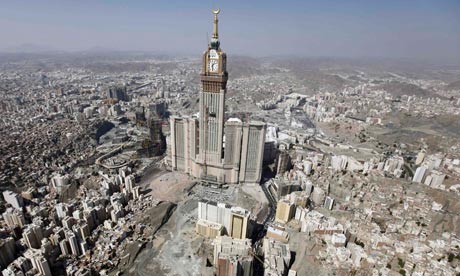
The four-faced Mecca clock tower

The four-faced Mecca clock tower: a concrete jungle now dominates the skyline of the holy sites. Photograph: Amr Abdallah Dalsh/REUTERS

Today I have completed my hajj – the annual pilgrimage that brings together millions of people in the holy city of Mecca. I am extremely worried that hajj may have lost its true spiritual meaning. I may have attained a personal triumph for completing the rituals but the economic, environmental and human cost is staggering. I lament the speed of change that is sweeping this city, obliterating history and heritage in its path.

Hajj is a spiritual journey of each and every pilgrim that merges into the journey of the masses. It is the coming together of every nation that makes hajj so special. It is personal yet collective. I came here with a clear focus: to centre God in my life. I would make a pledge to live a more conscientious life. I would care for my fellow human beings as I care for myself. Hajj is about an individual and collective renewal of the faith.

But when I look around I see the concrete jungle dominating the skyline and imposing itself over the house of God – the Ka’bah – and I feel betrayed by the custodians of the holy sites. If I want to see skyscrapers I can take a quick trip to the Docklands in London. I did not come here to be shown another city of tall buildings, just like Las Vegas or New York. In these places I find no spirituality. I am pretty certain God does not want his holy site to be desecrated in this fashion either.

The cost of hajj has trebled over the last five years, making the pilgrimage unaffordable for ordinary people. The new high-rise five-star hotels surrounding the Ka’bah are available to those who can afford them. I noticed this year that hajj has already become a ritual for the super rich. The poorer people are being priced out by the unfair and disproportionate price hike. The essence of hajj lies in creating equality between all people by putting on two unstitched white pieces of cloth. This instantly eliminates social and economic inequality. The current trend is making equality a distant dream. I came to hajj to give up material pursuits but materialism is here in full force. There is no spirituality in this.

Hajj for me is an invitation from God to visit his house. The infrastructure around the house of God is being built without any serious environmental consideration. Cars, gas-guzzling jeeps and diesel-operated buses are crowding the surrounding area. Making Mecca car-free should be at the forefront of public transport infrastructure strategy. People spend a lot of time stuck in the traffic jams; I spent half of my time waiting for my bus to take me to the holy site. I would have rather spent that time in the house of God in meditation, reflection and prayers. I found no spirituality in traffic jams.

In Mina, Muzdalifah and Arafat, the three most important places that form the pilgrim path, there are more plastic bottles, wraps and bags strewn around than many cities produce in a year. The curse of plastic has serious ecological consequences that will outlive all the pilgrims here in Mecca. The environmental damage caused by people littering these sites is in direct contradiction to the teachings of Islam. There are billboard messages reminding pilgrims that “Cleanliness is part of faith”, yet most simply ignore these words of wisdom. The hajj authority must takes serious steps to curb littering by introducing hefty fines for pilgrims and tour operators. They should ban plastic. Pilgrimage is about reconnecting with our humble origins and our ultimate destination. Being careless about the environment is the antithesis of spirituality.

At this rate, hajj soon will become a materialistic ritual, a showground for the super rich to display their wealth and nobility. I badly miss the hajj that reconnects me with the prophet Abraham and helps me to centre God in my life.

Posted in Current Events | Leave a comment

Mecca’s Urban Development

Mecca’s mega architecture casts shadow over hajj

Towering over Mecca, this is the world’s second-tallest building – and it is just a tiny part of a voracious development that has seen historic sites bulldozed and locals forced into shantytowns. As the hajj begins, Oliver Wainwright reports


Posted in Current Events | Leave a comment

60 Minutes Feature on Fethullah Gulen

[youtube]http://www.youtube.com/watch?v=O4OtHpUCqy0[/youtube]

Posted in Current Events | Leave a comment